Lavenham does not need much introduction if you have ever driven through Suffolk on the way somewhere else and slowed down without quite meaning to. It is routinely named among England’s best-preserved medieval villages, a place where the wool merchants’ timber-framed houses lean gently into each other along streets that have not changed their footprint in five hundred years. The Swan at Lavenham sits directly on the High Street in the middle of all of it, a 15th-century inn that has spent those same centuries as a working part of the village rather than a museum piece borrowed for the occasion.
The village earned that wealth, and those houses, from wool. Lavenham was among the richest towns in England in the 15th and 16th centuries, its merchants growing fat on the broadcloth trade before the industry moved north and left the village to sit quietly, largely unrebuilt, for the next four hundred years. That accident of decline is the reason it survives today looking the way it does: no Victorian or Georgian rebuilding campaign ever swept through and replaced the timber frames with brick, because there was no longer the money to do it. Couples marrying at The Swan are, in a very literal sense, borrowing the same streets those wool merchants built and then, by economic misfortune, never got round to modernising.
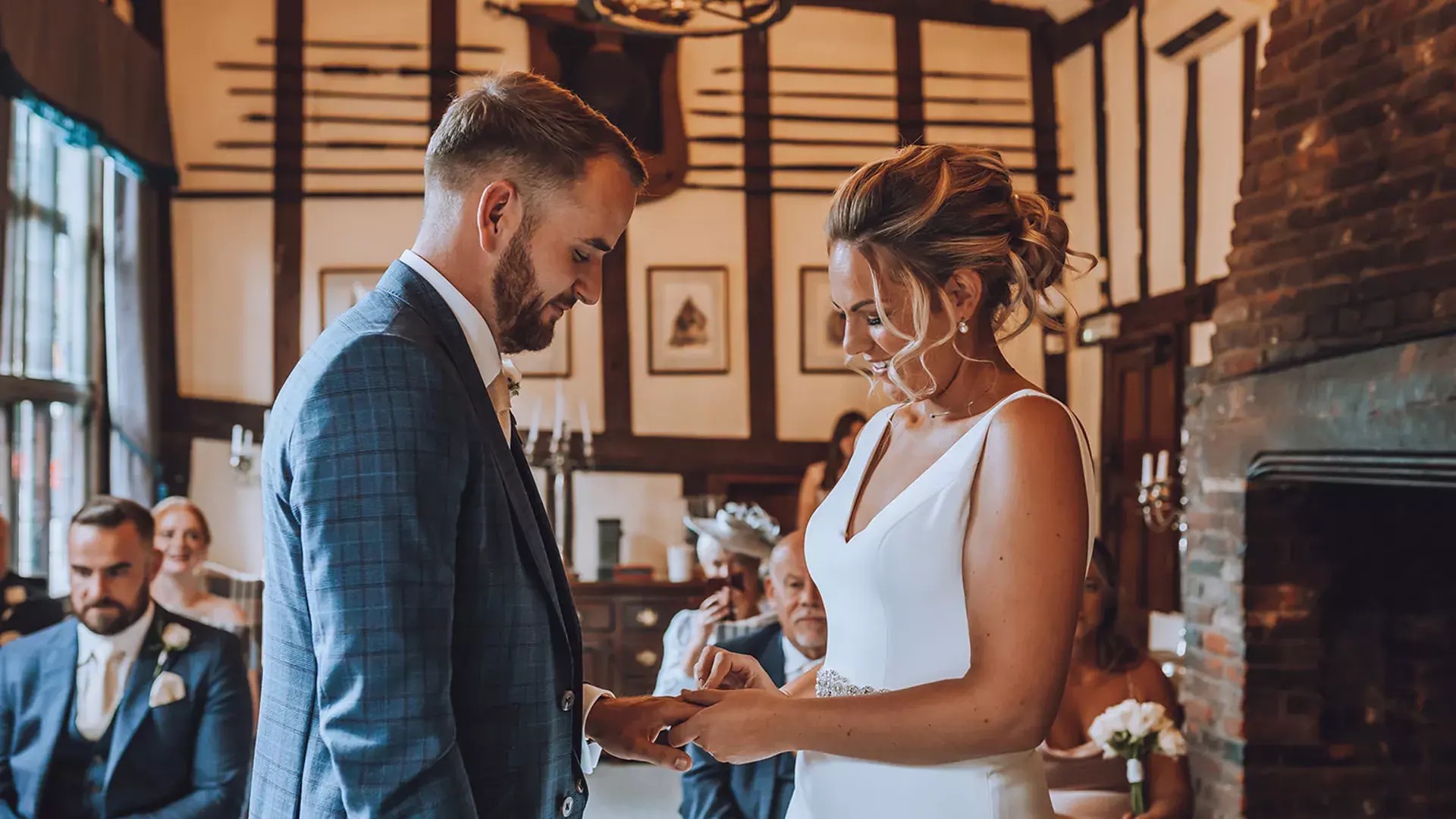
What that means for a wedding is straightforward enough to state and harder to find elsewhere: the building itself is the history, not a backdrop bolted onto it. Oak beams cross every ceiling at a height that was normal in the 1400s and is not now. Open fireplaces, once the only source of heat in the building, still burn in the rooms where couples now stand to say their vows. The Swan runs today as a 45-bedroom hotel and spa, which is the other half of what makes it work as a wedding venue: nobody has to leave after the last dance, because the same building that hosted the ceremony has a bed waiting upstairs.
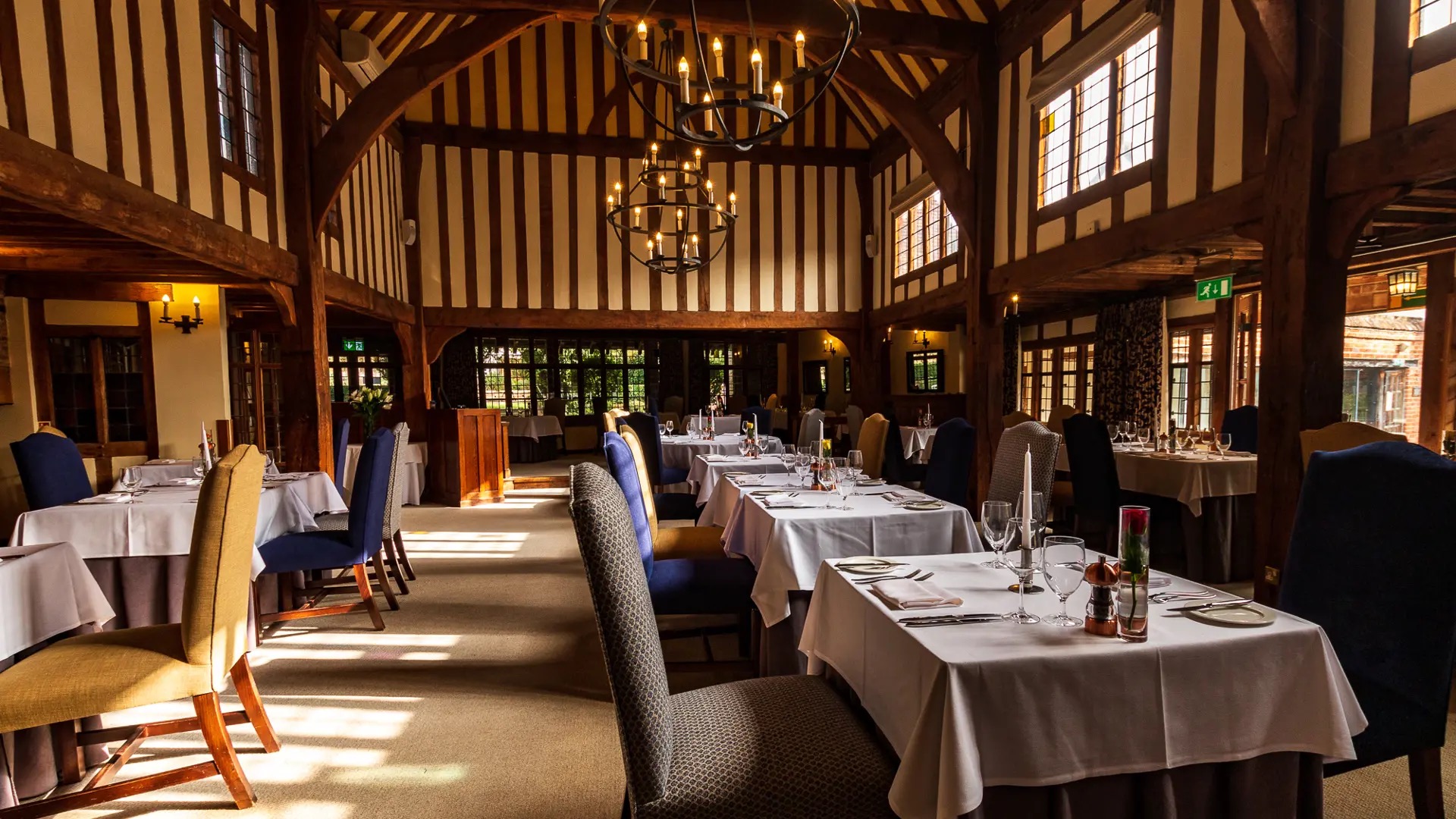
Ceremonies are licensed across four private rooms, and The Swan is unusually candid about their different scales rather than pretending one room suits every wedding. The McCallum is the smallest, seating up to 20 once two registrars are accounted for, built for a couple who want a handful of people and nothing more. The Woolhall takes up to 40 for the ceremony and 80 for the evening, the room built into the venue’s Sapphire, semi-exclusive package. The Gallery is the largest and, in a nice piece of double duty, also The Swan’s own restaurant: chandelier-lit, oak-beamed, and licensed for up to 104 guests, a figure independently confirmed by Suffolk County Council’s own approved-venues register rather than just the venue’s own marketing.
That double duty matters more than it might first sound. The Gallery Restaurant carries 2 AA Rosettes in its own right, awarded for the food rather than the wedding trade, which means a couple marrying there is getting married inside one of the better restaurants in the county, not a function room dressed up to look like one. A resident pianist plays there most Sunday lunchtimes, for anyone who wants to picture the room on an ordinary day rather than a wedding one.
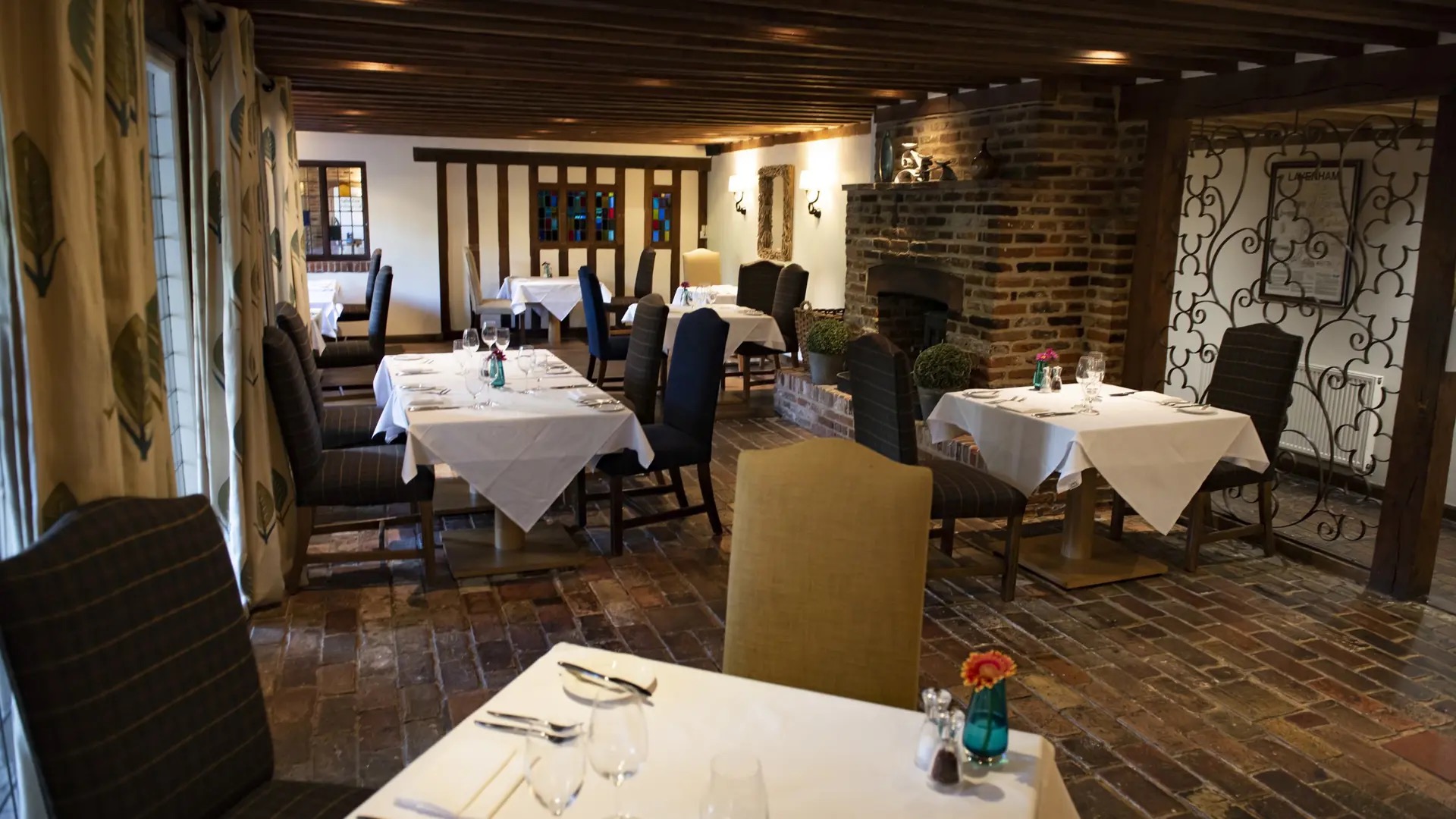
Three tiers of exclusivity sit above the four rooms. The Sapphire, semi-exclusive, includes 15 bedrooms and exclusive use of the Woolhall, the Suffolk room and the courtyard. The Cerulean, half-exclusive, steps up to 30 bedrooms and adds the Gallery to that same exclusive-use list, with the ceremony capacity rising to 104 and the evening reception to 150. The Azure, fully exclusive, closes The Swan’s doors entirely: all 45 bedrooms and suites, both restaurants, the lounge, the bar and the gardens, priced from £25,000, a figure published directly on the venue’s own package page rather than pieced together from third parties. A separate, un-packaged Intimate Wedding option exists below all three, for couples who want the McCallum room and nothing else, priced individually rather than against a fixed tier.
Food follows the same pattern of quiet specificity rather than vague reassurance. The Food and Beverage Package, built by The Swan’s own Head Chef and in-house culinary team, is quoted plainly from £125 per person: a glass of Prosecco or sparkling elderflower on arrival, three savoury canapes, a three-course wedding breakfast, two glasses of house wine through the meal, and tea and coffee to finish. Every wedding package folds this in as standard rather than treating it as an upsell.
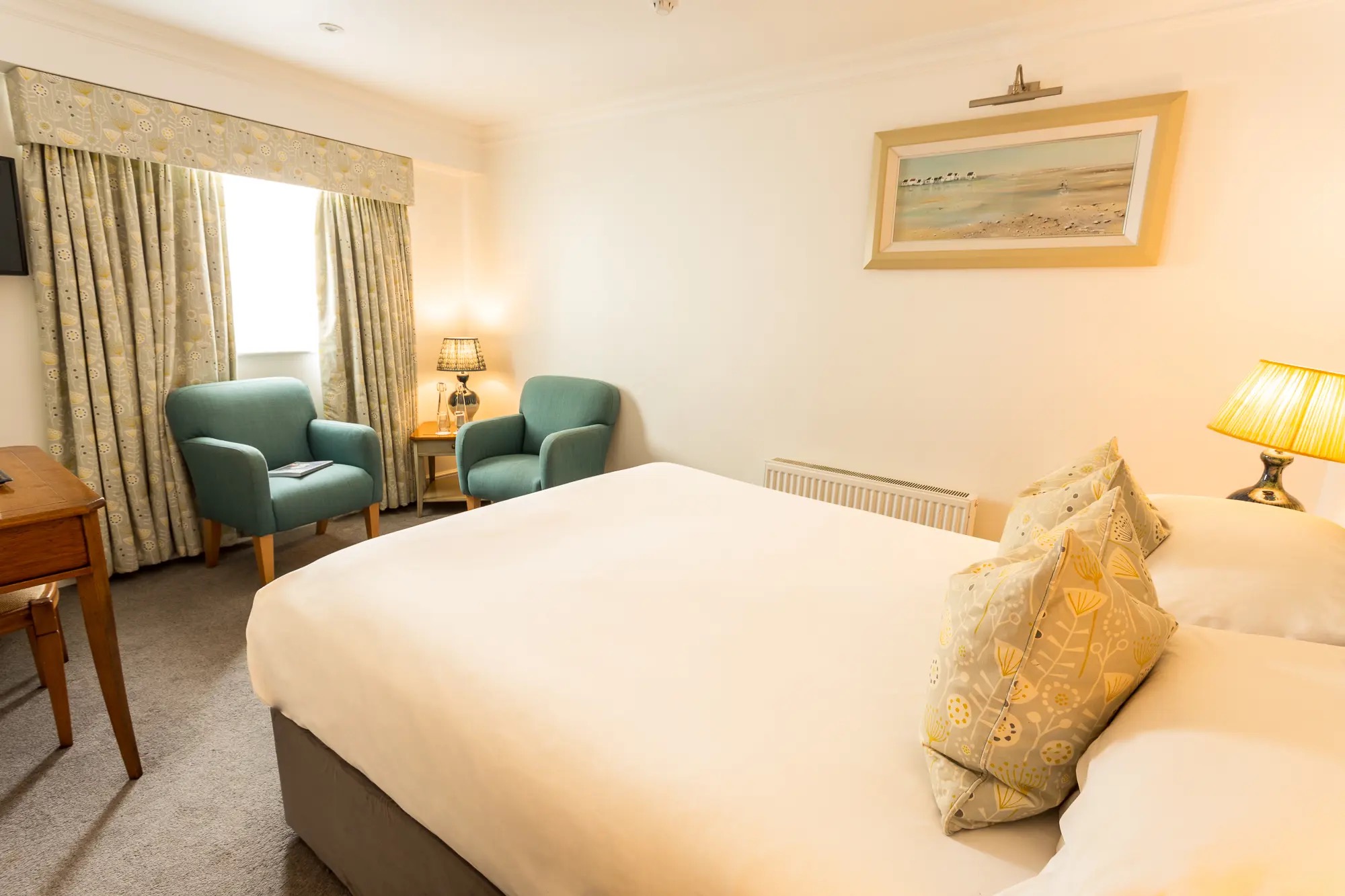
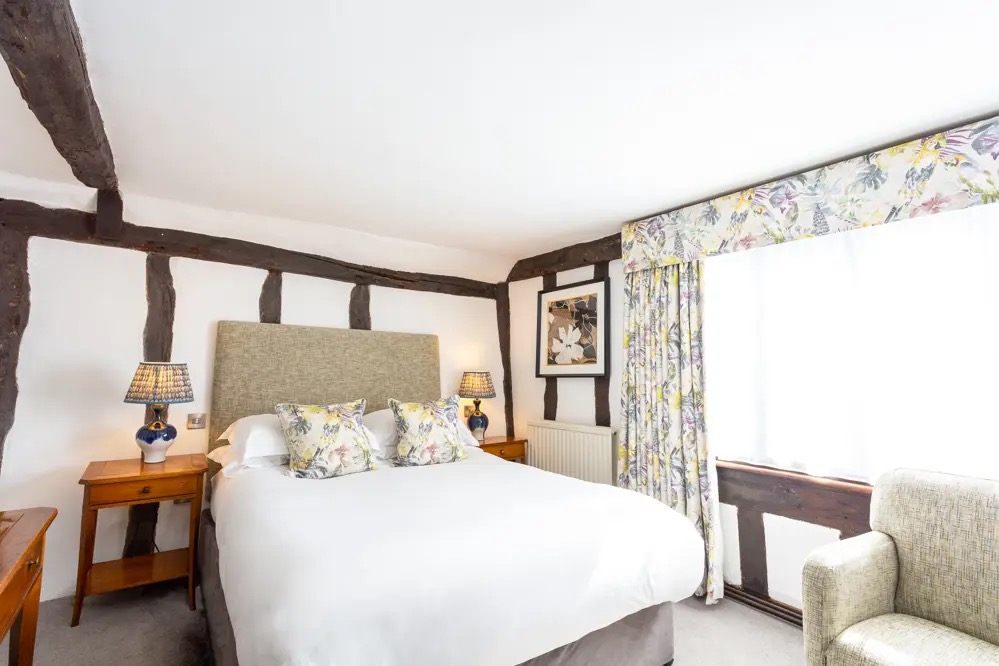
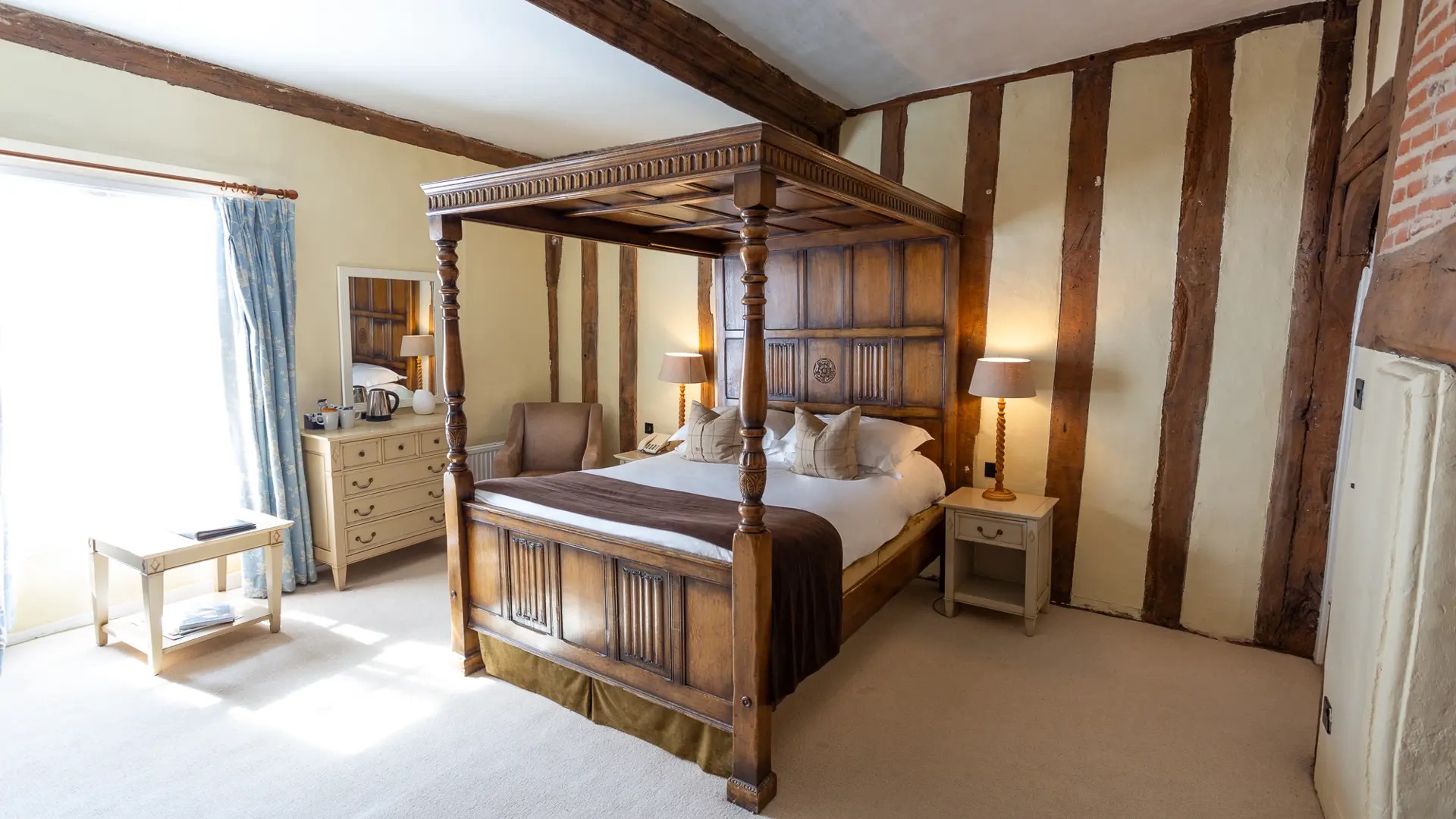
The 45 bedrooms and suites are where The Swan stops resembling a single-room wedding venue and starts resembling a proper wedding weekend. Nine named categories run across the building: Constable Suites, Gainsborough Bedrooms, Heritage Bedrooms, Suffolk Bedrooms, Lavenham Bedrooms, The Priory Suite, Garden Bedrooms, Tudor Bedrooms and Four-Poster Bedrooms, several set directly beneath the original Tudor timberwork, one with a freestanding bath tucked under the eaves. On an Azure exclusive-use booking every one of them belongs to the wedding party, and breakfast the next morning is included for everyone who stayed.
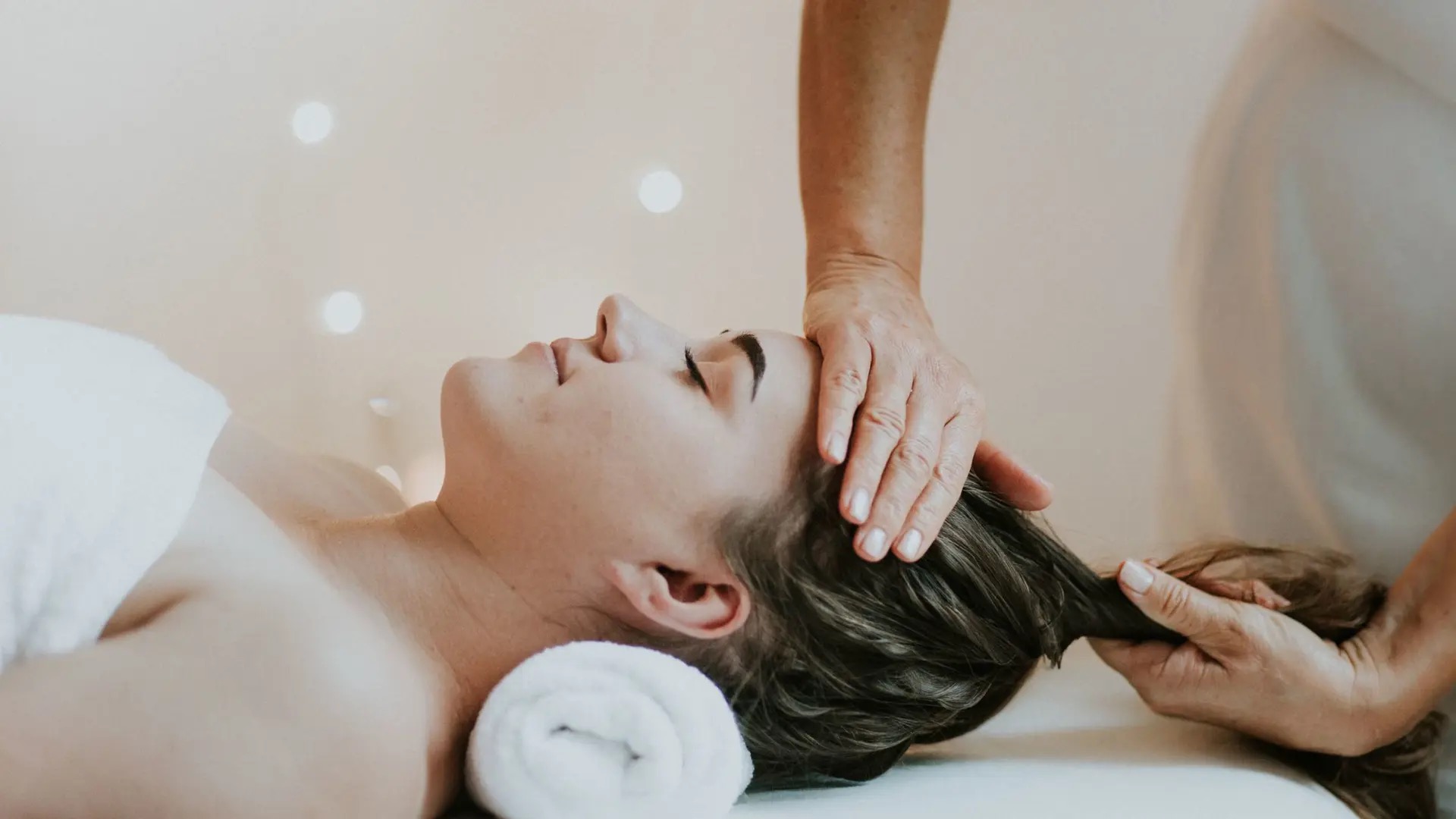
The spa deserves its own mention, not as an afterthought but because of what it is named after. Weavers’ House Spa takes its name directly from the wool-weaving trade that built Lavenham in the first place, a small piece of the village’s own economic history folded into a modern amenity: an outdoor vitality pool, heat and relaxation suites, a sauna, a steam room, and a menu of Temple Spa treatments. Every wedding package at The Swan includes two complimentary spa hours per guest, worked in before the ceremony for a couple’s own nerves or saved for the morning after for everyone who overdid the dancing.
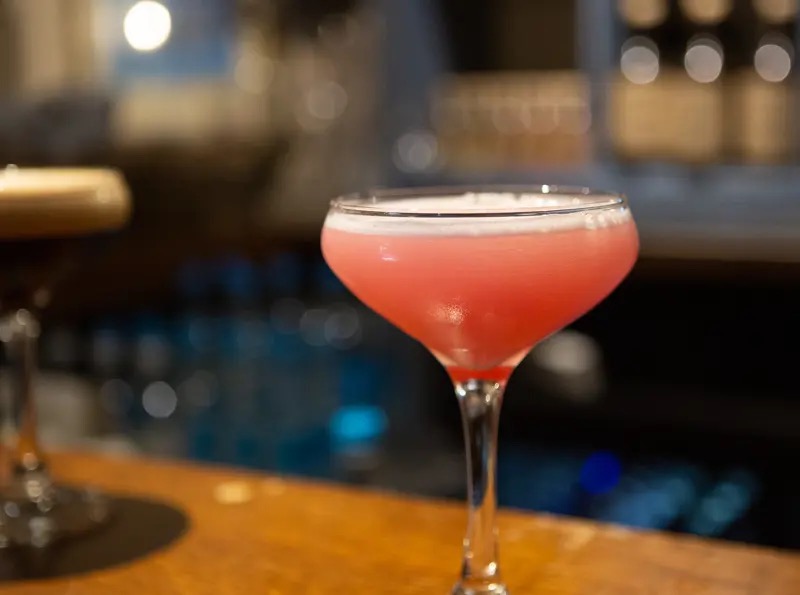
A few doors along the same High Street corridor sits the Airmen’s Bar, which has nothing to do with wool and everything to do with a different chapter of the same building’s history. It takes its name from the 487th Bombardment Group of the United States 8th Army Air Force, known as The Mighty Eighth, which flew 185 missions and more than 6,000 sorties from Lavenham airfield during the Second World War. Servicemen from the 487th and beyond drank and socialised in what is now The Swan’s own bar, and the walls still carry a genuine collection of their signatures and mementos, not reproductions. For an evening reception, it makes an unusually specific, unusually real alternative to a generic hotel bar.
Not every couple wants, or can afford, £25,000 and a full building. The Swan’s Intimate Wedding option sits apart from all three named packages, un-tiered and priced individually rather than against a fixed rate card, built around the McCallum room and its ceiling of 20 guests once two registrars are counted in. It suits precisely the couple the venue itself describes as wanting to ‘do small things, with great love’: fewer people, more time with each of them, and none of the logistics of closing an entire hotel to outsiders for a weekend. The same medieval building, the same oak beams, the same Gallery Restaurant kitchen supplying the wedding breakfast, just scaled down to a guest list that fits around a single long table.
Getting there is straightforward without being effortless, which suits a village that has spent five centuries resisting easy access almost as a point of pride. Lavenham itself has had no railway station since 1961; the nearest is Sudbury, around seven miles south, at the end of a branch line that joins the Norwich to London main line at Marks Tey, running on into the capital. Bury St Edmunds is a similar distance the other direction, and London Stansted is roughly an hour by car for guests flying in. None of it is a difficult journey, but none of it is a motorway-adjacent hotel wedding either, and that slight friction is arguably part of what has kept Lavenham’s High Street looking the way it does.
None of this is invented atmosphere. The building’s medieval bones, the Gallery’s independent AA Rosettes, the council-verified ceremony capacity, the Airmen’s Bar’s actual wartime history, and the venue’s own published £25,000 Azure starting price are all facts that check out under scrutiny rather than marketing language that dissolves on contact. What The Swan offers a couple, in plain terms, is a genuinely old building in a genuinely well-preserved village, run as a proper working hotel rather than a house that only exists for weddings, with three different ways to book it depending on how much of it a couple wants to themselves.
It will not suit every wedding. A couple wanting a private country estate with acres of exclusive grounds will find The Swan is a village-centre hotel first, sharing its High Street with other shops and visitors even on a semi-exclusive booking. What it offers instead is harder to manufacture: five centuries of continuous use in one of the more genuinely well-preserved medieval villages left in England, a restaurant good enough to have earned its own rosettes independent of the wedding trade, and a bar with a real, checkable story on its walls.
The Swan at Lavenham Hotel & Spa
- Venue: The Swan at Lavenham, High Street, Lavenham, Sudbury, Suffolk, England
- Images: Courtesy of The Swan at Lavenham