In 1902 Dr Georg Wegner, a Szczecin surgeon and pathologist who had once directed the city hospital in Pomorzany, bought a plot on the shore of the Szczecin Lagoon that he had leased since 1882, and began a house to retire to. The villa was finished by 1908 at a forest settlement then called Horst. Today it is Manowce Palace, and it takes one wedding at a time on exclusive use, and couples can marry in the garden between the house and the water.
A doctor’s retreat at Horst
The land had a working past. A tar works stood here from 1754, and later a timber yard, where logs were bound into rafts and sent across the water to Szczecin, Świnoujście and Ueckermünde. Wegner and his wife Maria kept horses and dogs, and they built more than a house: a stable and carriage house, a riding hall, and a Chinese pavilion that held the boiler room and the kennel. The villa had plumbing and central heating from the start. It was most likely designed by Theodor Bless, a Szczecin builder and developer who had designed the couple’s previous villa in the city in 1897; the two houses share an almost identical floor plan.
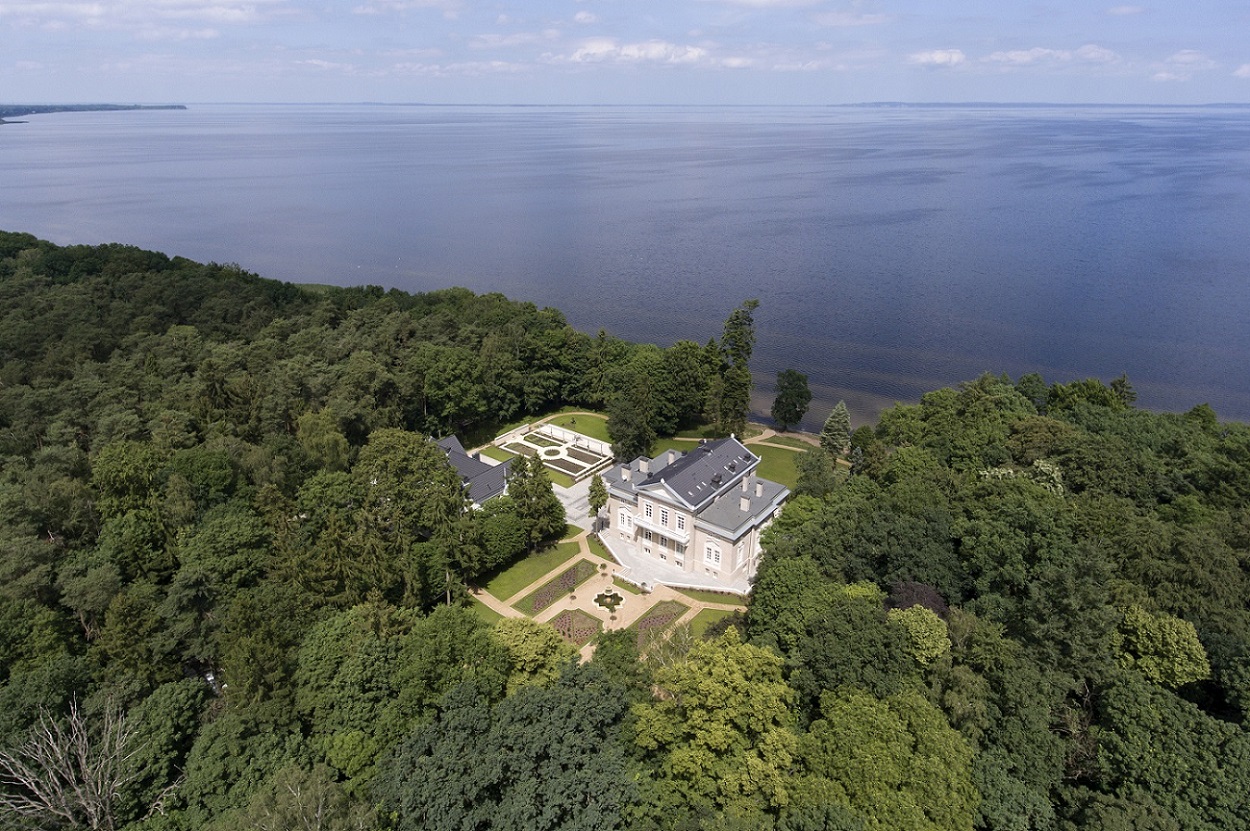
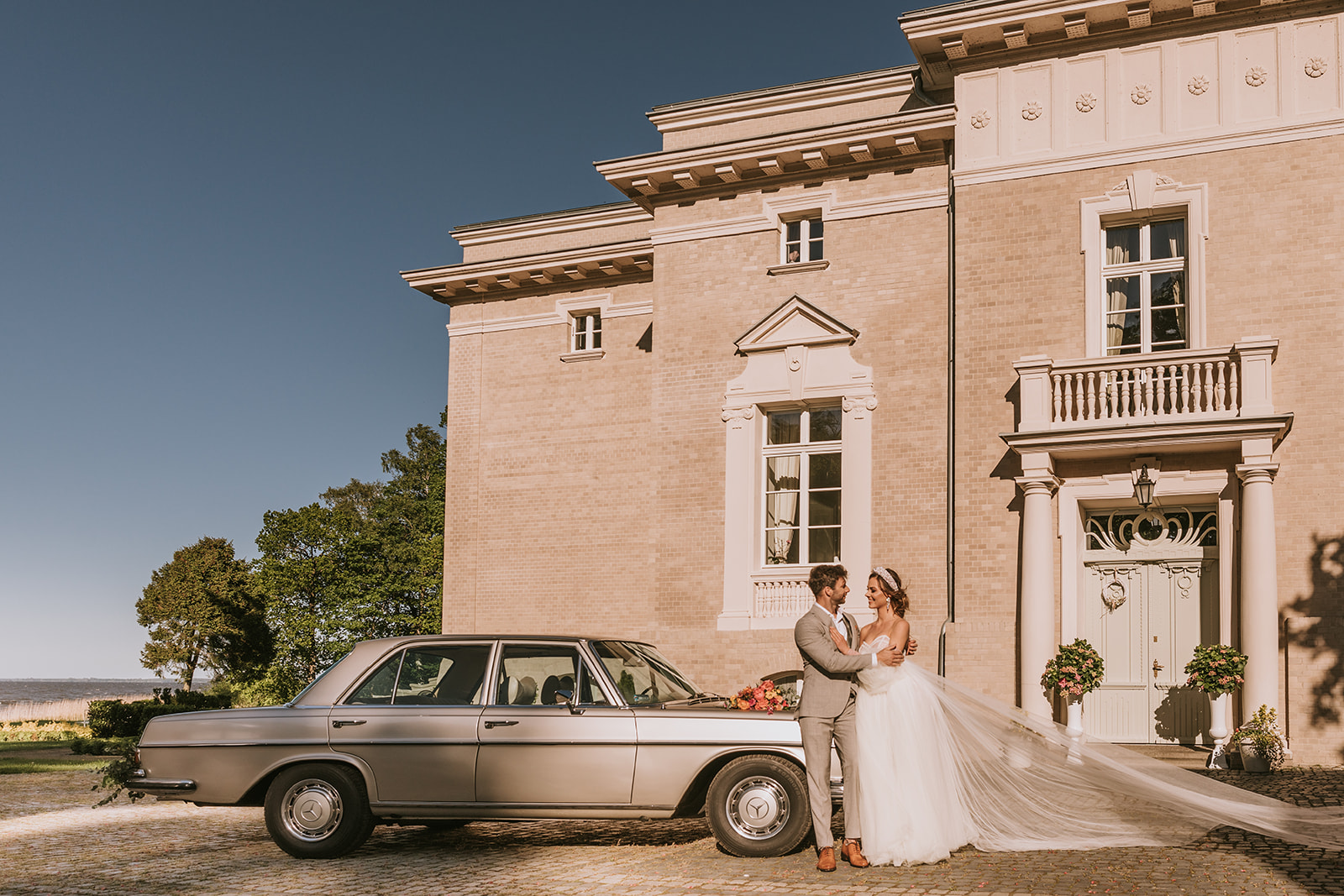
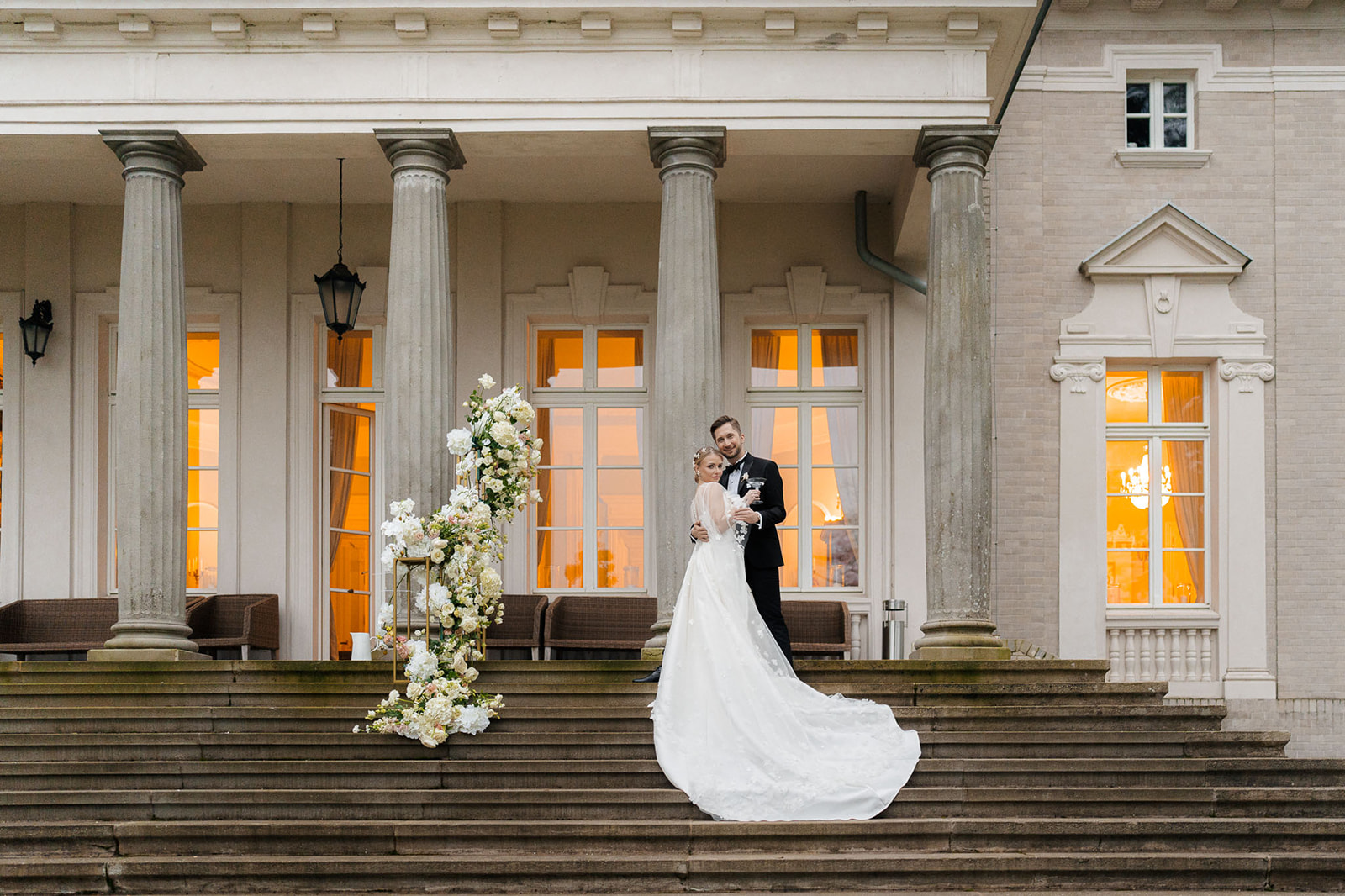
The house stands 50 to 60 metres back from the shore, facing the lagoon. On the north front a portico of six Doric columns carries a balcony, and the gable above holds a relief of griffins supporting a shield. Beneath the portico a terrace opens onto wide steps towards the water. The main door is on the west side, framed by a pair of smooth Tuscan columns under a shallow balcony. The walls are faced in ivory clinker brick laid in Flemish bond, and the window surrounds, balustrades and the decoration of the gables are cast in Portland cement.
From Horst to Manowce
Wegner died in 1917 and Maria stayed on in the villa. From 1923 the estate belonged to Elisabeth Ladwig and the engineer Eduard Silbernagel, whom she married soon after, and in 1941 they sold it to the Nazi party’s welfare organisation, which used the villa as a training school for party members and the other buildings as a home for mothers. The house came through the war undamaged. Soviet troops arrived in April 1945, a border guard post followed, and from 1947 the estate became a summer camp, later run by Warsaw City Hall under the name Syrena until 1989. A Szczecin company that acquired it in 1997 stripped out the original staircase, doors, floors and plaster for a restaurant scheme it never finished, and the house stood empty for years until its present owner completed the restoration of the building and part of the park in 2017.
With none of the original interior left, the rooms have been furnished with antique furniture and paintings alongside modern bathrooms. The settlement was known as Horst, and later Haffhorst, taking its prefix from the German word for the lagoon; the name Manowce was given to the property in 2019.
The park and the kitchen garden
The park Wegner laid out grew from what was probably an older tree nursery, and its trees include copper beech, Nootka cypress, Greek fir and shagbark hickory, with an avenue of limes leading from the gate to the palace. Part of the park was entered in the Polish register of historic monuments in 1979. In 2015 Małgorzata Haas-Nogal, commissioned by the owner, designed the restoration of the gardens beside the house. A fountain now stands among flowerbeds edged in box on the south side, and an ornamental vegetable garden, with a trellis and a wall fountain, occupies the site of Wegner’s riding hall, which had been demolished. The kitchen cooks with West Pomeranian produce, much of it grown in the palace’s own vegetable garden.
A ceremony between the house and the water
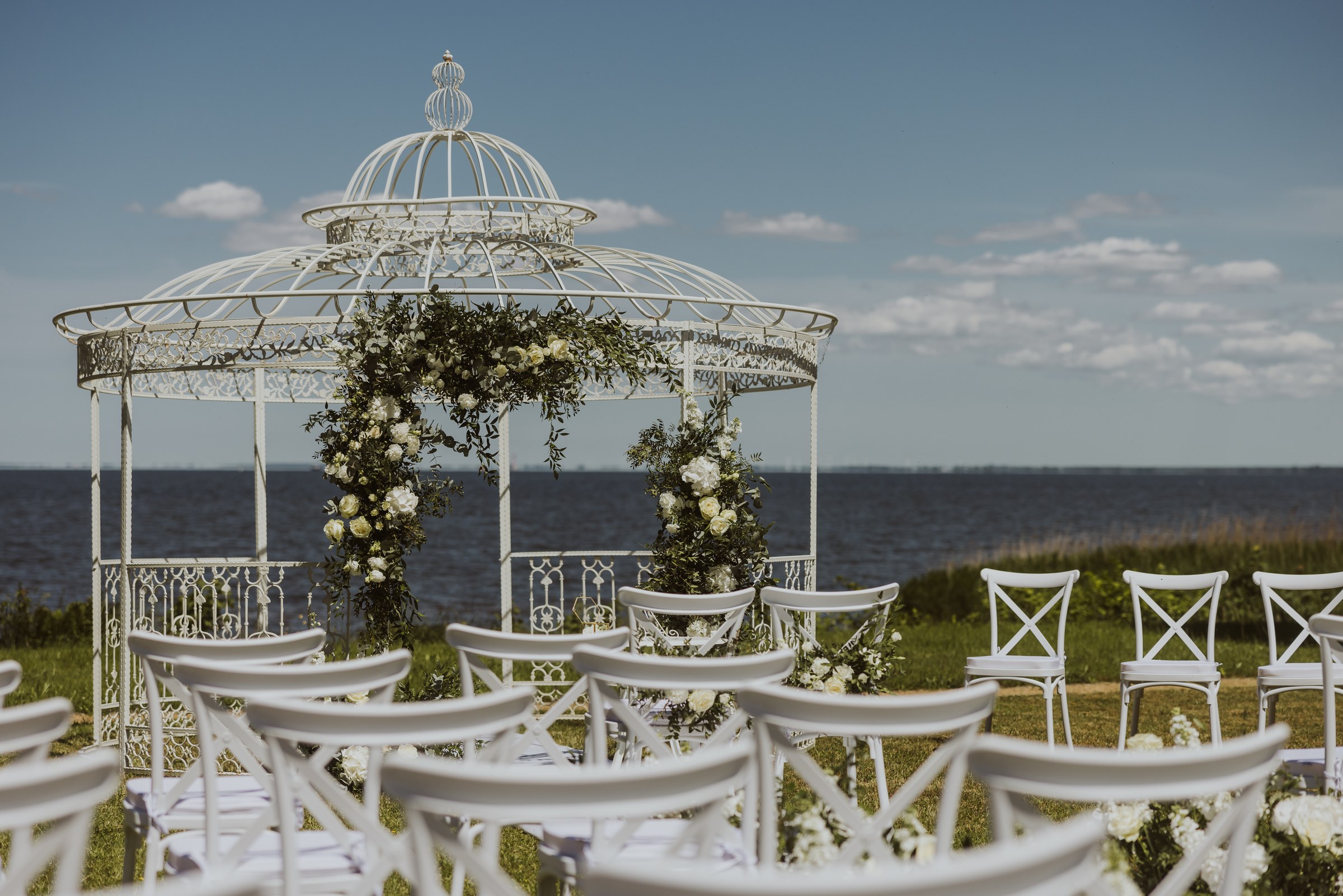
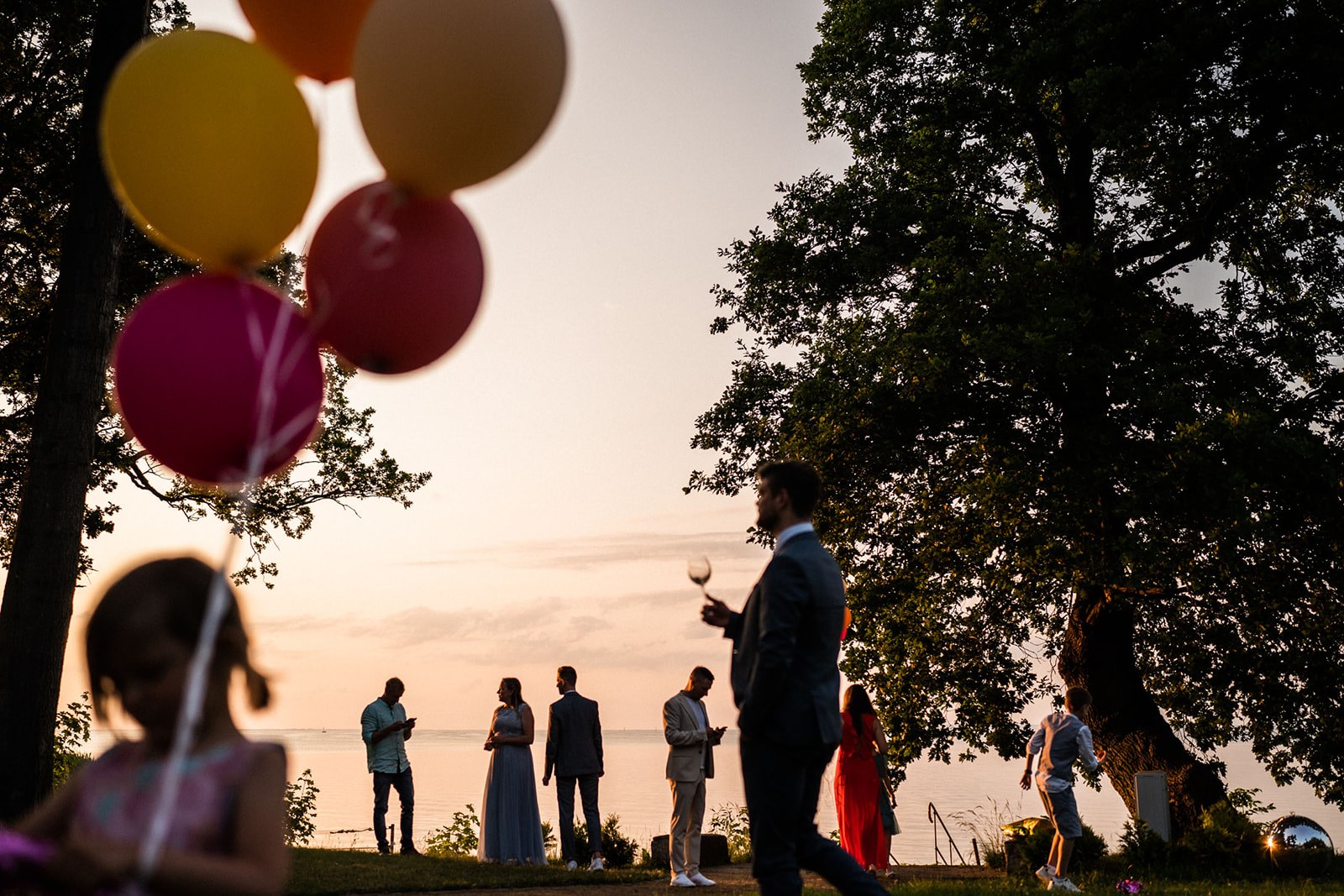
Civil and humanist ceremonies are held at the palace, either in the ground floor salon, which looks out over the lagoon, or outdoors at a white gazebo in the garden at the water’s edge, for up to 100 guests. Couples often add an aisle of about 20 metres from the palace to the gazebo, laid as boards under white carpet or as staging finished in white gloss or mirror foil. The outdoor setting comes with the gazebo, a table for signing the marriage certificate and chairs for the guests, with sound available on request, and the palace helps with the formalities at the Civil Registry Office.
Church weddings take place in nearby churches, among them the sixteenth-century Church of the Assumption in Nowe Warpno, about 11 kilometres away, and the palace can help with the paperwork for the parish. After the ceremony there is sparkling wine with finger food; outdoors, it is usually prosecco with four or five canapés, or coffee and cake, depending on the menu.
Dinner in the ballroom, or on the lawn
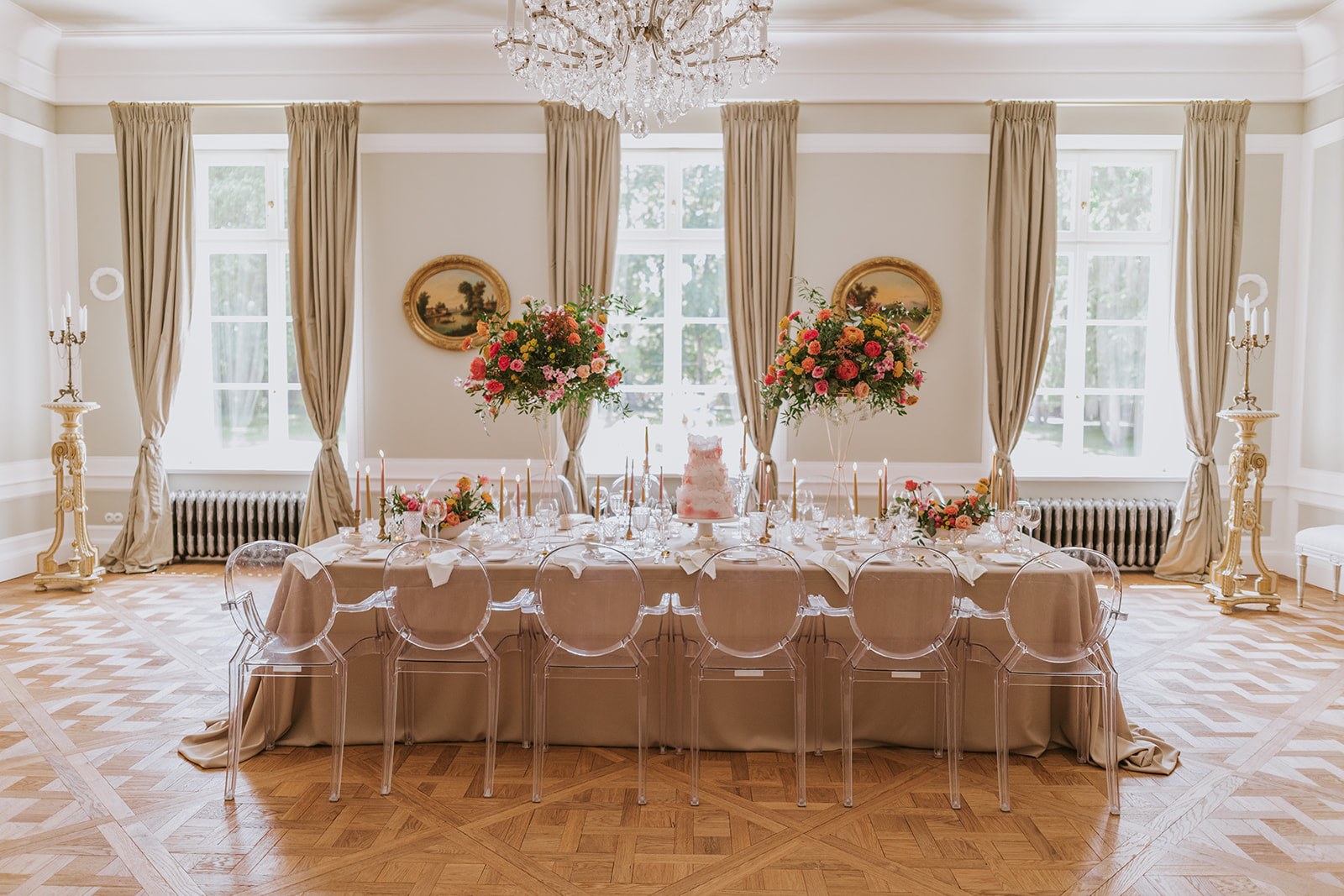
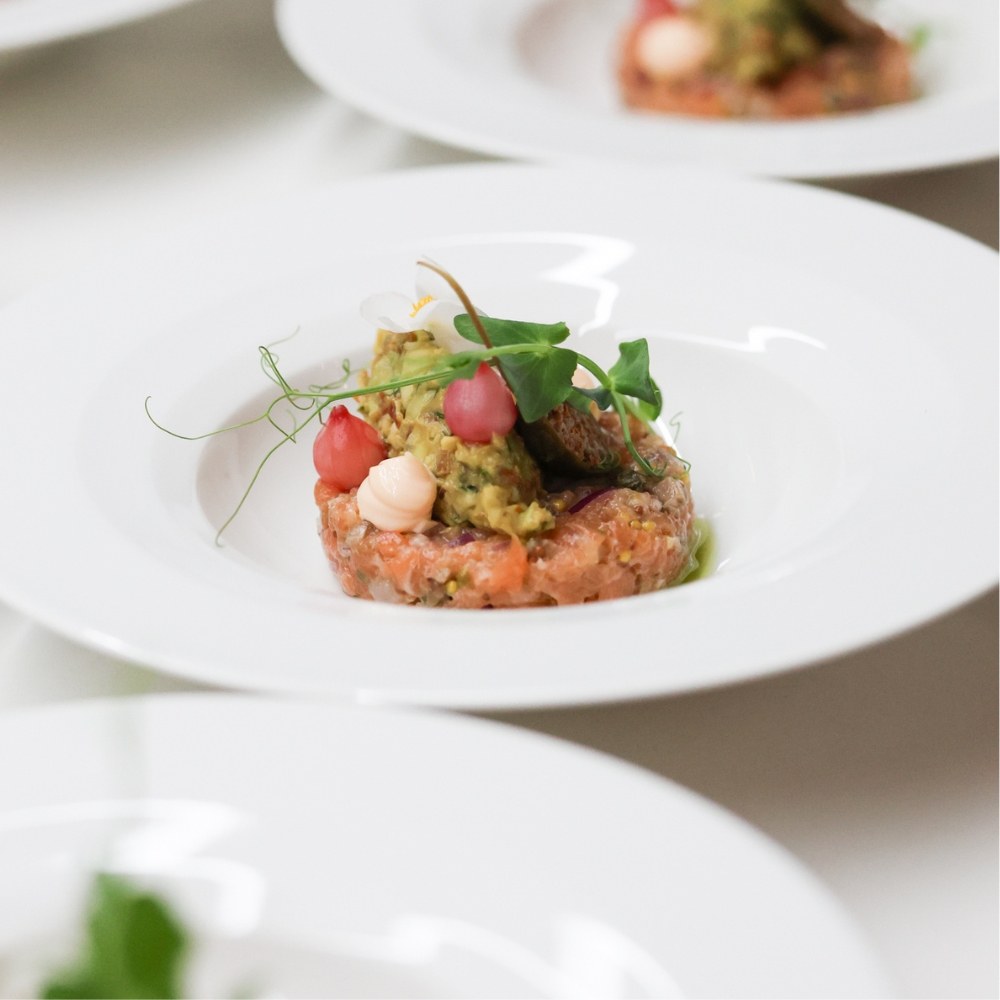
The ballroom, hung with crystal chandeliers, seats 64 for the wedding breakfast and stays in use for the dancing. For up to 100 guests, dinner moves outside to a marquee on the lawn. There are three menus, Silver, Gold and Platinum, each of four courses (a starter, soup, a main course and dessert) with a choice of two dishes at every course, one of them usually vegetarian. The packages differ at the toast: a glass of sparkling wine with Silver, cocktail snacks as well with Gold, champagne with Platinum.
A cold buffet and cakes stay out through the evening, and at a wedding a further hot dish comes out around midnight. Waiters pour at the table rather than leaving bottles out, drinks are arranged as an open bar in three versions, and a tasting for two can be booked beforehand. Dietary needs and the requirements of the main religions are catered for.
Sleeping in the palace and the old stable
Rooms come with evening weddings, for the couple and their closest family, and are included in the wedding packages. Three apartments and thirteen double rooms sleep 33, or 42 with sofa beds and extra beds. The bridal apartment has a bedroom and a sitting room with antique dressing tables and a private terrace over the garden, and it is ready from noon on the wedding day; the other rooms open at three in the afternoon, and everyone checks out by eleven the next morning. The palace bedrooms are in the attic, with antique wardrobes. Seven more doubles are on the first floor of the annex beside the palace, part of which was once a stable, and they keep its exposed timber and brick; some look out to the lagoon, 50 metres away. Guests who do not stay at the palace can be booked into hotels in Szczecin, with transport arranged for the journey.
Forest, lagoon and border
The palace sits in the woods of the Ueckermünde Heath, Puszcza Wkrzańska in Polish, on the Szczecin Lagoon, a body of water of 687 square kilometres shared by Poland and Germany. The nearest village is some distance away. Nowe Warpno, the small town at the border, has a timber-framed town hall from the seventeenth century and a ferry across an 800 metre strait to Altwarp in Germany. Guests can kayak on the lagoon, and the area offers sailing, fishing and boat trips to watch white-tailed eagles.
Szczecin is about 40 minutes away by road and Szczecin-Goleniów airport about 75 minutes; Berlin and its airports are around two and a quarter hours. The last stretch runs through forest, so guests should follow the palace’s own map. There is free parking for 20 cars. A wedding lunch runs for up to five hours and ends by nine in the evening, a reception for up to eight hours ends by eleven, and a wedding with dancing finishes at two in the morning, with up to two more hours available for a fee. Prices follow the format, the length of the day and the number of guests. Flowers are supplied only through the palace; other suppliers, from bands to photographers, are approved by the palace, and bringing in outside suppliers carries a flat fee.
The guest list decides the room
Manowce gives a wedding the whole of a doctor’s lagoon villa for the day and, for the closest family, the night: vows at the water’s edge, dinner under the chandeliers, and the run of a park he planted more than a century ago. The decision that shapes everything else is the guest list. At 64 or fewer, dinner and dancing stay in the ballroom; beyond that, the meal moves into a marquee on the lawn, booked as an extra and sized to the party.
See the Manowce Palace profile for the gallery and films, or browse weddings in West Pomerania and across Poland. Ready to plan? Check your date.