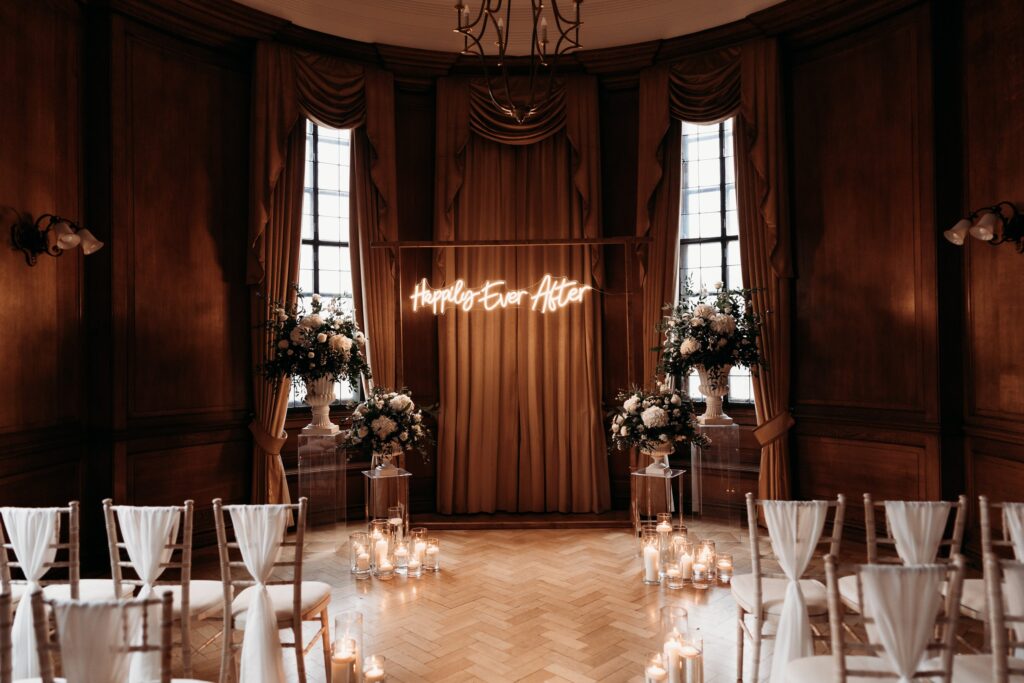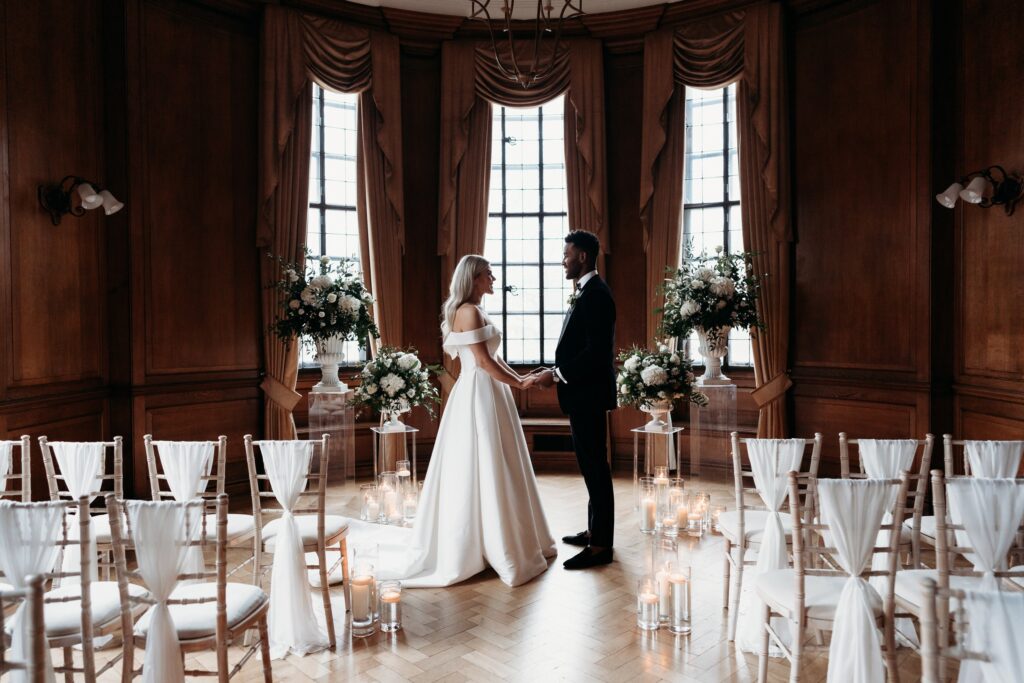
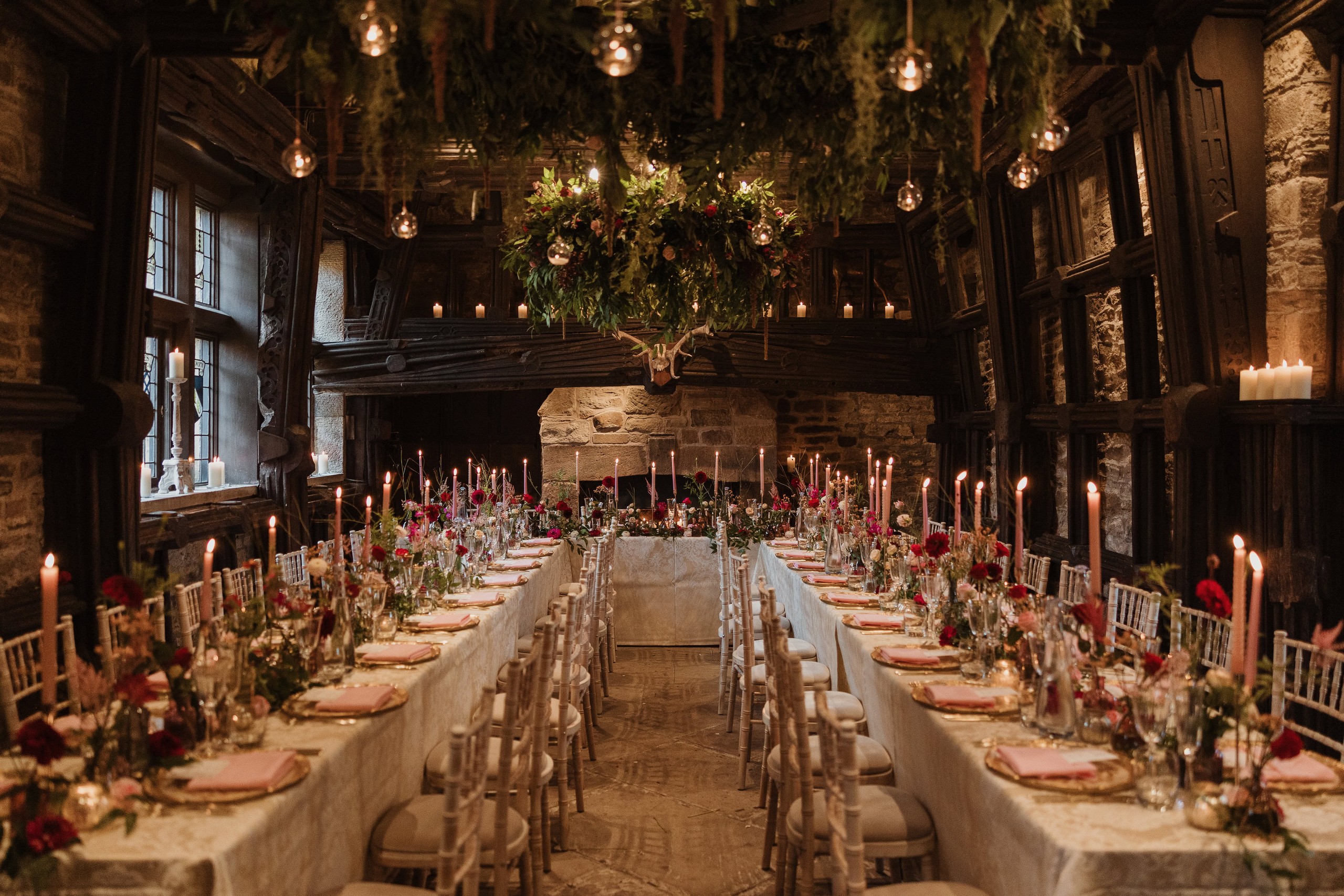
The hall where couples marry at Upper House is roofed and panelled with medieval timbers taken from a church. They were fitted when a gritstone farmhouse on the side of Kinder Scout, above Hayfield in the Derbyshire Peak District, was remodelled as a hunting lodge from 1905, and the house now takes one wedding party at a time, hired whole for the weekend. Historic England lists the building at Grade II and records two dated lintels: 1754 over the hall door, 1905 over a door to the east of the hall. One date belongs to the farmhouse, the other to the lodge it became.

A farmhouse where three packhorse routes met
Upper House stands alone on the lower slopes of Kinder Scout, at the point where old packhorse routes from Glossop, Hayfield and Edale came together. The Kinder family held a house here from at least 1378 and kept it for around three and a half centuries. By 1754 it belonged to a family called Bennet, who rebuilt around the courtyard and left date stones over the doorways.
The building is quadrangular, in coursed gritstone and rock faced rubble around a paved and cobbled courtyard, with stone slate roofs, mullioned windows and, on the later ranges, embattled parapets. Historic England first listed it in April 1967. The courtyard still sits at the centre of a wedding day. It is covered and heated for the drinks reception, and the Tipi Dining Hall opens off it.
The Watts family and the church in the hall
The house took its present shape under the Watts family of Abney Hall in Cheadle, whose fortune came from S & J Watts, the Manchester textile wholesalers. Sir James Watts, Mayor of Manchester from 1855 to 1857, acquired the Kinder estate in the middle of the nineteenth century. When the land for Kinder Reservoir was sold to Stockport Corporation, the family kept Upper House as its shooting lodge. The reservoir was built between 1903 and 1911, and two farms were abandoned to make way for it.
The remodelling added the castellated gatehouse and the embattled tower at the front, the Solstice Tower, whose sundial was set to read true at the summer solstice. Inside, the single storey hall was fitted with most of the woodwork of a late medieval church, believed to have come from Cheshire, which lines its ceiling and walls. A large mullioned window pushes through the hall’s low eaves, and its stained glass, in the Arts and Crafts manner, carries the names and crests of the landed families and industrialists invited to the Watts shooting parties. More of that glass survives in the Gamekeeper’s Cottage.
The family also brought a literary connection to the house. James Watts married Margaret Miller, known as Madge, in 1902. Her younger sister was Agatha Christie, who stayed often with the family at Abney Hall and drew on it for the country houses of her fiction. The family sold Upper House in 1958, and Christie’s family is still remembered in its bedroom names.
Marrying in the Great Hall
Upper House is licensed for marriages, same sex marriages and civil partnerships, and legal ceremonies are conducted on site by the High Peak registrars of Derbyshire County Council. The order of booking matters: the house is reserved first, then the couple asks the registrars for the date. Couples from abroad also need their visas and documents for a marriage in England in place.
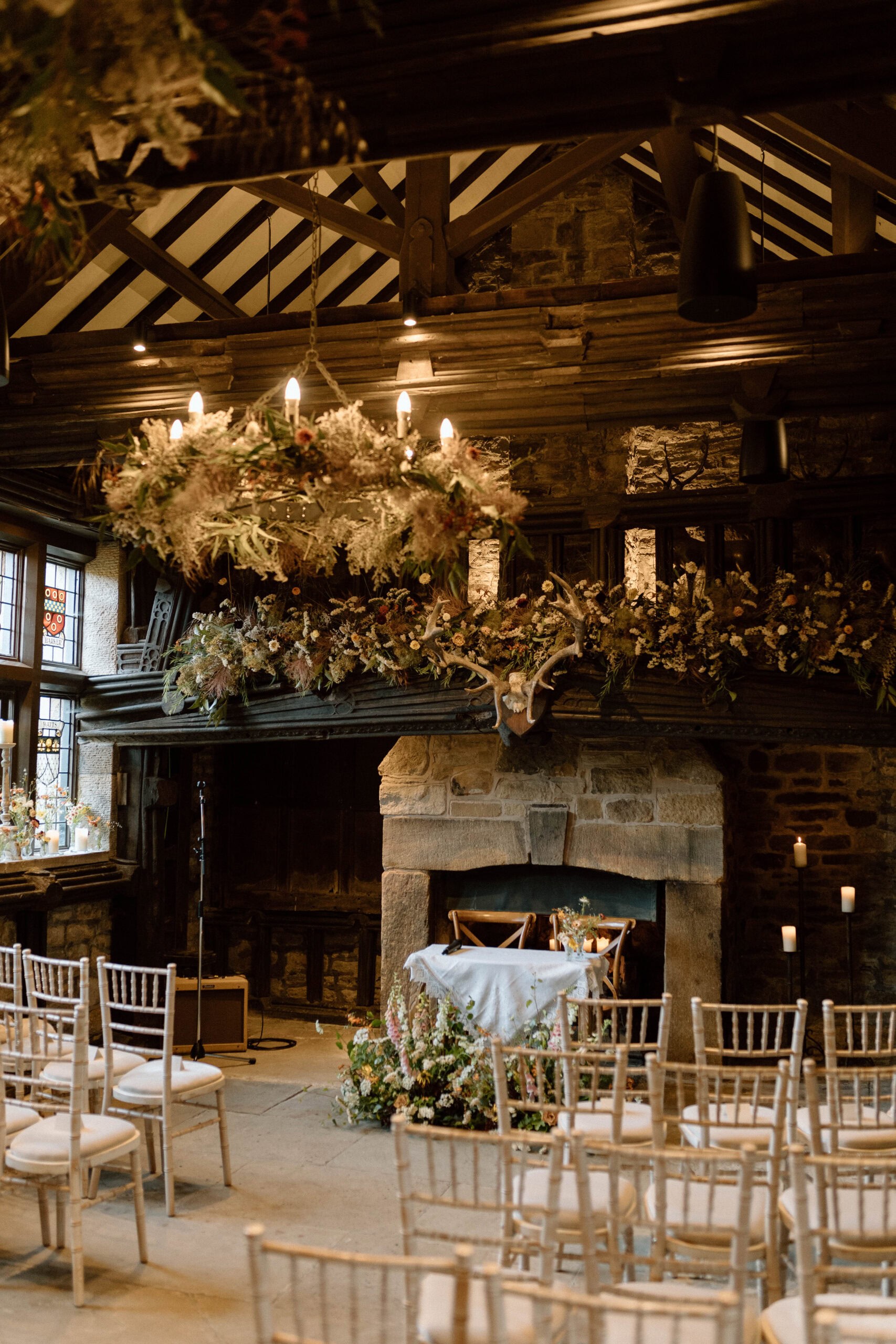
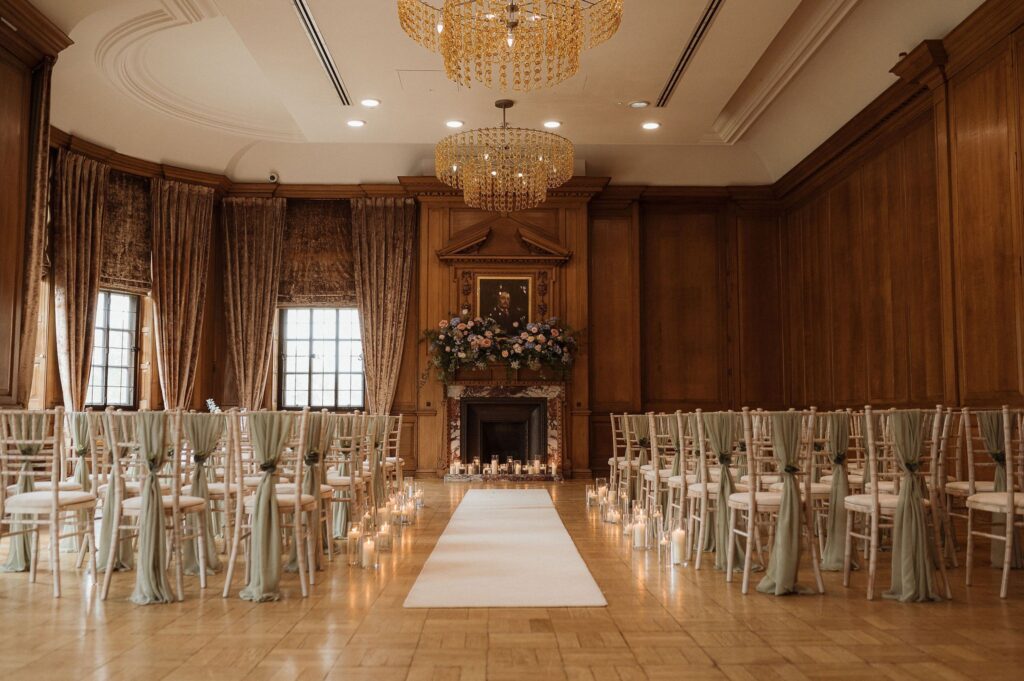
The Great Hall seats 100 for a ceremony. It has a fireplace at each end, a minstrels’ gallery, stained glass and hoops of flowers hung beneath the old timbers. Outside, the Solstice Tower is a licensed ceremony space with level access from the terrace and the drive, and guests sit on the front lawn below it. For a ceremony that is not a legal one, the house can find a celebrant, and translators can be arranged for families who need them.
Dinner in the Tipi, drinks at the Huntsman’s Inn
The wedding breakfast is served either in the Tipi Dining Hall or at long tables in the Great Hall beneath its stained glass. The Tipi is a heated, tented hall off the courtyard, reached by a ramp, with a decked floor, forged iron flower hoops and a picture window looking over Kinder Reservoir. It seats up to 100, at round tables or long ones.
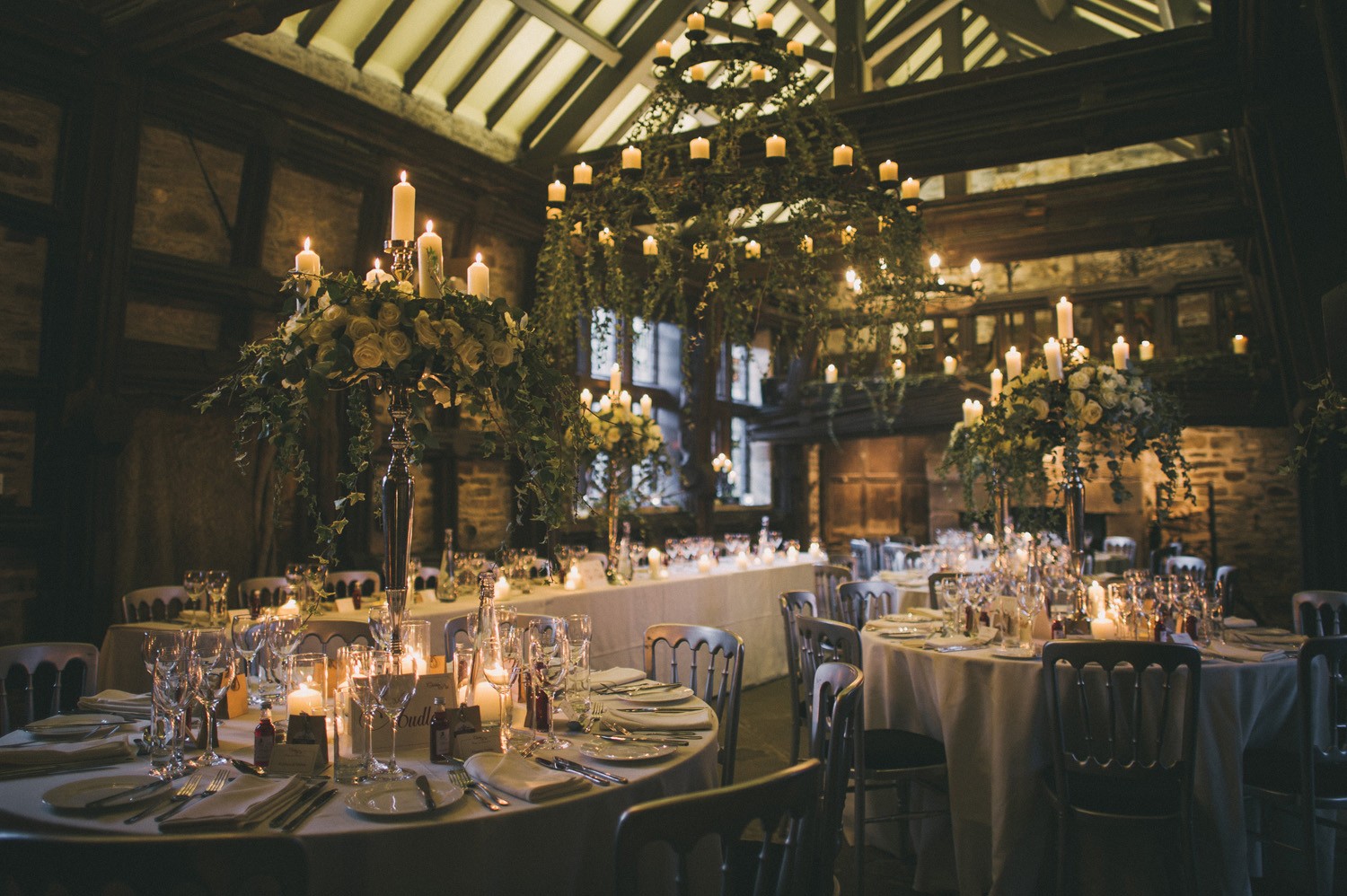
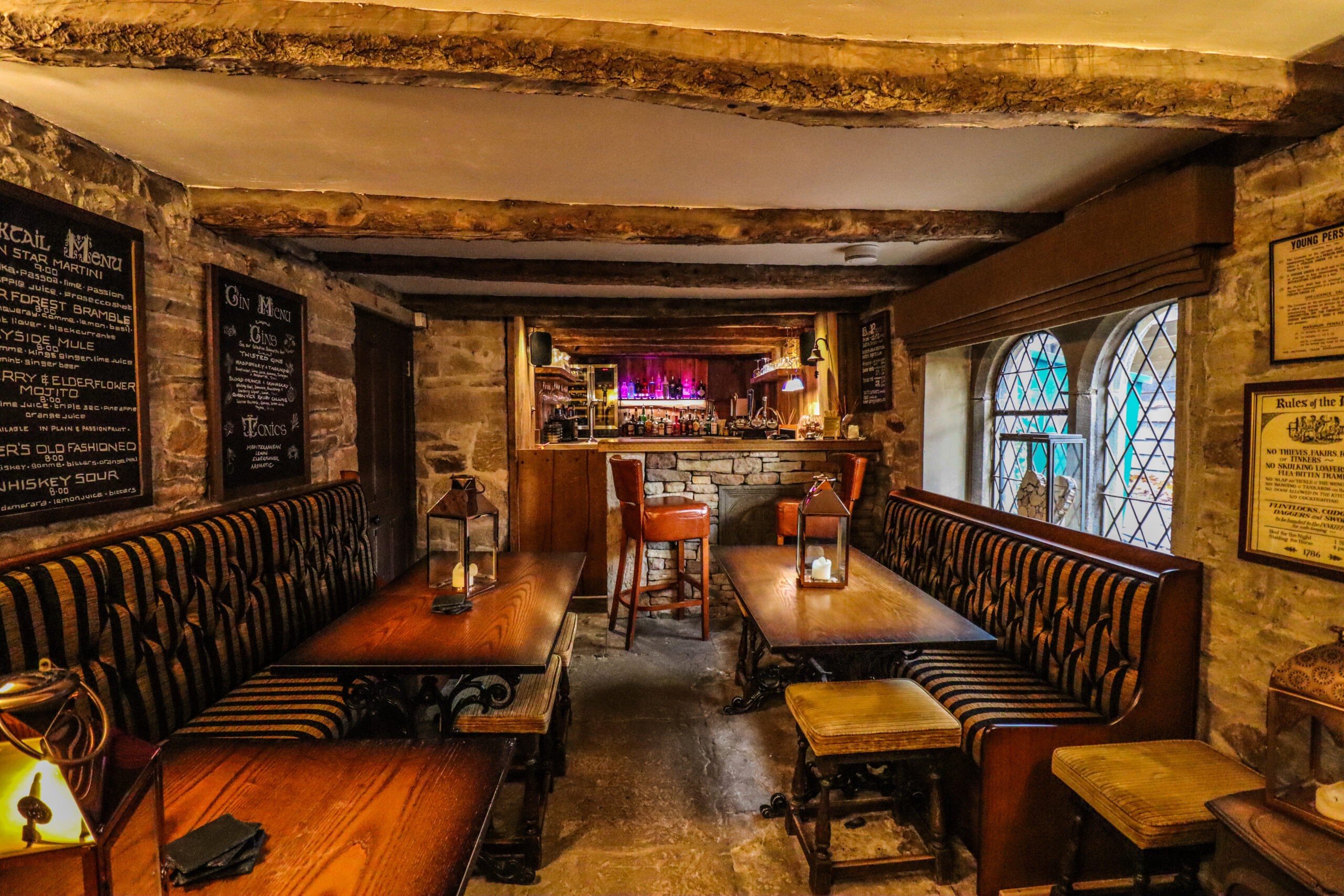
After dinner the party spreads through the house. The courtyard has patio heaters, festoon lights and rattan sofas under its cover. The Garret Room beside the hall is a quieter sitting room with sofas and a wood burning stove. The house has two bars of its own: the Huntsman’s Inn, a beamed pub with booth seating, and the Woodstore Cocktail Bar, which opens on the wedding evening with a mixologist behind it. Up to 120 guests can be at the party.
Twelve bedrooms across three nights
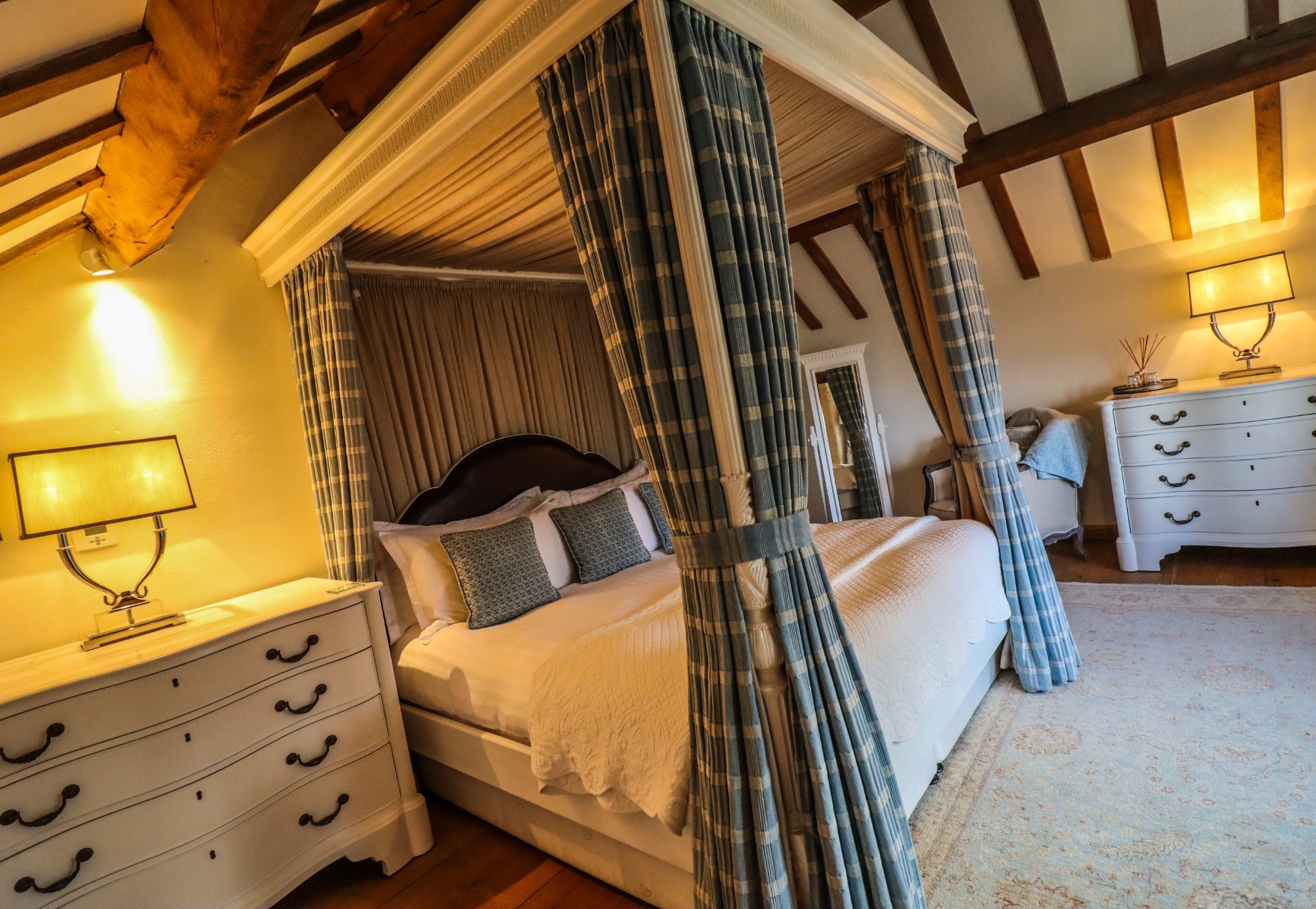
The Estate for the Weekend is the full hire: three nights with the house, the Great Hall, the Tipi, the courtyard, the pub and the cocktail bar held for one wedding party, from £27,500. Twelve bedrooms, three of them family suites, sleep up to 30 resident guests, with ten bathrooms and five kitchens spread through the house, and lounges that include the panelled Snug and the Drawing Room. Agatha’s Room has beams and stone walls, Rosalind’s Room, named for Christie’s daughter, has a buttoned velvet chaise, Poirot’s Perch sits under exposed timbers with a stair to a gallery, and the Reservoir Room has a four poster hung in tartan.
The weekend is a dry hire and largely self catered, so the couple builds the food around their own plans. The wedding feast is charged separately. The house’s catering partner is Vanilla in Allseasons of Congleton in Cheshire, which holds menu meetings and tastings at its own premises, and further meals can be added, from a wine tasting the night before to a family breakfast in the Great Hall the morning after. Couples also have access to the house in the week before the wedding. A Sunday night can be added, with check out on Monday morning. Shorter one night packages and a midweek ceremony are also offered.
Kinder Scout, the reservoir and the 1932 trespass
Kinder Scout is the moorland plateau of the Dark Peak, and at 636 metres part of it is the highest ground in the Peak District. The house’s 30 acres of woodland sit above Kinder Reservoir, opened in July 1912, with walks onto Kinder from the door.
The moor has its own place in English history. On 24 April 1932 around 400 walkers set out from Bowden Bridge quarry near Hayfield and climbed by William Clough, the valley that feeds the reservoir, onto the plateau in the mass trespass of Kinder Scout, a protest against the closure of the moors to the public. It is remembered as a turning point in the campaign for access to open country; in 1951 the Peak District became the first national park in the United Kingdom. A plaque at Bowden Bridge, about a mile east of the village, marks where it began.
Bringing the guests up the hill
Upper House is about 25 miles from Manchester Airport, around 40 minutes by road, on Kinder Road above Hayfield. The nearest railway stations are Chinley and New Mills Central, on the line between Manchester and Sheffield. Under a travel plan agreed with the Peak District National Park Authority, only resident guests drive up. Everyone else parks at the Sett Valley Trail car park on Station Road in Hayfield, where staff meet them, and travels to the house by the free minibus; runs back to the village go from 10pm until 12.30am. Disabled guests and those who are heavily pregnant may drive up, at times arranged around the minibuses on the narrow access road.
There is no wifi or mobile signal at the house, so taxis home from the village need booking in advance. Guests who are not staying in the house find rooms in Hayfield’s inns, bed and breakfasts and holiday cottages. The house is built into a hillside, with steps, cobbles and flagged paths, but the Solstice Tower, the courtyard on matted walkways, the Tipi, the ground floor and one ground floor bedroom can all be reached by wheelchair. Its planning permission rules out day only events for more than 46 guests, so a larger wedding here always includes a night in the house.
For another northern house taken whole by a wedding party, read the Edits on Rudby Hall in North Yorkshire and Askham Hall in Cumbria. See the Upper House profile, weddings in Derbyshire and the United Kingdom Wedding Atlas.
The decision to make first is whether the wedding can be a weekend. Upper House is arranged around staying: the hall, the Tipi and the twelve bedrooms are held for three nights, and up to thirty people wake under the same gritstone roof the morning after. Check your date.