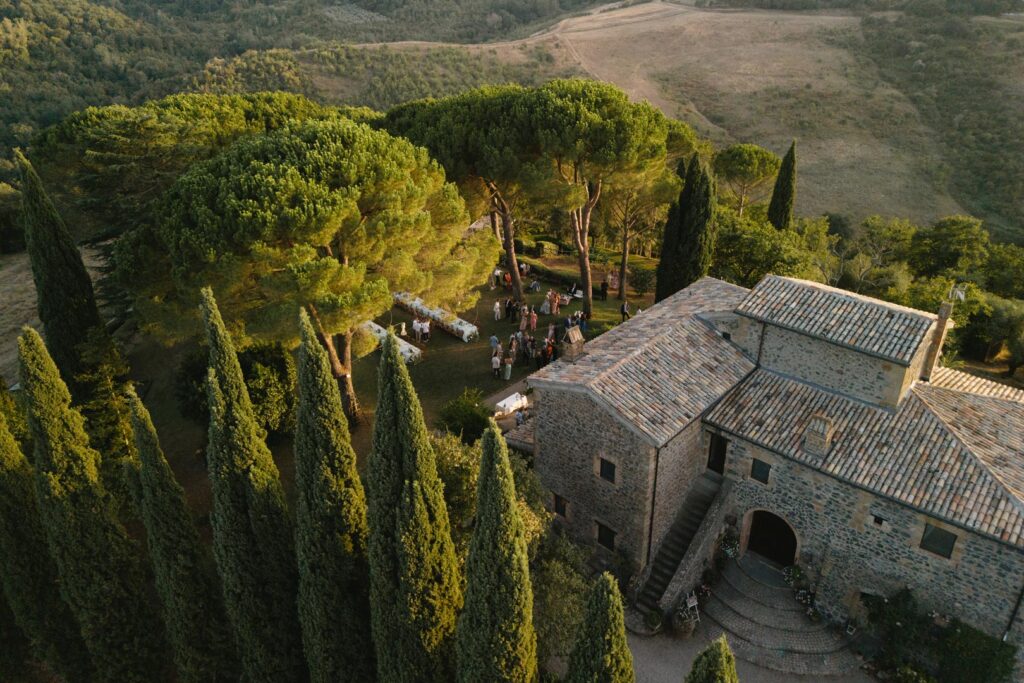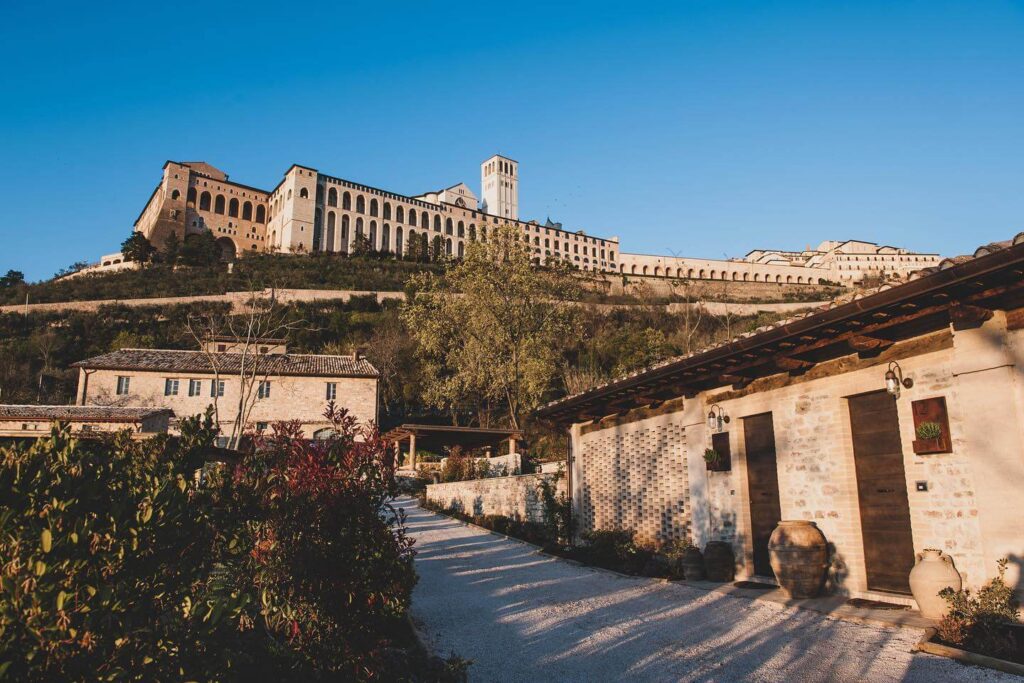
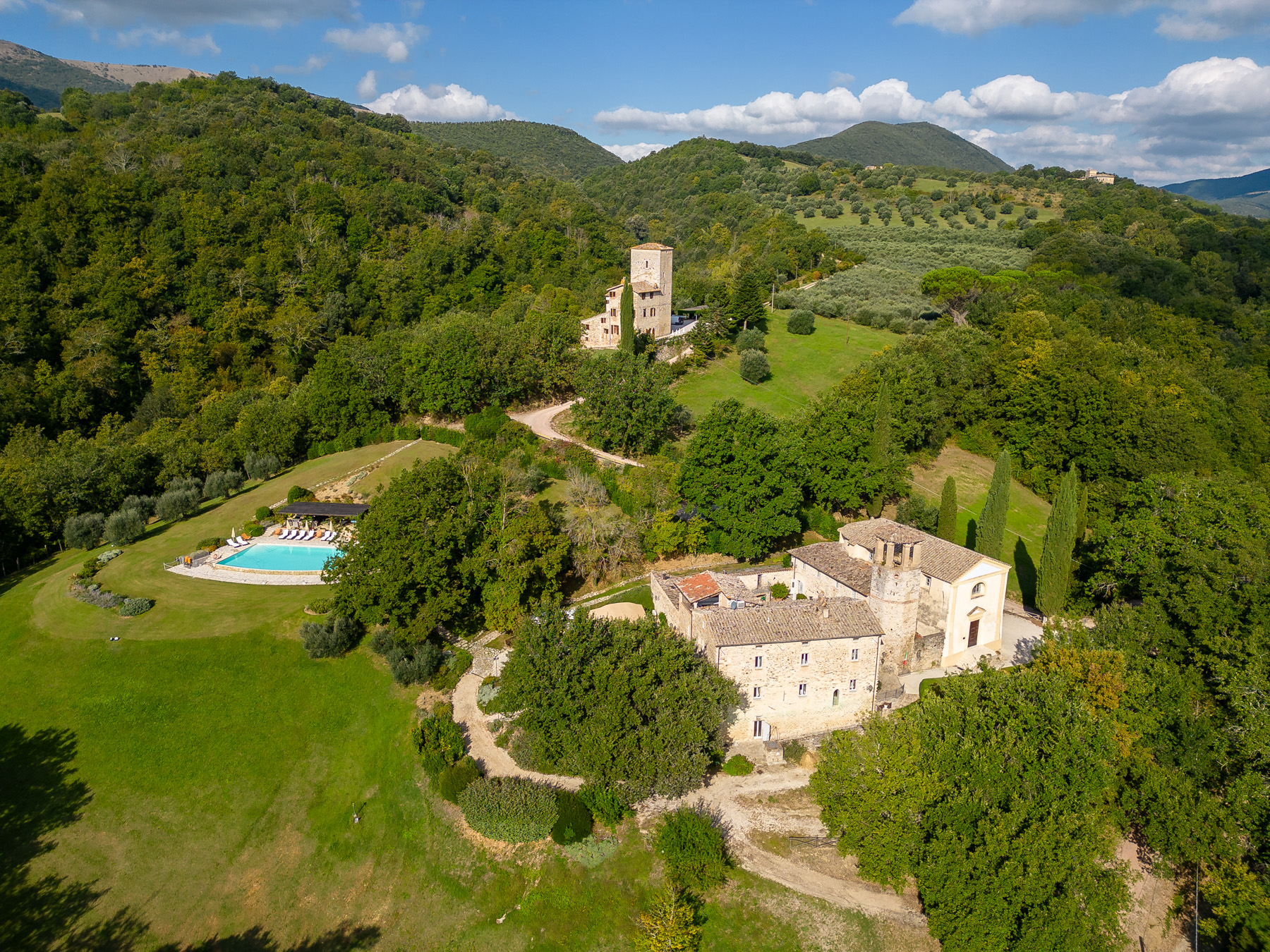
Since 1901 the Tenuta di Bagnara, 590 hectares of farmland, woods and river plain in the upper Tiber valley north of Perugia, has belonged to the Giunta Tremi counts. Two of its medieval buildings stand together on a hill near the middle of the estate: Castello di Pieve San Quirico, with its own consecrated parish church, and the Tower Palace, a stone lookout raised around the year 1000. The family lets the pair to one party at a time, by the week in high summer, and that sets the shape of a wedding here: a small celebration on the hill, with the closest guests sleeping inside the castles for the whole stay.

A family estate in the upper Tiber valley
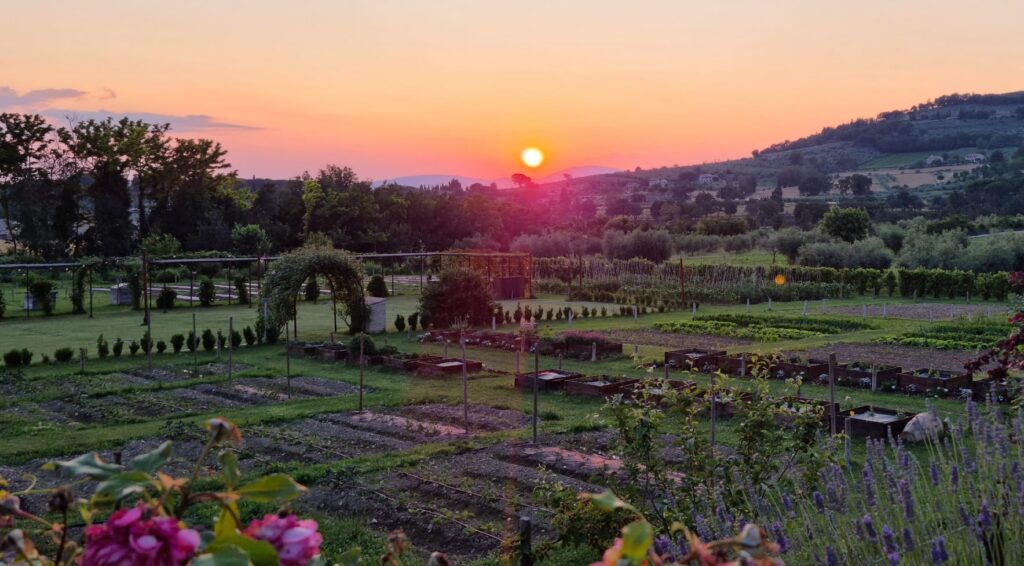
The estate lies at Solfagnano, a village at the northern edge of the comune of Perugia, where the Tiber crosses flat land along the river and the ground rises towards Monte Tezio. The Tenuta di Bagnara takes in both. On the plain there are fields of wheat and sunflowers and the corn grown for the family’s Chianina cattle; the hills hold woodland, small lakes, streams and olive groves of more than 3,000 trees. Roe deer and hares are bred on the land, and grey herons, cormorants and buzzards are among the birds seen there.
The counts bought the estate in 1901, together with Castello di Bagnara, the castle on the valley floor that is still the family’s home. Today it is run by Countess Zenaide Giunta Tremi, a great-great-grandniece of Napoleon Bonaparte, who brings decades in public relations and events to the work. Her late mother began restoring the castles. The work started with Castello di Bagnara, repaired between 1985 and 1987 after the earthquake that struck Umbria in 1984, moved on to the hilltop Tower in the late 1980s and reached Pieve San Quirico in the early 2000s.
Two castles on one hill
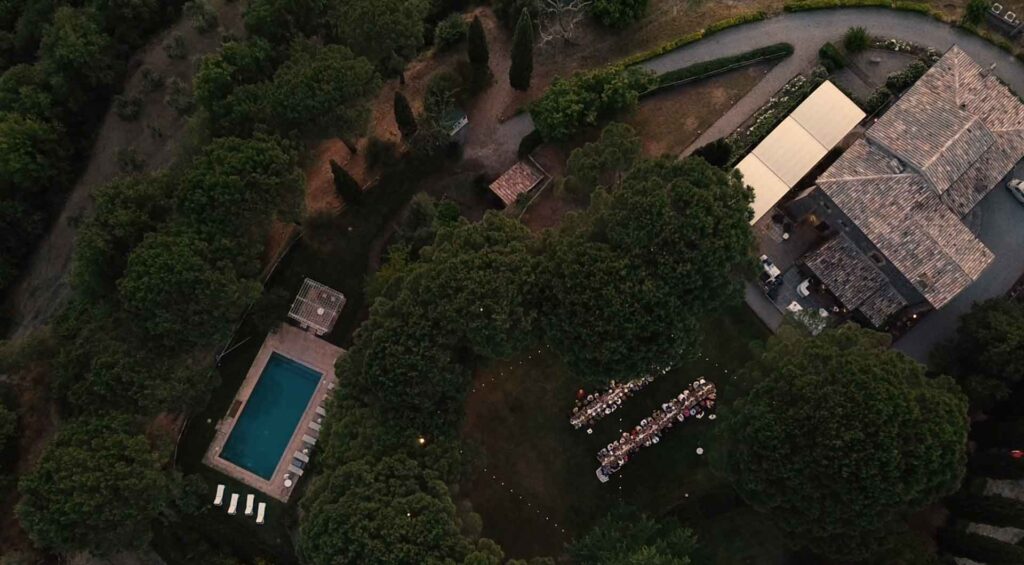
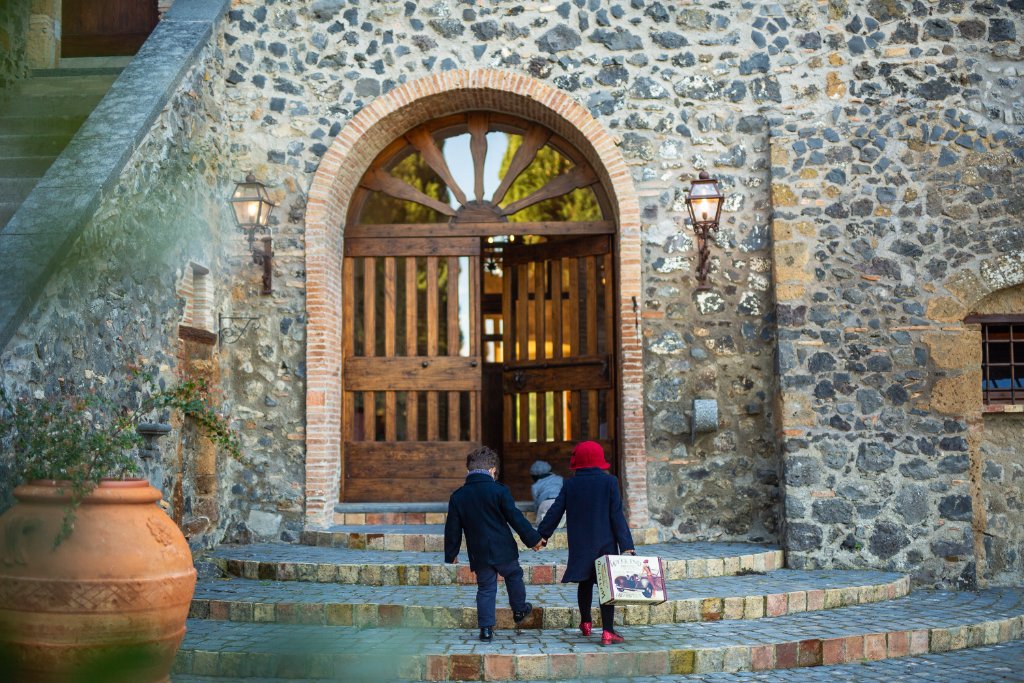
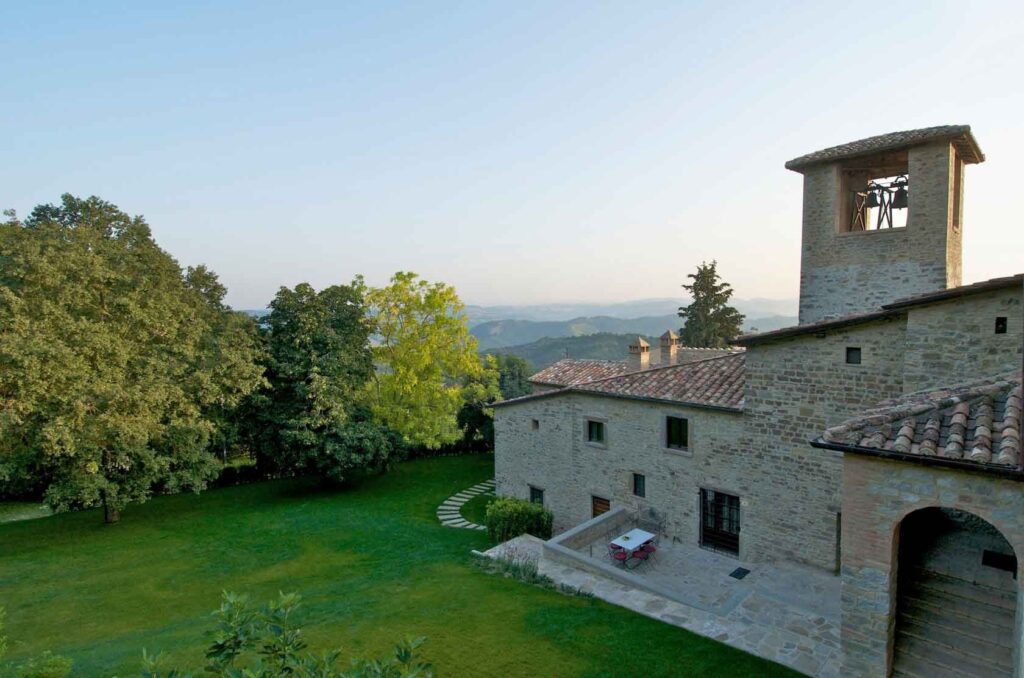
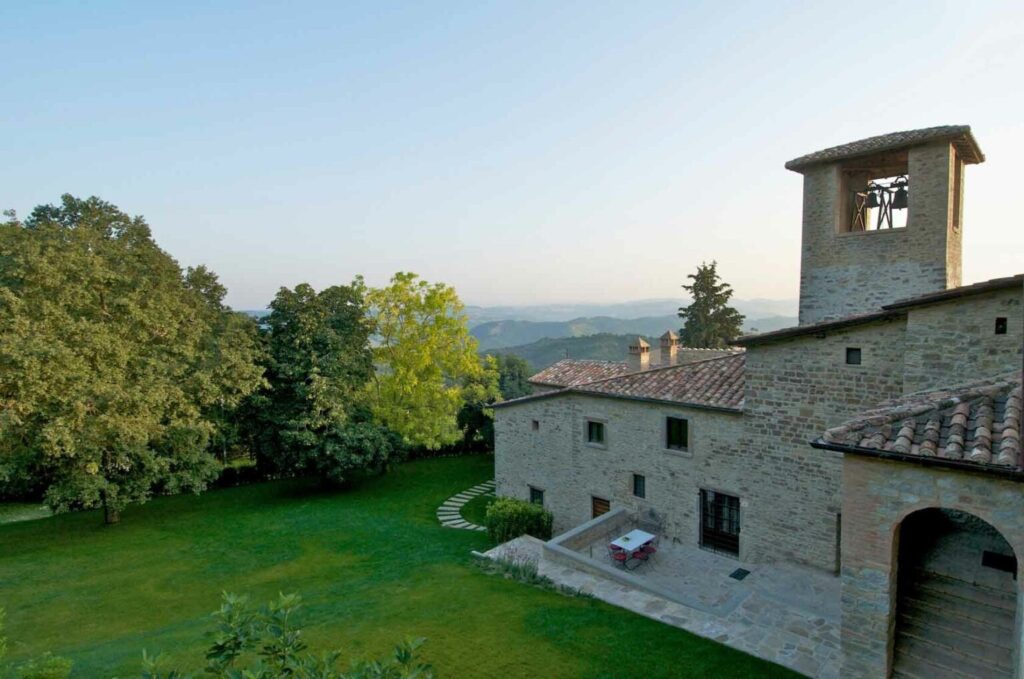
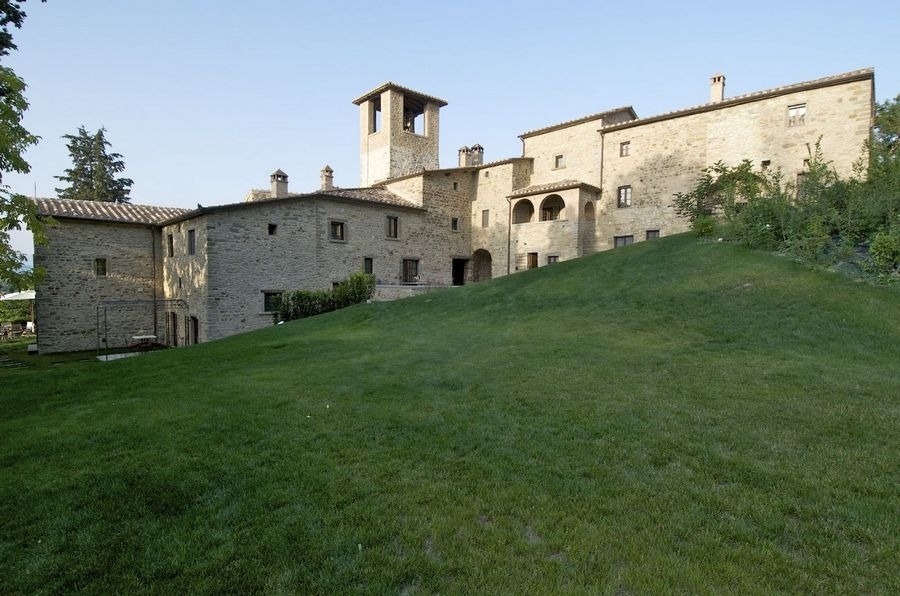
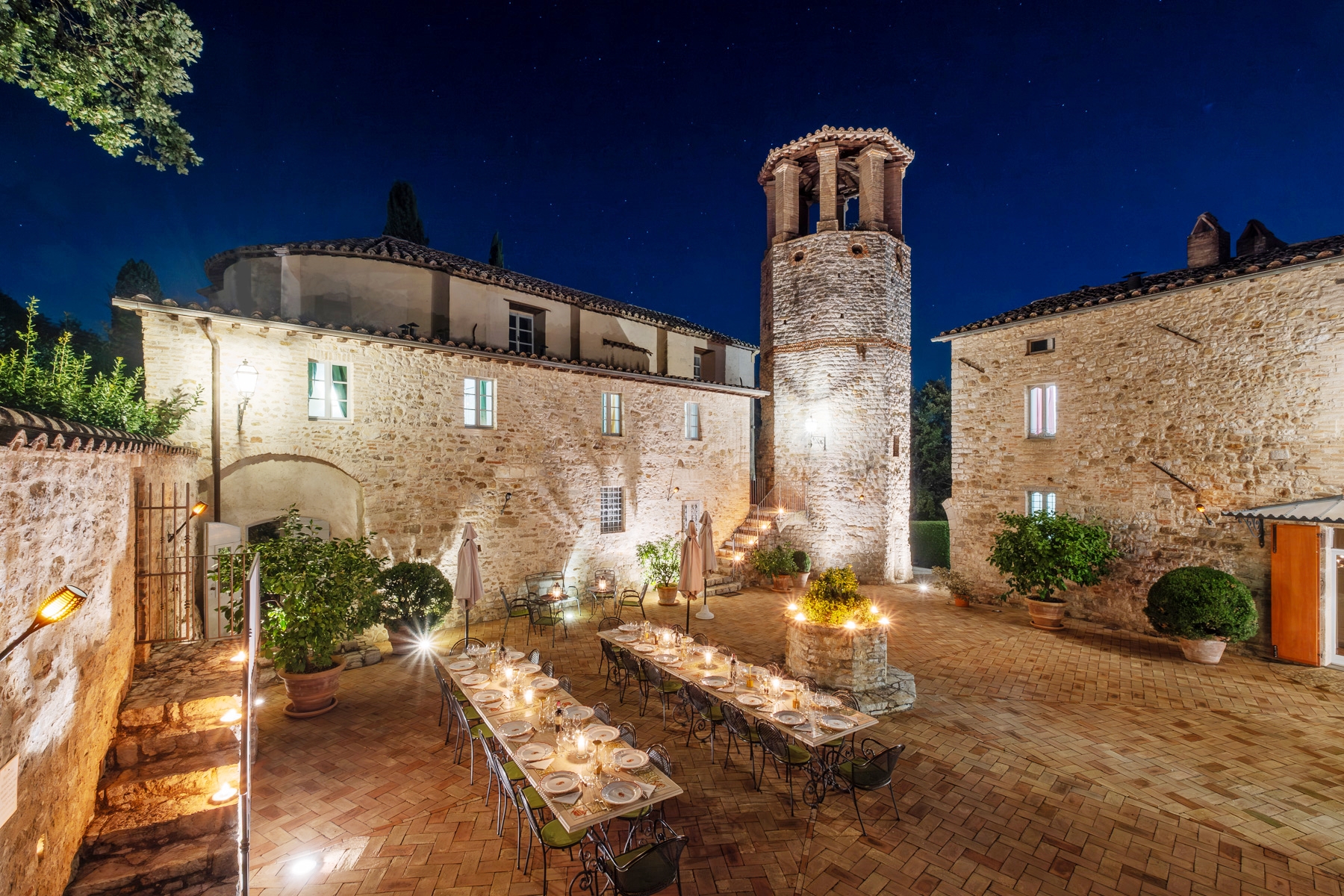
Pieve San Quirico takes its name from its church. In medieval Italy a pieve was a rural church with a baptistery that governed the smaller churches of its The castle’s foundations go back to the eleventh century, and family history credits the architects of Emperor Frederick II of Swabia with enlarging it in the thirteenth. The buildings close around an inner courtyard with an octagonal tower. Restored as a house of 550 square metres, the castle has seven bedrooms, six doubles and a triple, each with its own bathroom and each named for a flower: Periwinkle, Primrose, Tulip, Peony, Geranium, Myosotis and 7Flowers. The house also has a billiard room and a home cinema.
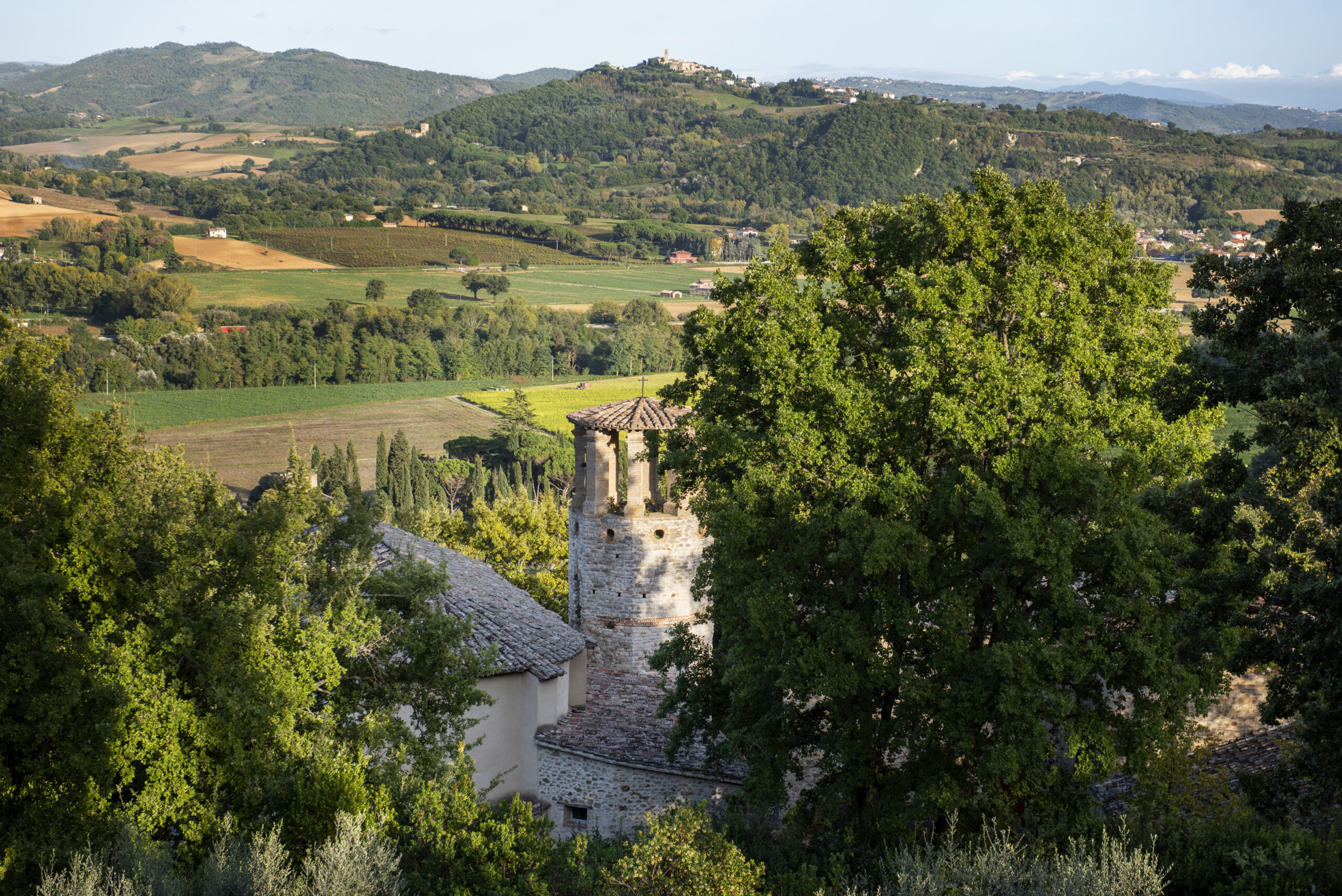
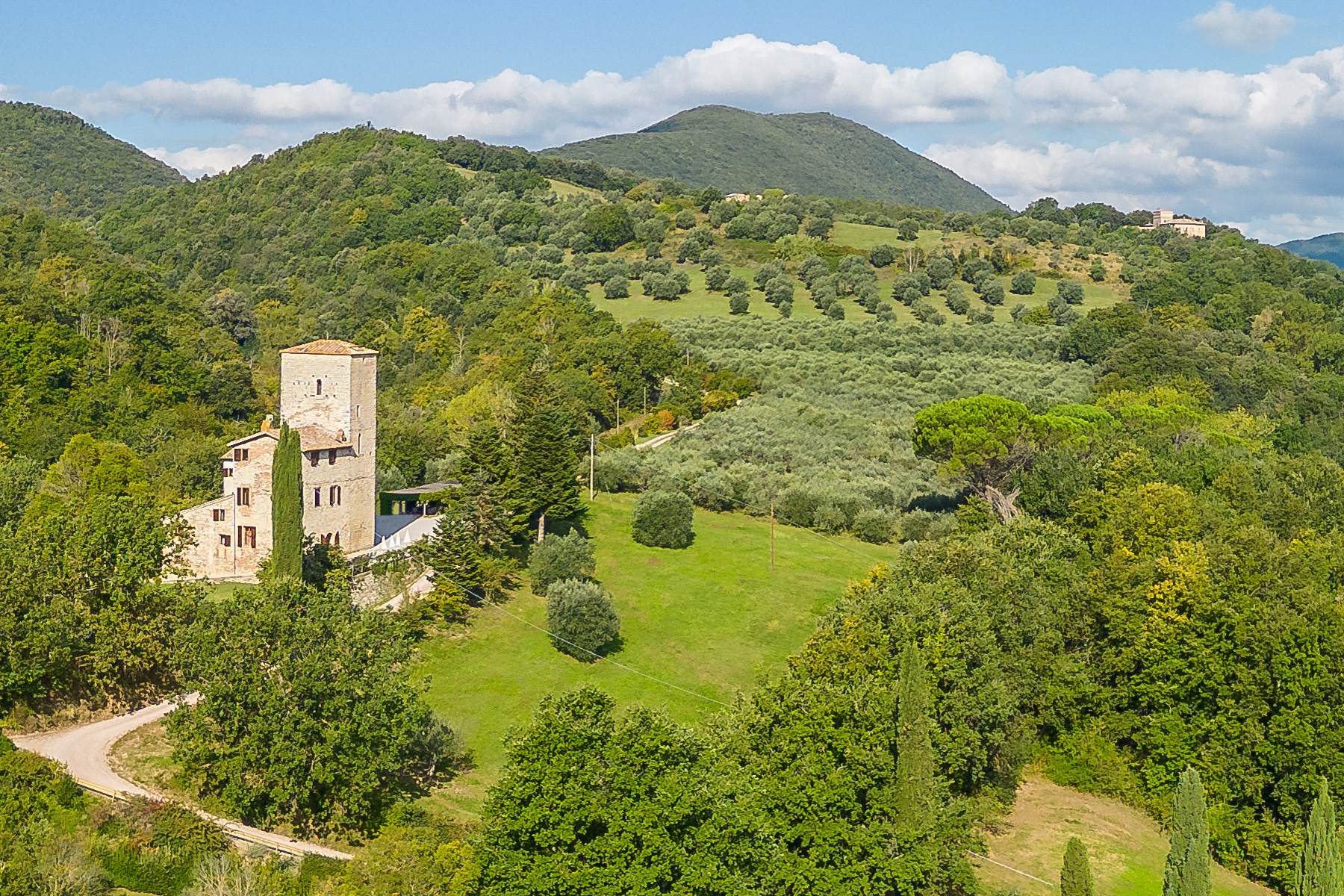
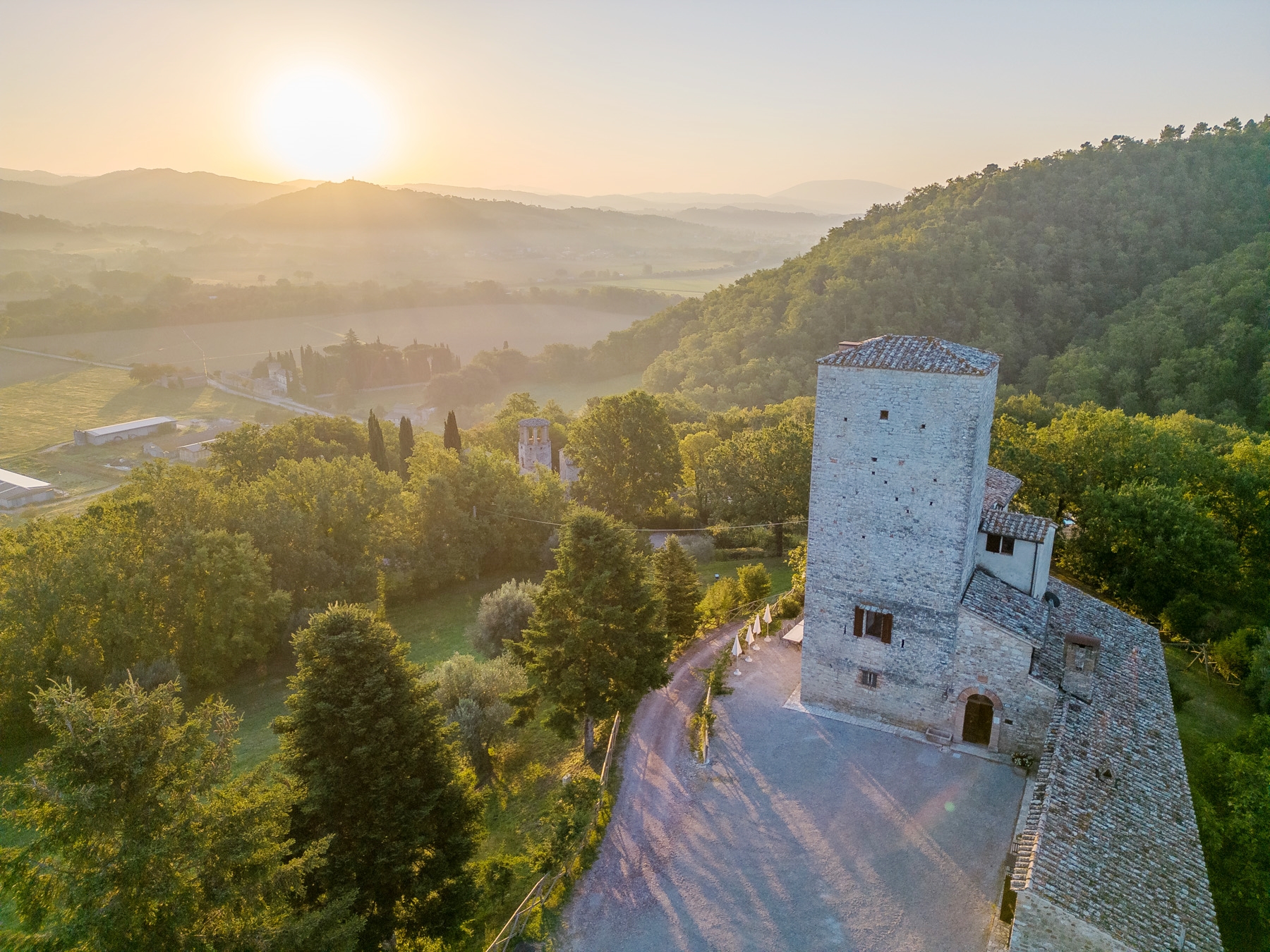
A hundred metres up the hill stands the Tower Palace. Its stone tower, 20 metres high, was built around the year 1000 as a lookout, and a palace wing grew against it over the following centuries. Converted into apartments in the 1990s, it was fully renovated in 2023 as an eight bedroom villa sleeping 15, with heat pumps for heating and cooling that run on solar power generated on the estate. The rooms keep barrel vaulted ceilings, working fireplaces and Romanesque windows, and they are named for the cast of a medieval court: The Joker, The Vassal, The Minstrel, The Princess, The Lady, The Falconer and The Knight, a suite whose second bedroom is on the third floor of the stone tower, reached by an inner wooden stair.
The Tower Palace is let only together with the castle, and all meals are served at Pieve San Quirico, so the two houses run as one household for the week.
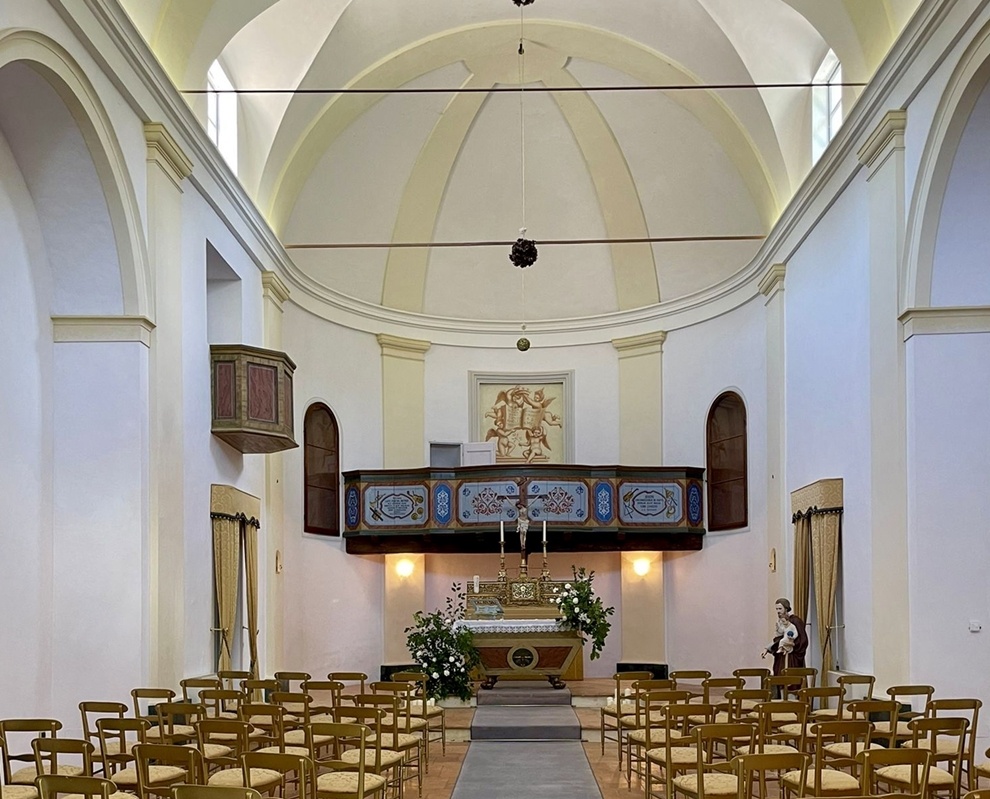
Vows in the parish church or the garden
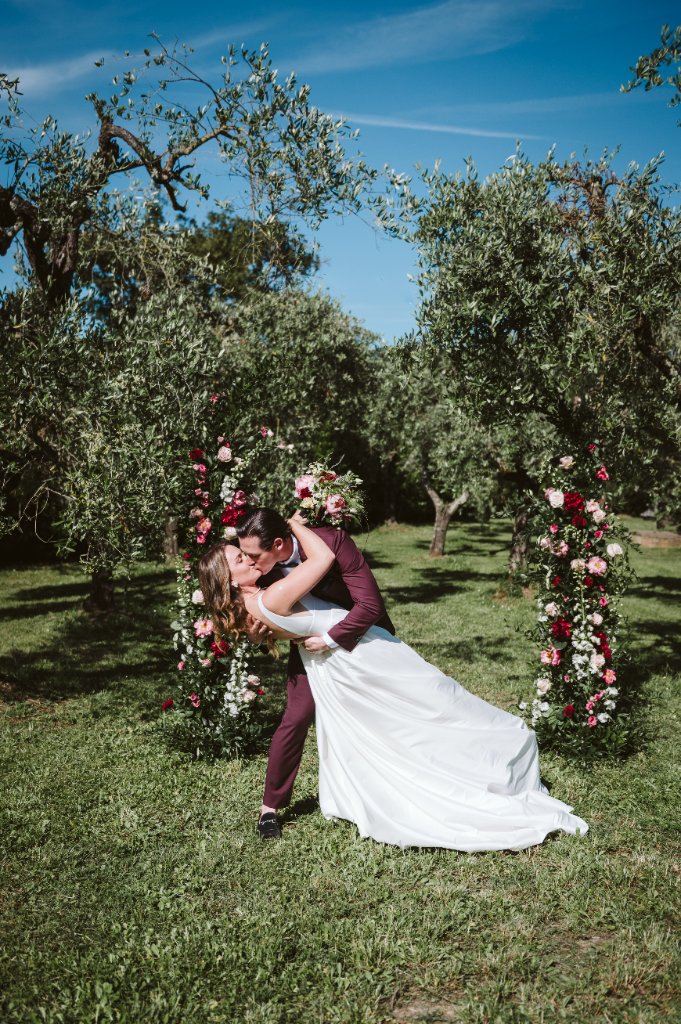
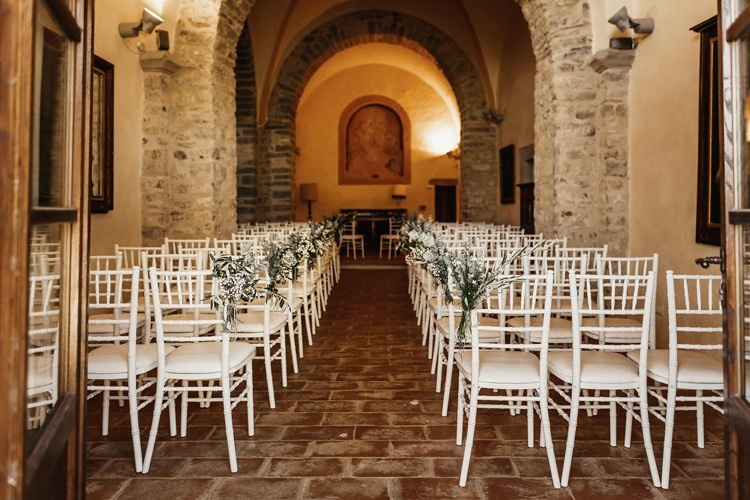
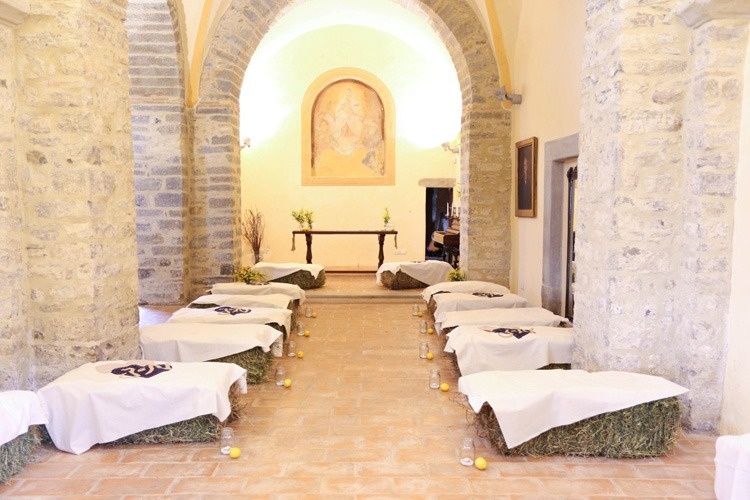
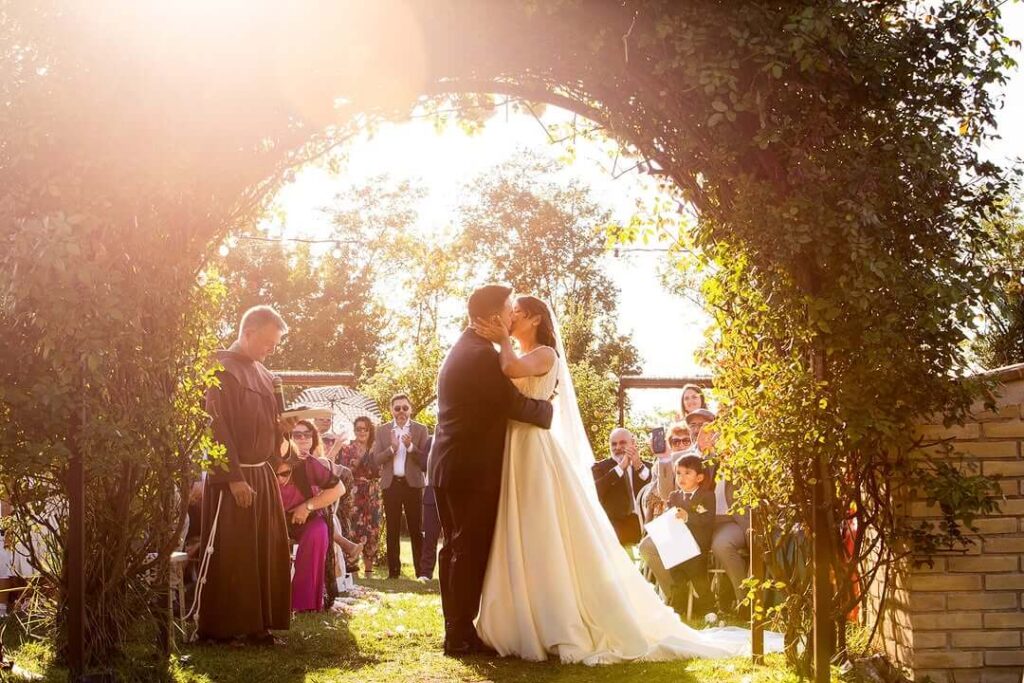
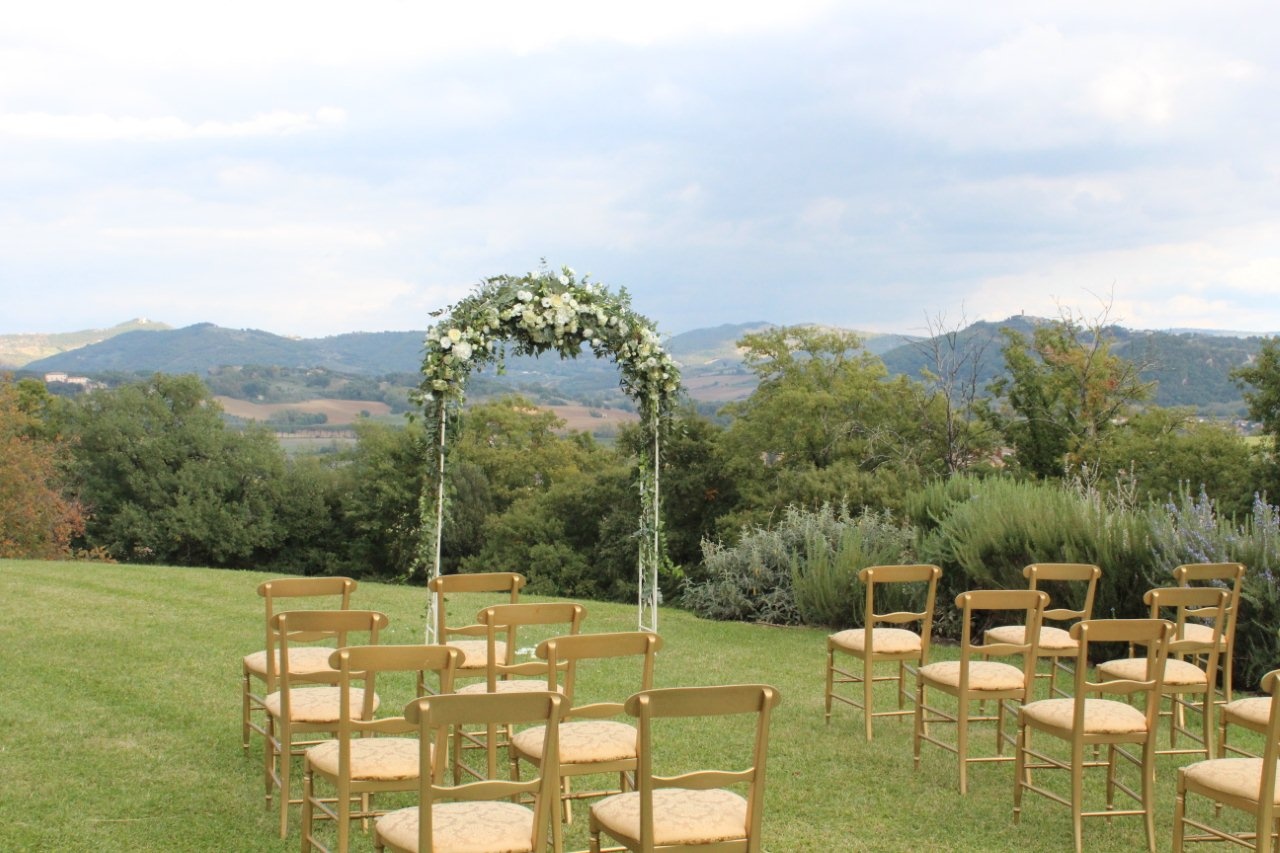
Both castles are authorised by Perugia City Hall to celebrate legally valid civil marriages on site. At Pieve San Quirico the civil ceremony can take place in the gardens, in the inner courtyard or beside the pool. The eighteenth century parish church, still consecrated, seats 70 to 80 and holds Catholic weddings with the permission of the Bishop. Symbolic ceremonies and blessings can be arranged as well, and the panoramic terrace at the Tower is used for symbolic vows and for drinks before dinner.
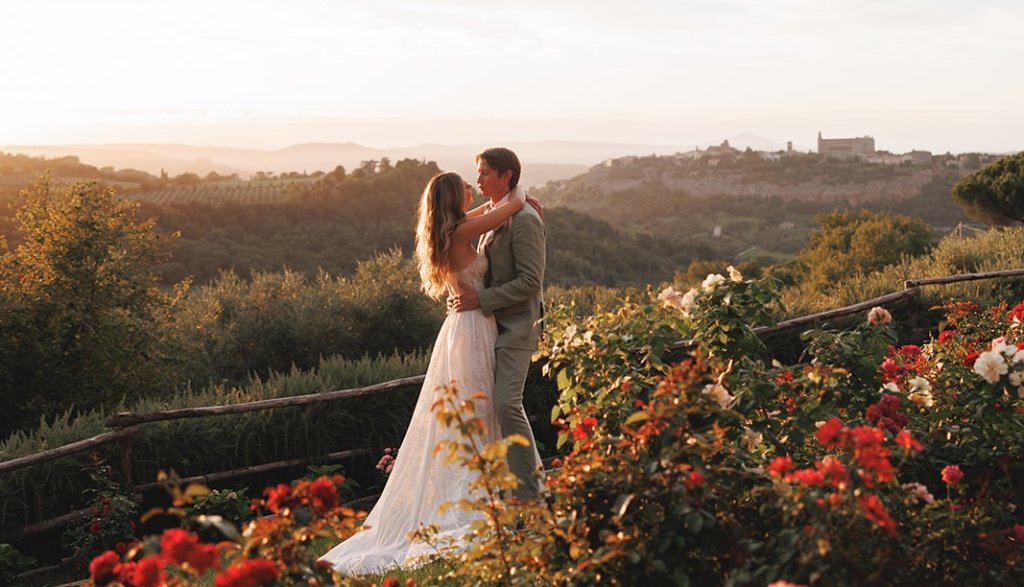
The gardens around the castle cover 5,000 square metres and were designed by the Tuscan landscape architect Alberto Margheriti. David Austin roses, lavender and herbs grow among old oaks and olive trees, with pomegranates, lemon trees and cherry trees planted alongside, and there are seating areas that look out over the hills and the upper Tiber valley.
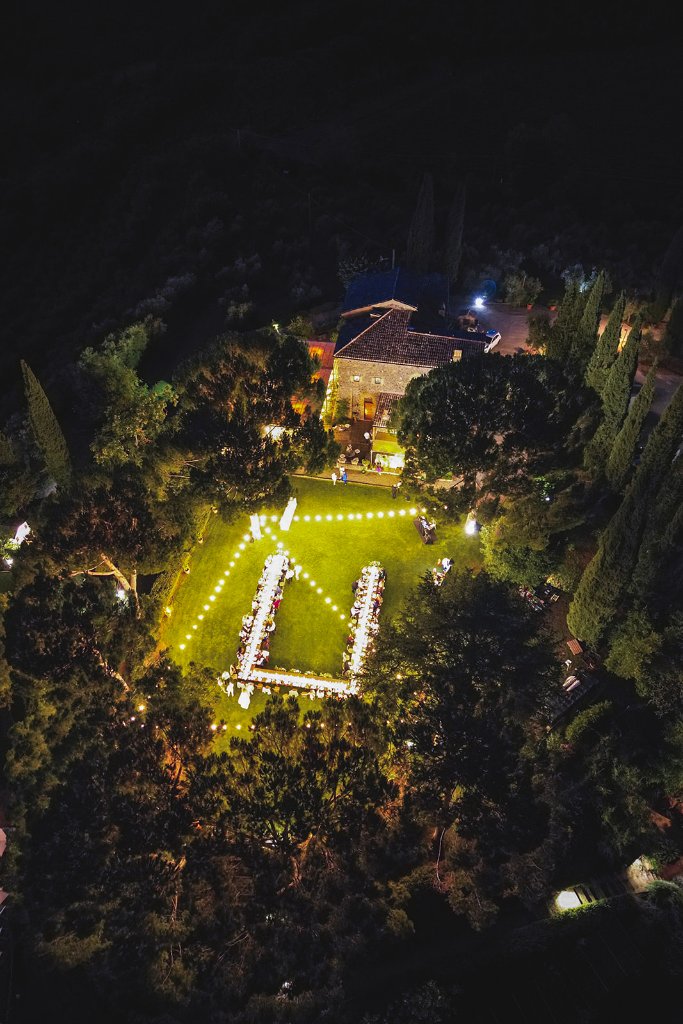
Dinner in the castle courtyard
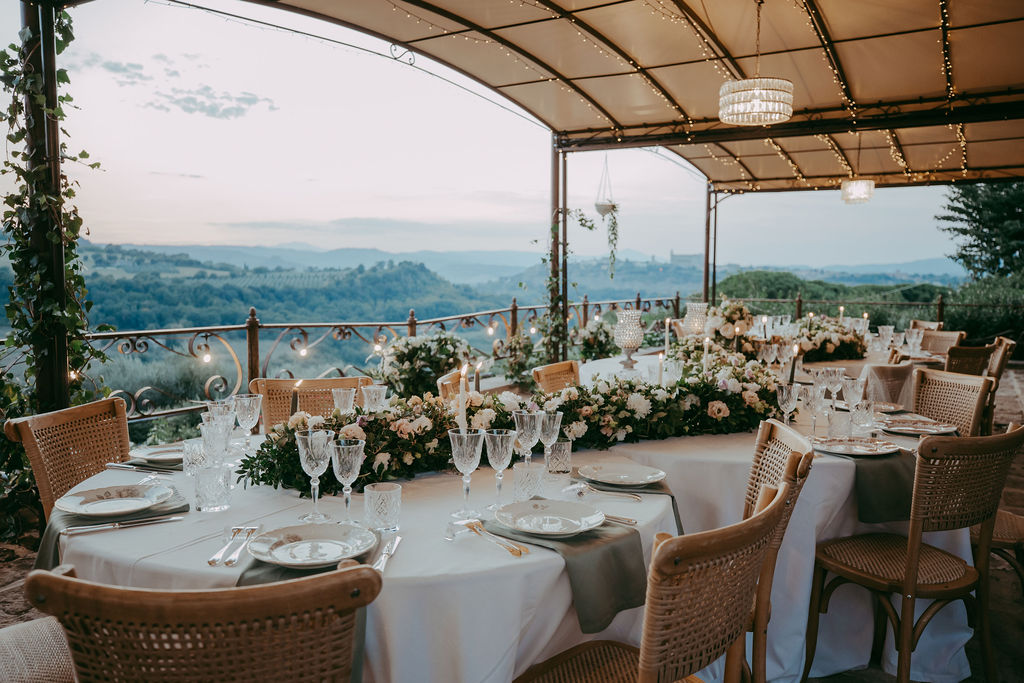
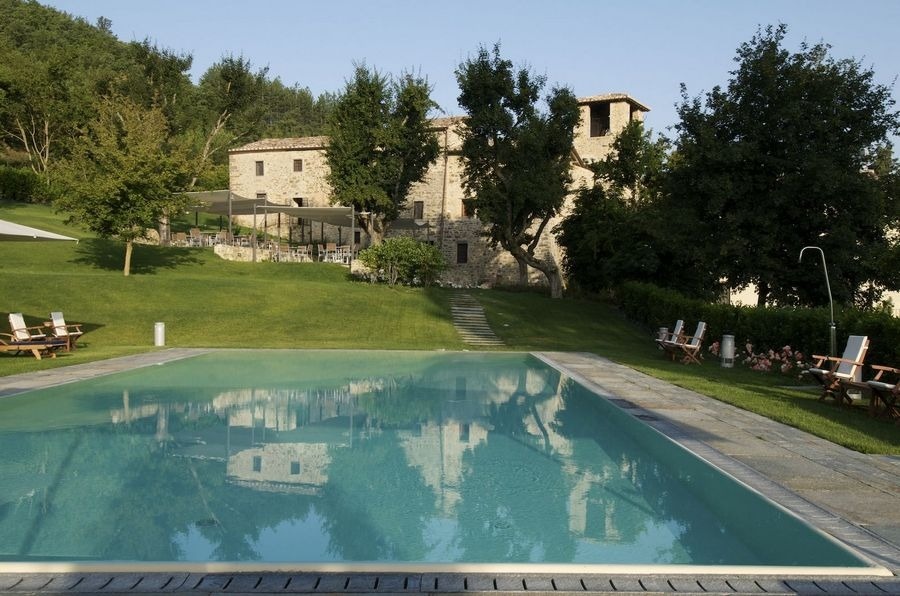
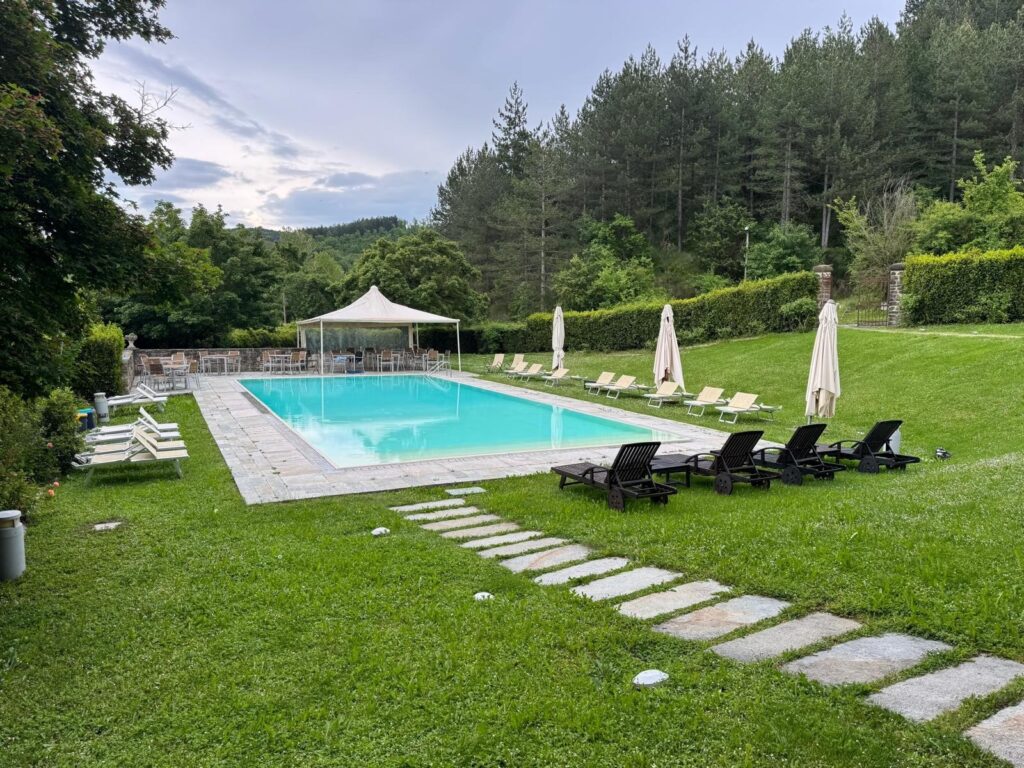
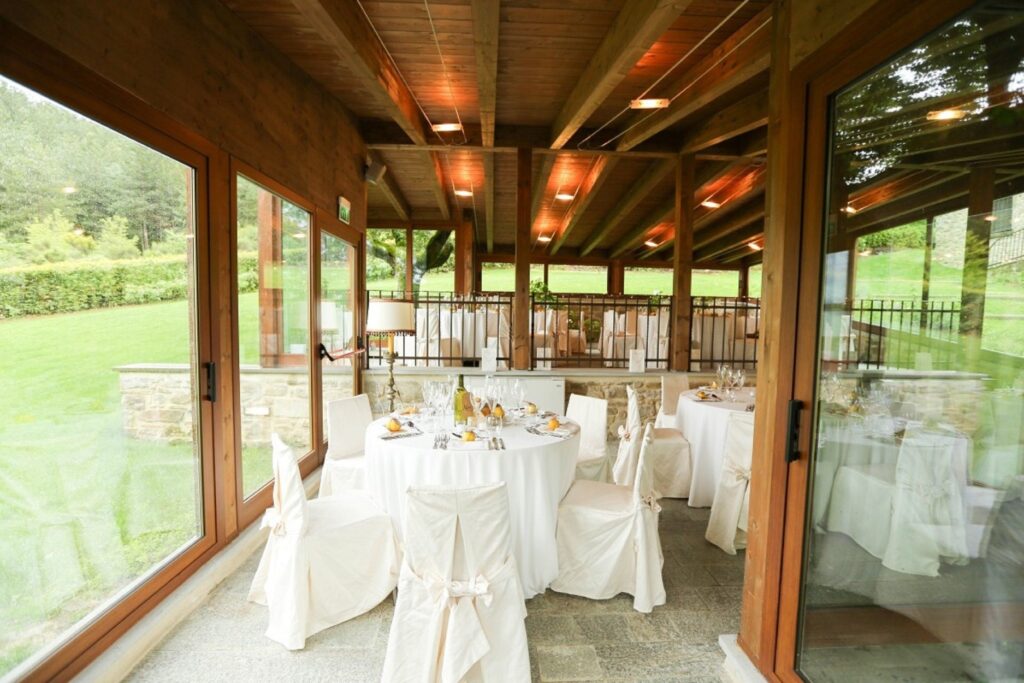
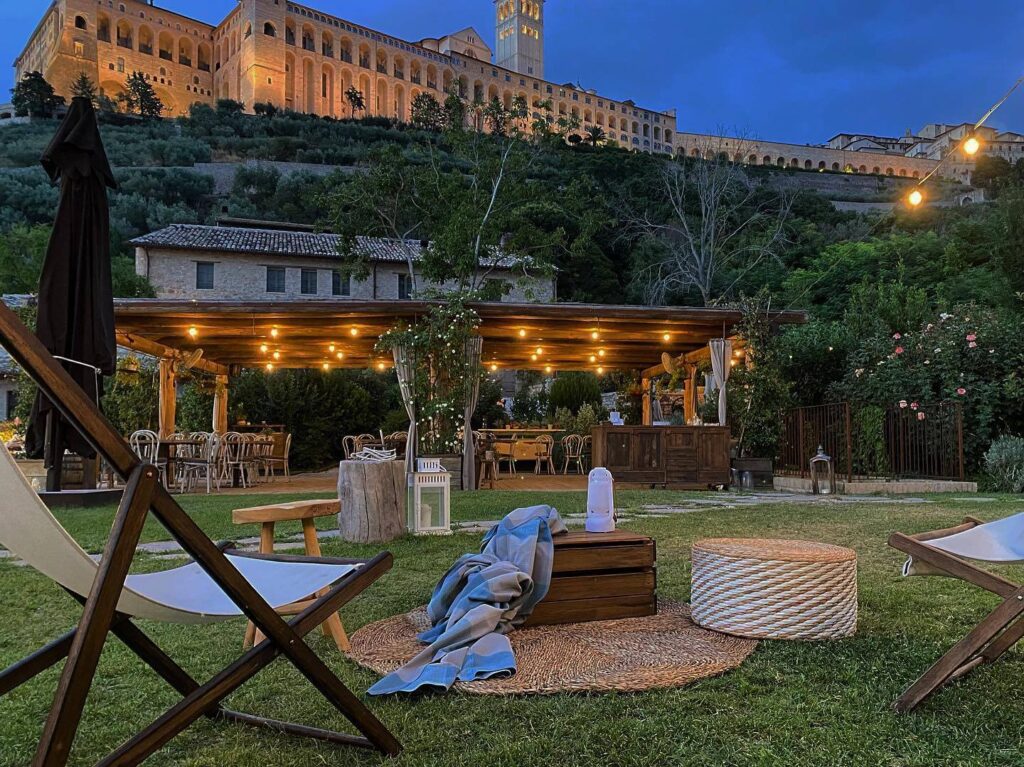
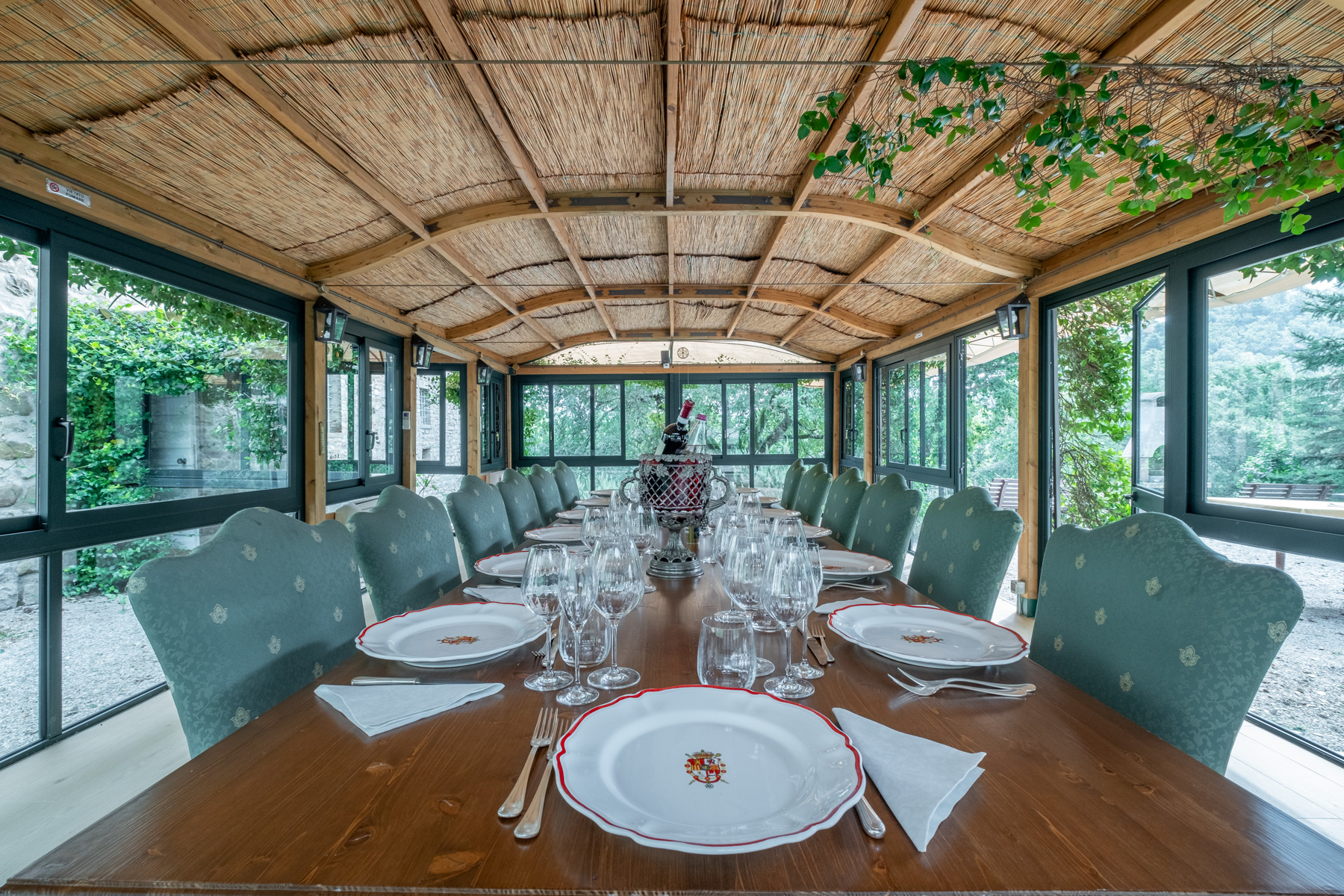
Receptions are for up to 60 guests. In fine weather dinner is laid in the inner courtyard, in the gardens or around the pool, and a smaller dinner for 30 can be set on the Tower terrace. The glazed dining veranda at the castle is air conditioned and seats 35, and if the weather turns, the courtyard can be covered with a marquee. Live music and a DJ are both possible, and there is no set time for the music to stop.
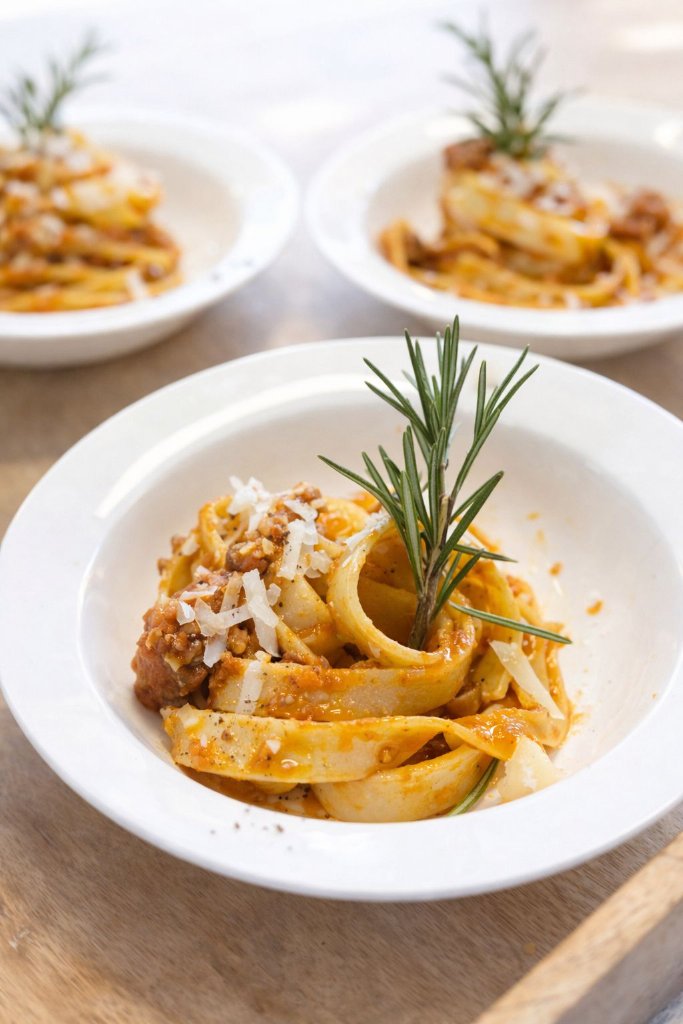
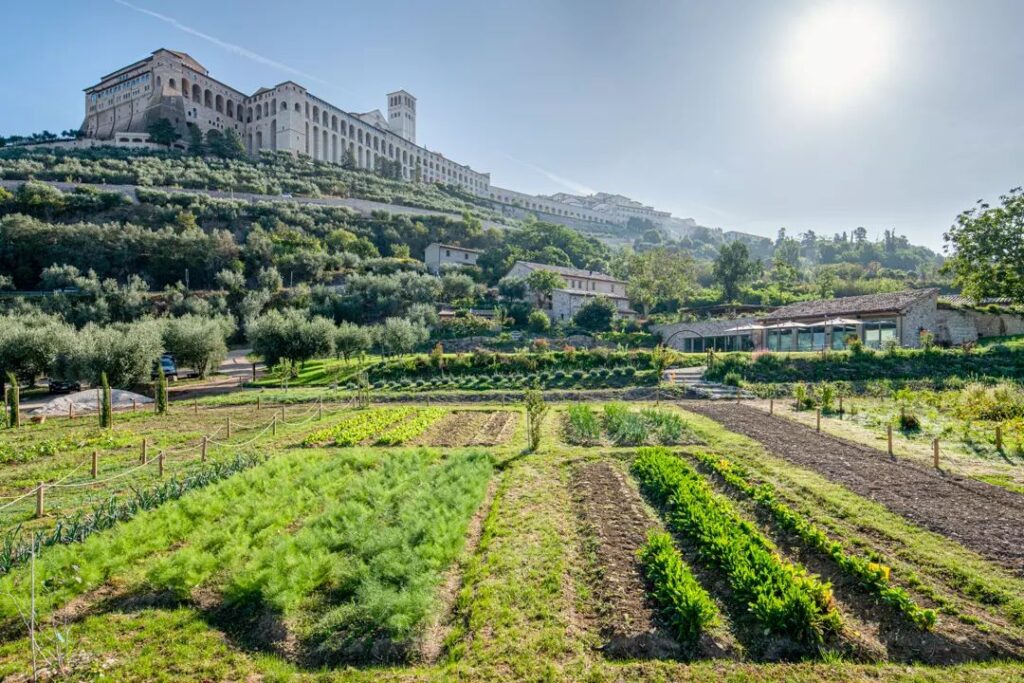
Catering stays in house. Outside caterers are not used; the estate’s chef writes the menus, creative, traditional or international, and pastry chefs make the wedding cake. Much of what reaches the table comes from the farm, which produces cold pressed extra virgin olive oil, honey, organic vegetables, legumes, Chianina veal and Senatore Cappelli wheat, an old variety whose flour the chef uses for fresh pasta. The land also gives truffles, wild asparagus and berries in their season.
The family castle in the valley
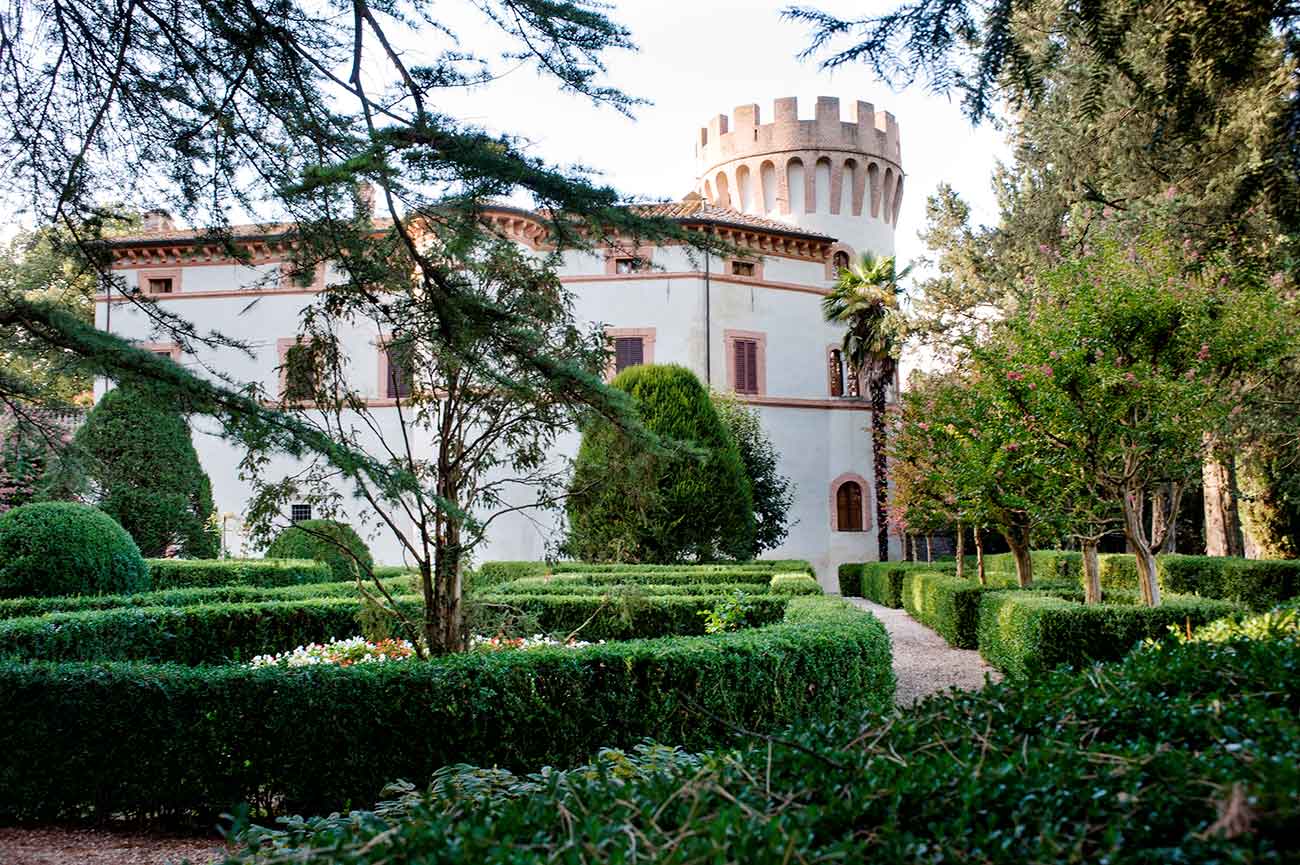
For a larger celebration the family opens Castello di Bagnara, a kilometre away on the valley floor, on a few chosen occasions, for weddings and events of up to 150 guests. It has no bedrooms, so the hill castles remain where the wedding party sleeps. The castle is a group of buildings laid out in the shape of a Y and begun in the eleventh century: an L shaped house with a square tower and a stone mill, a round tower added in the fourteenth century, and, at the end of the 1400s, the Palazzo di Bagnara, with a Renaissance spiral staircase built inside a second, smaller tower. The round tower was lowered and crenellated when the palazzo went up.
Beside the oldest building is a small seventeenth century chapel dedicated to St Charles Borromeo, and on the west front of the palazzo a clock restored in the eighteenth century by Countess Baldeschi Cennini still keeps time. The park of about 2.5 acres holds an Italianate garden under the protection of the Italian fine arts authorities, planted with lagerstroemia, yew, wild roses and begonias, and the park around it has tall cedars of Lebanon, holm oaks, magnolias and limes. An old drawing in the Perugia archives shows a maze here that has since been lost. Civil ceremonies at Bagnara can be held in the park, the inner courtyard, beside the pool or in the old oil mill.
Days either side of the wedding
A stay of several days leaves time around the wedding itself. The panoramic infinity pool is filled with salt water and looks out over the valley. Massages by the pool use the farm’s olive oil and honey, and there are also Watsu water therapy, yoga, cooking lessons, Umbrian wine tastings and mountain bikes for the estate’s tracks. Truffle hunts go out with a trained dog. Concierge service, daily housekeeping, gardening and pool care are included in the rental, a property manager is on call day and night, and helicopters can land on the estate. Guests beyond the 30 who sleep in the castles are found rooms in nearby hotels, with transfers arranged.
The season runs from late April to the end of October. In high summer the estate is let by the week, Saturday to Saturday, with shorter minimum stays in spring and autumn. Perugia’s airport is about 20 minutes away by car, and Rome and Florence airports about two hours. Assisi is a short drive, with Todi and Gubbio about half an hour away. Prices are given on enquiry. For more places to marry in the region, see our guide to wedding venues in Umbria and The Umbria Wedding Atlas.
How many guests the hill can hold
Le Torri di Bagnara suits a wedding that is also a stay: a parish church a few steps from the bedrooms, dinner in a castle courtyard, and a week shared with the people closest to the couple. The decision to settle first is the size of the guest list. Kept to what the hill can seat, the ceremony, the dinner and the bedrooms are all within a short walk of one another; any larger, and the question becomes whether the family will open Castello di Bagnara in the valley for the day, with the party still sleeping on the hill. Read the Le Torri di Bagnara Castles profile and check your date.