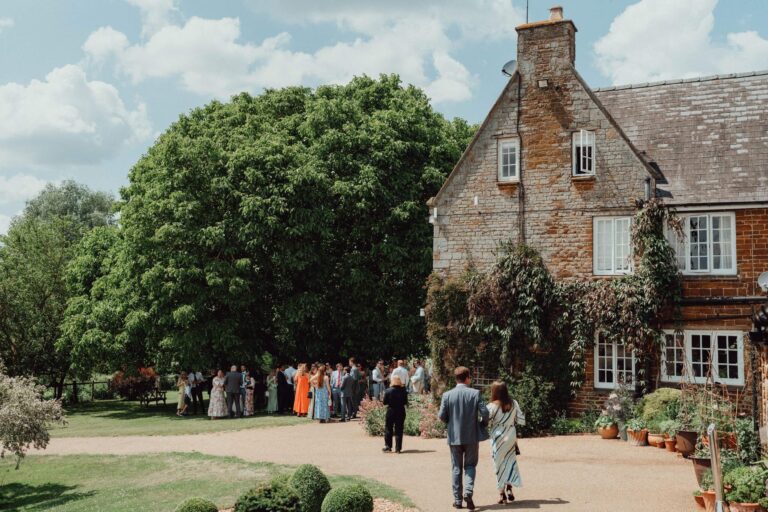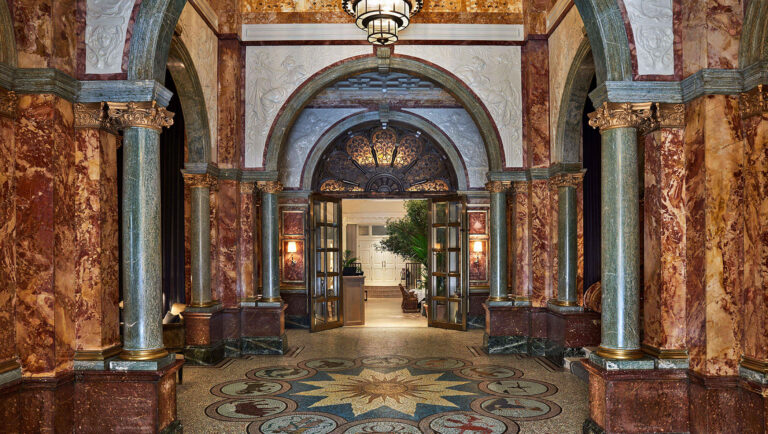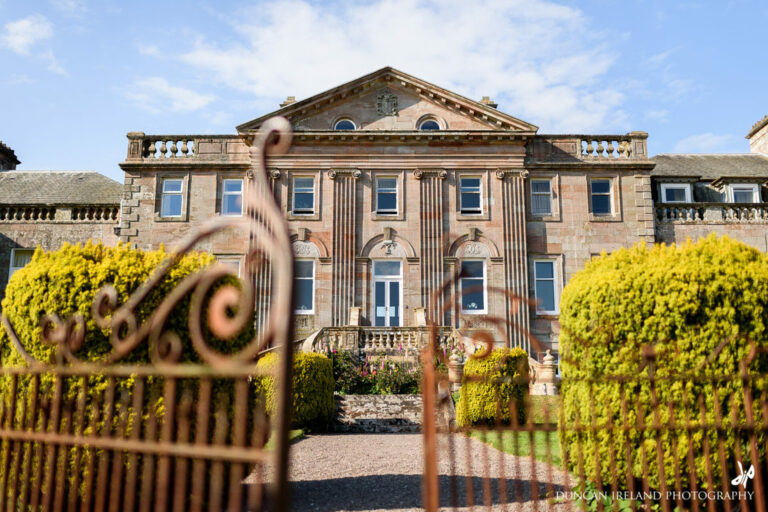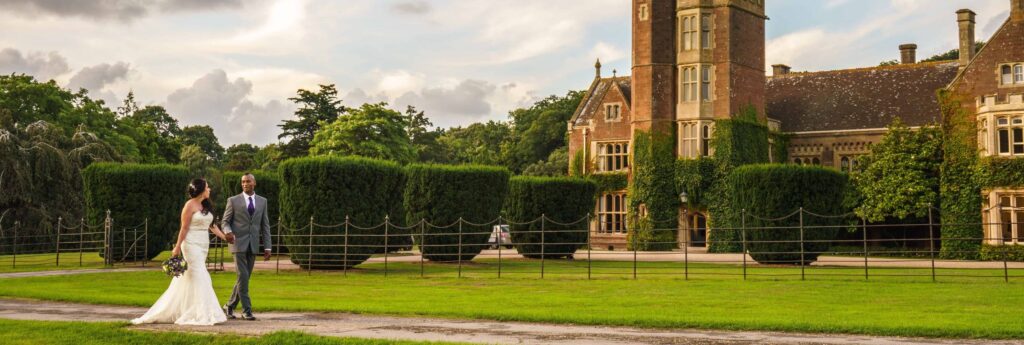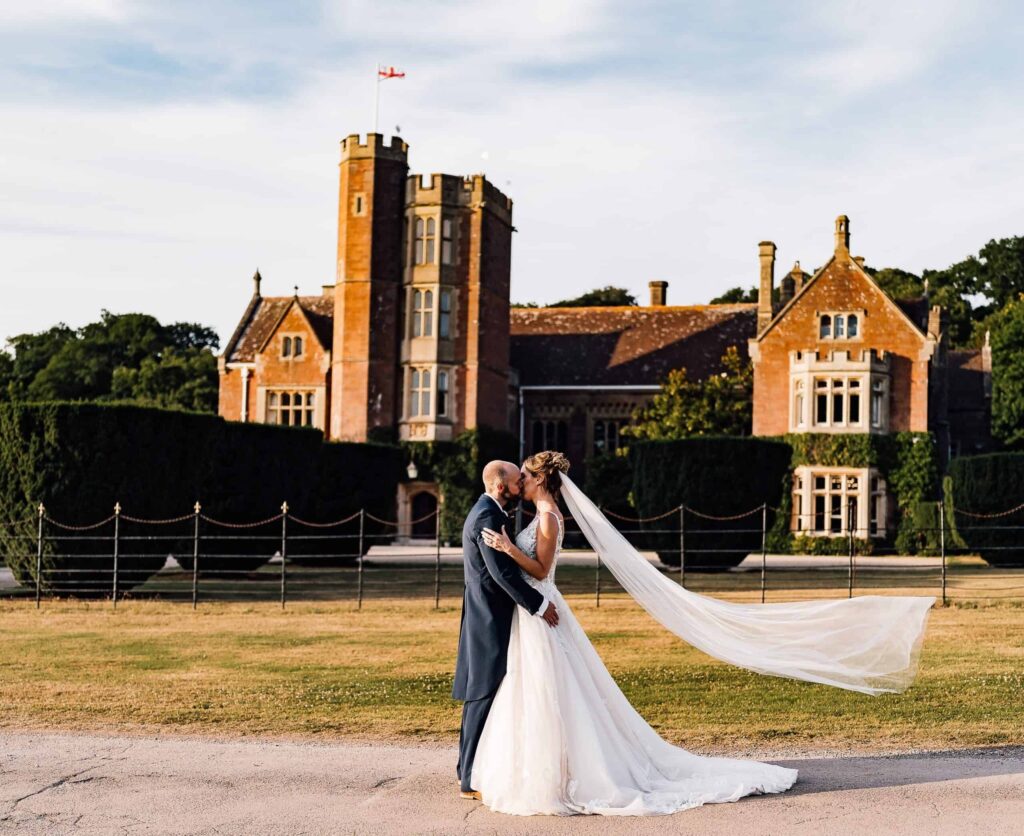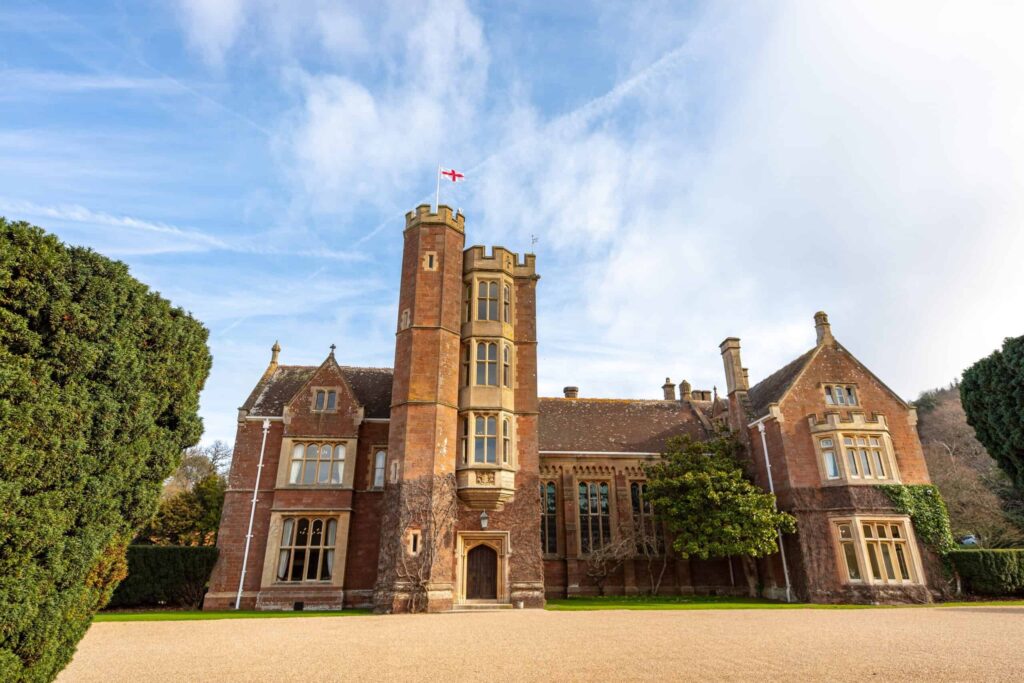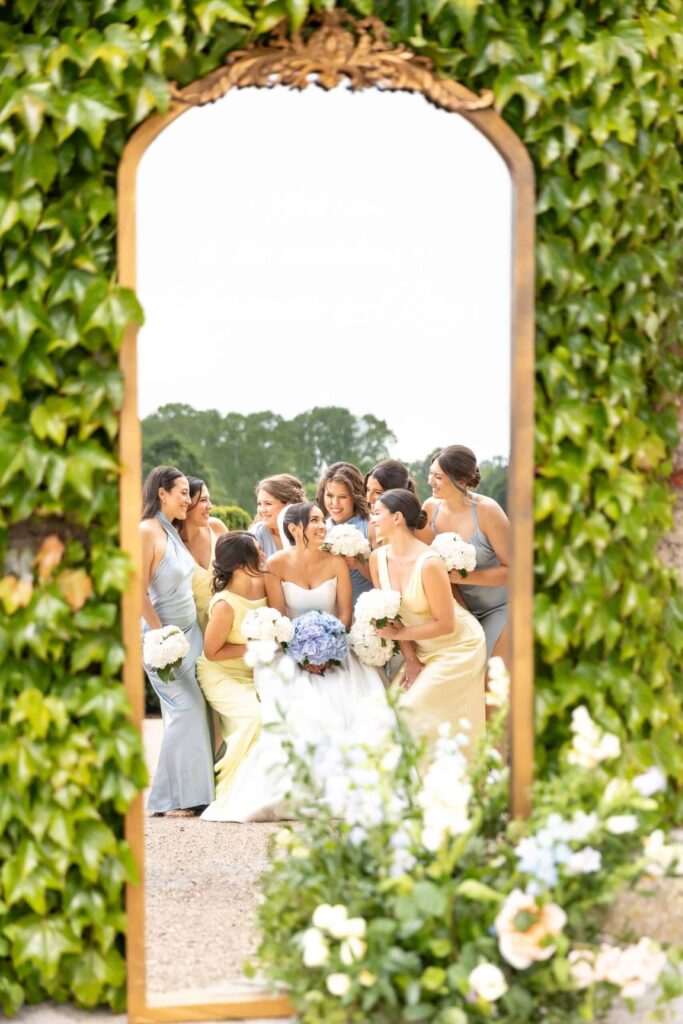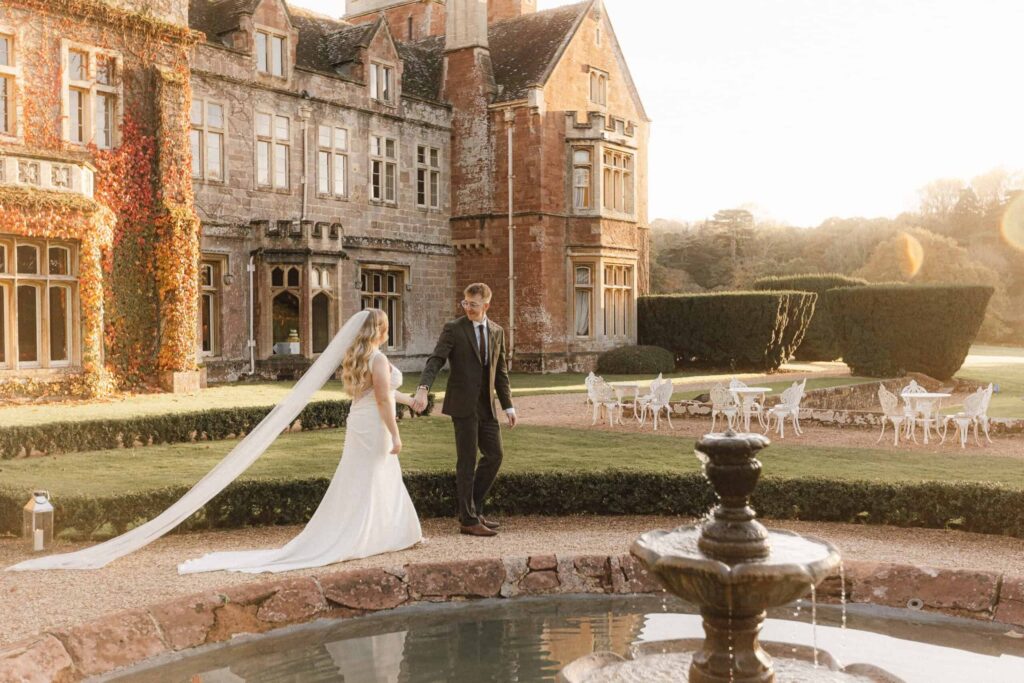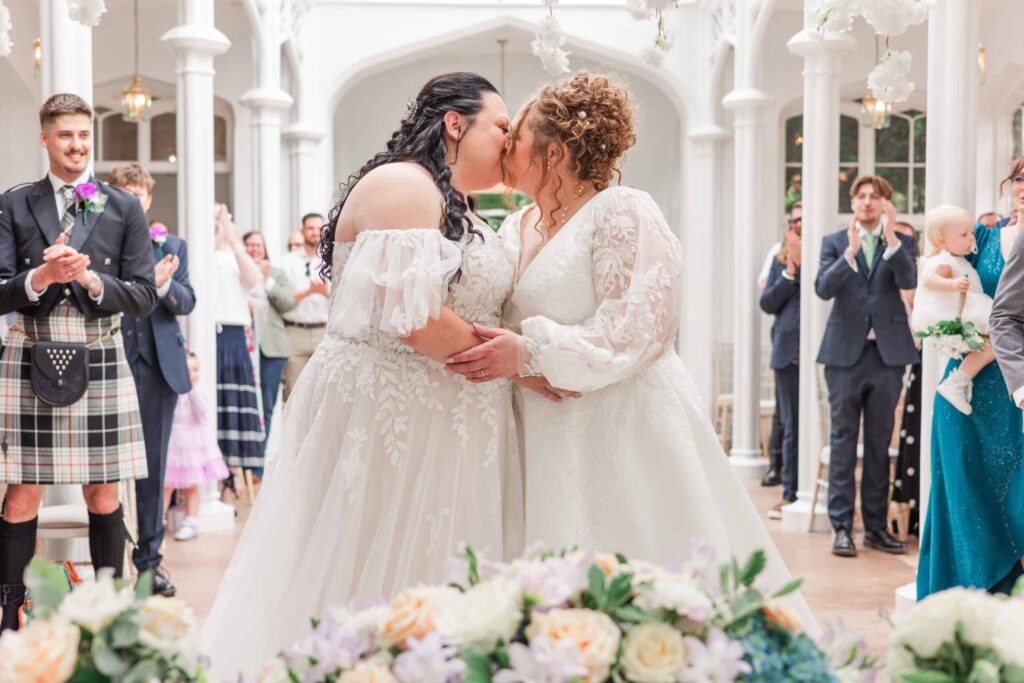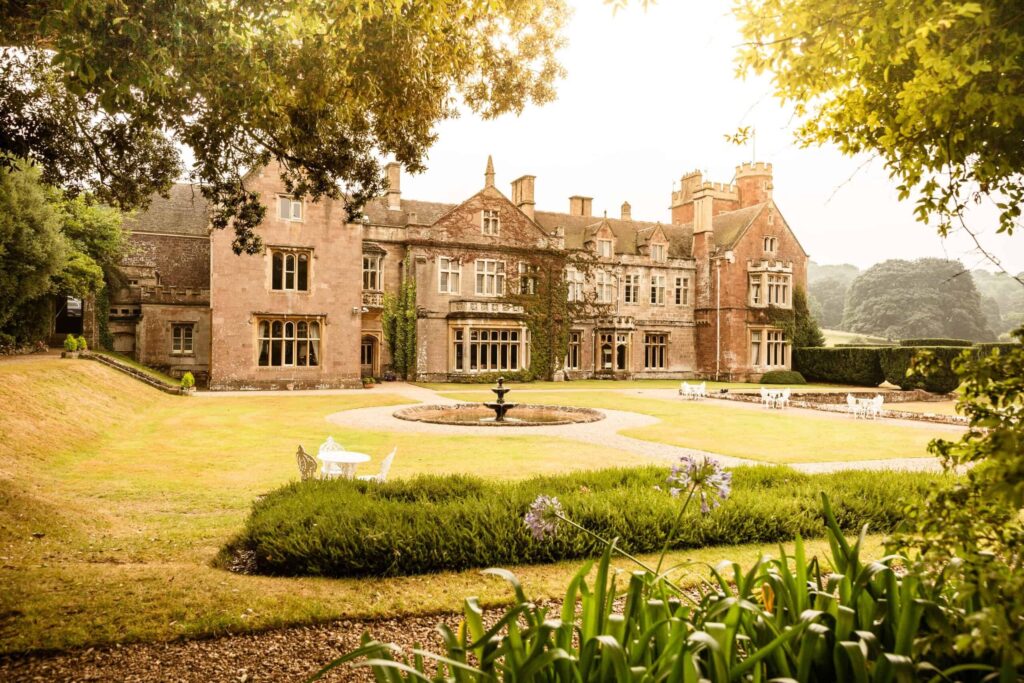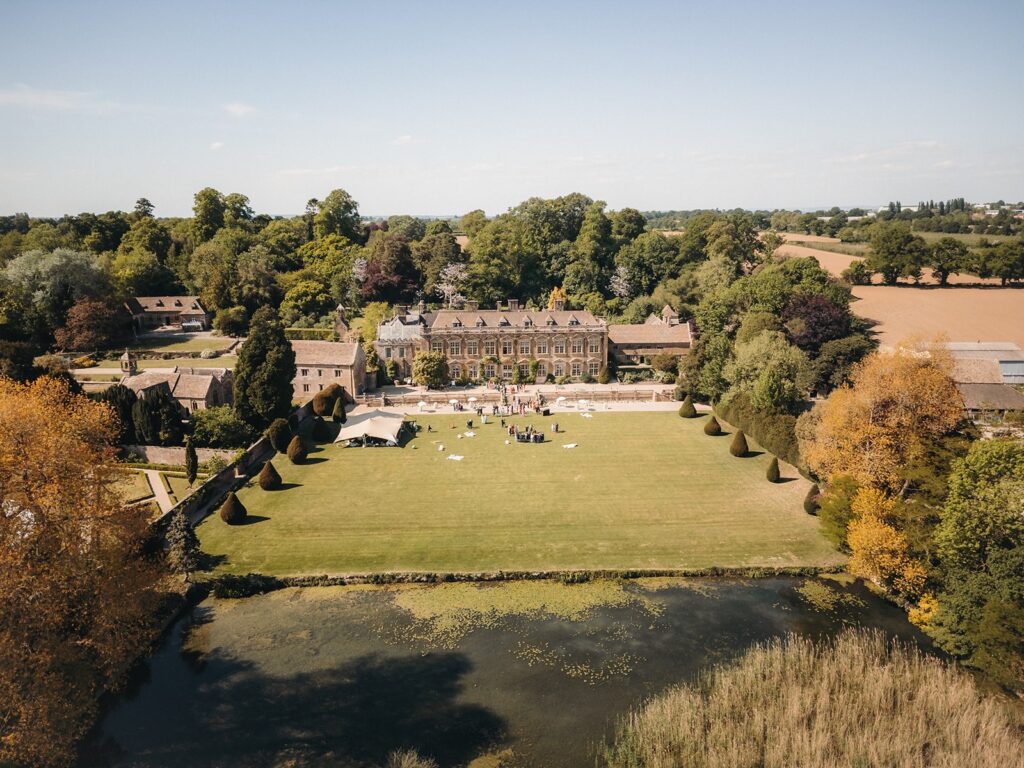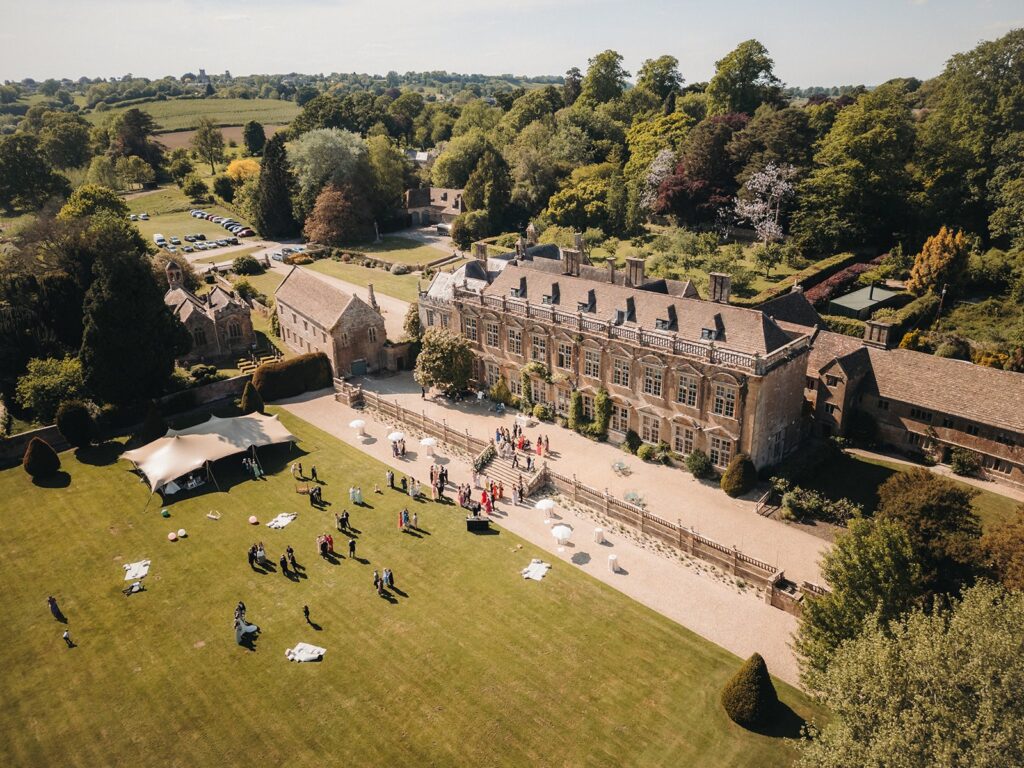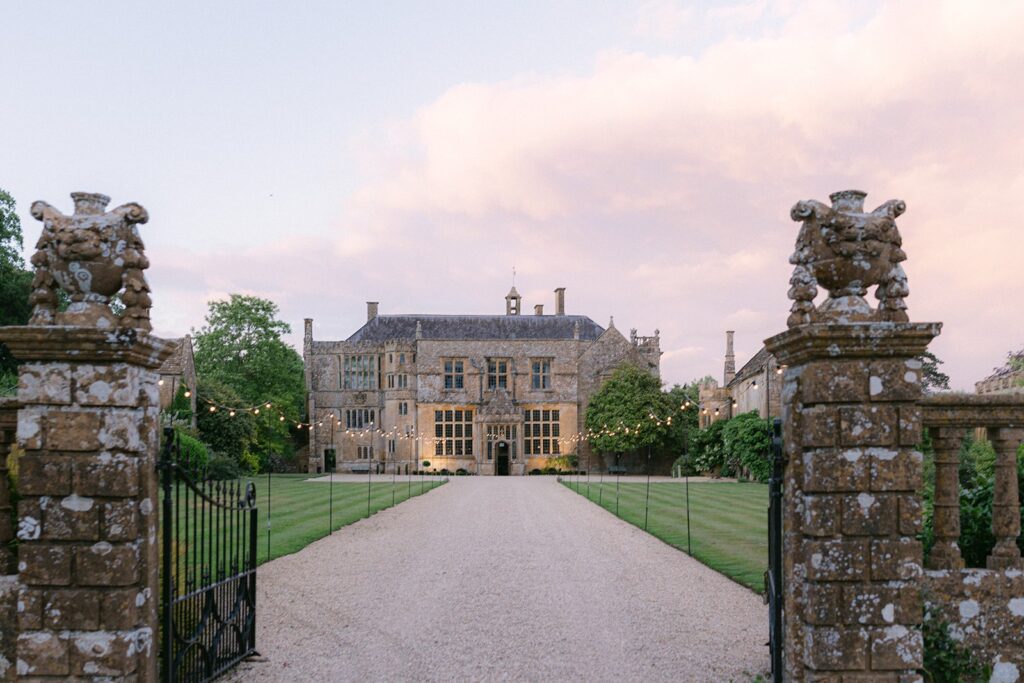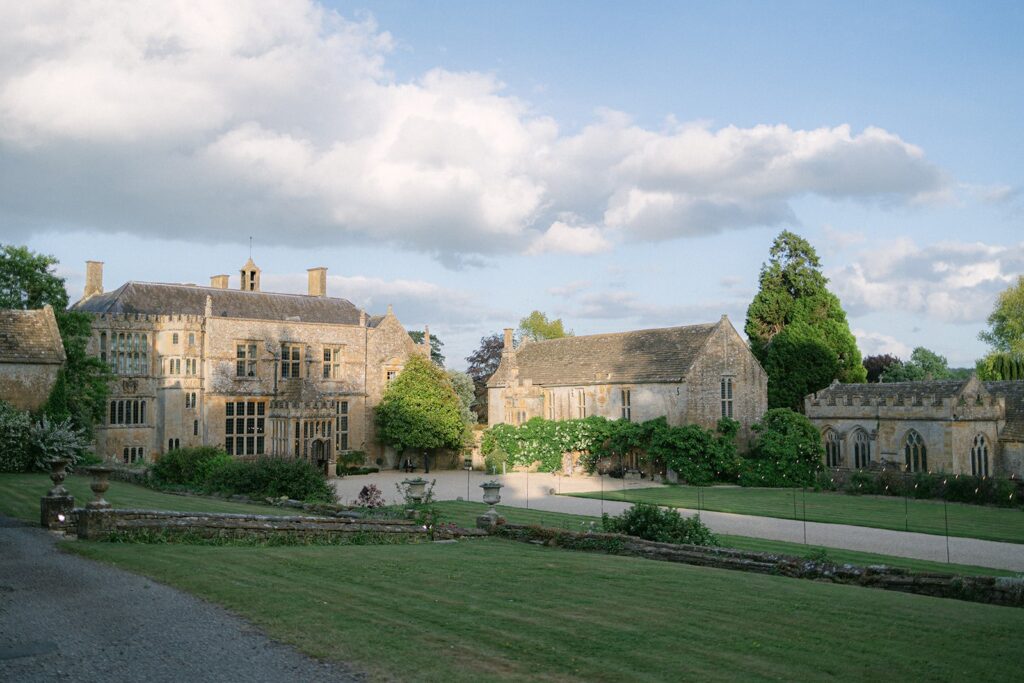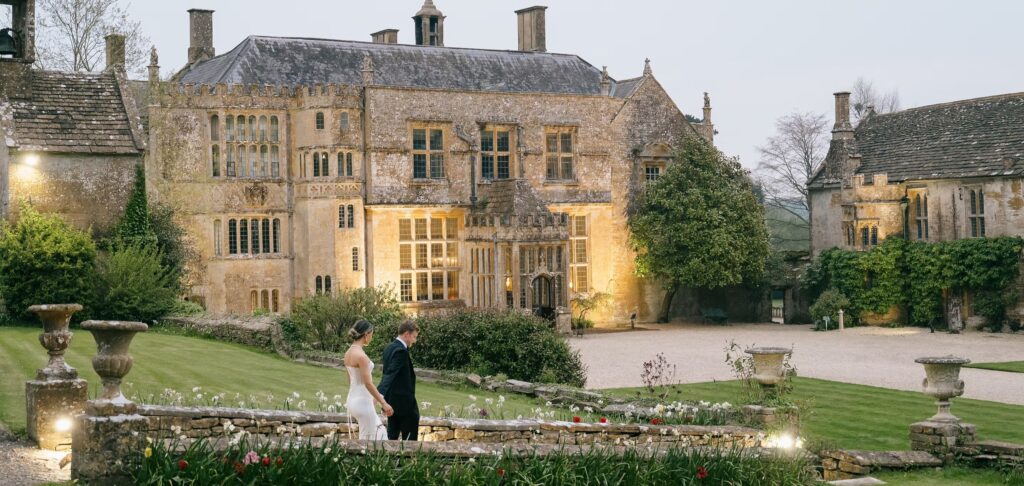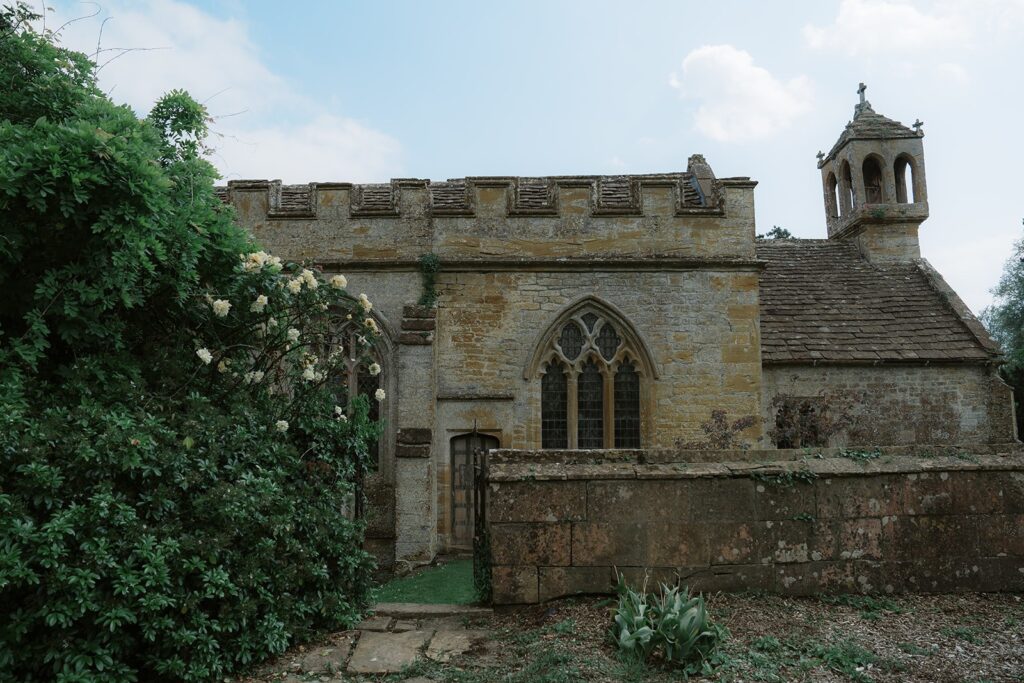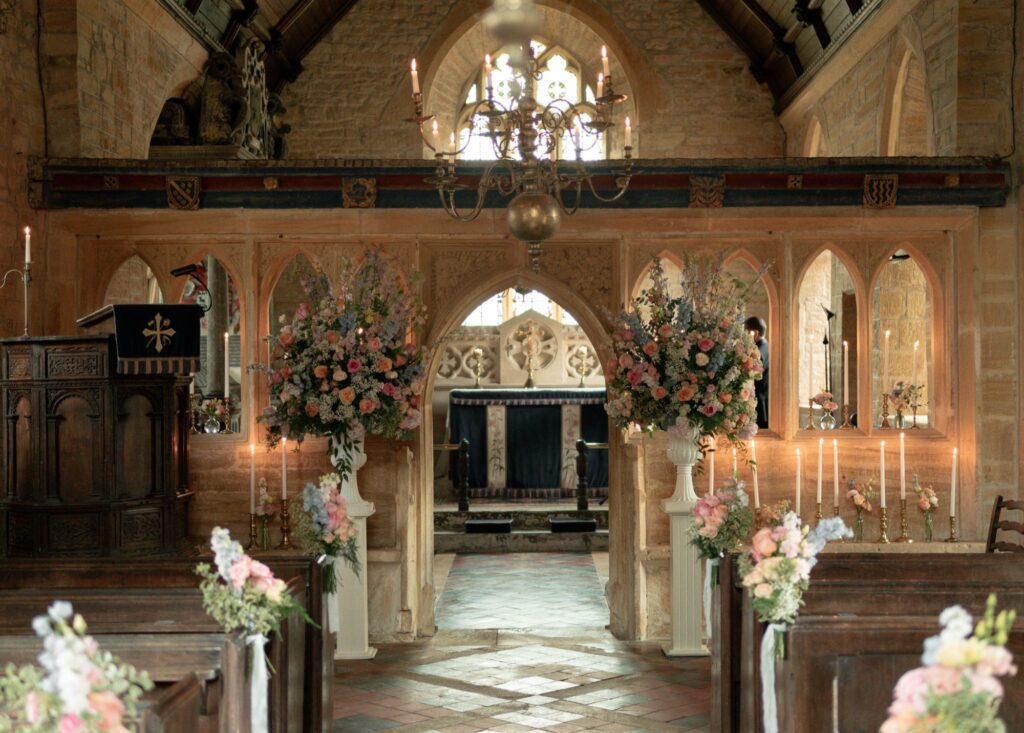
There is no mansion at the centre of an Elmhay Park wedding. The day is held in a walled garden, an Italian garden with a covered veranda and a Victorian style Orangery, behind the woods of the Orchardleigh Estate two miles north of Frome in Somerset, and the whole venue is taken on exclusive use for 60 to 250 guests. Elsewhere on the estate, on an island in the lake, stands St Mary’s, a thirteenth century church listed at Grade I. It has no electricity, so every service is lit by candles and the organ is pumped by hand. Planning here starts with one question: the garden or the island.

A church on its own island
The island was created when the upper ornamental lake of the park was made, and the church is reached by a rubble bridge of a single arch with wrought iron handrails. Sir George Gilbert Scott rebuilt much of the fabric in 1878 for the Reverend W. A. Duckworth, whose family then owned the estate, and much of the stained glass dates from the mid fifteenth and early sixteenth centuries.
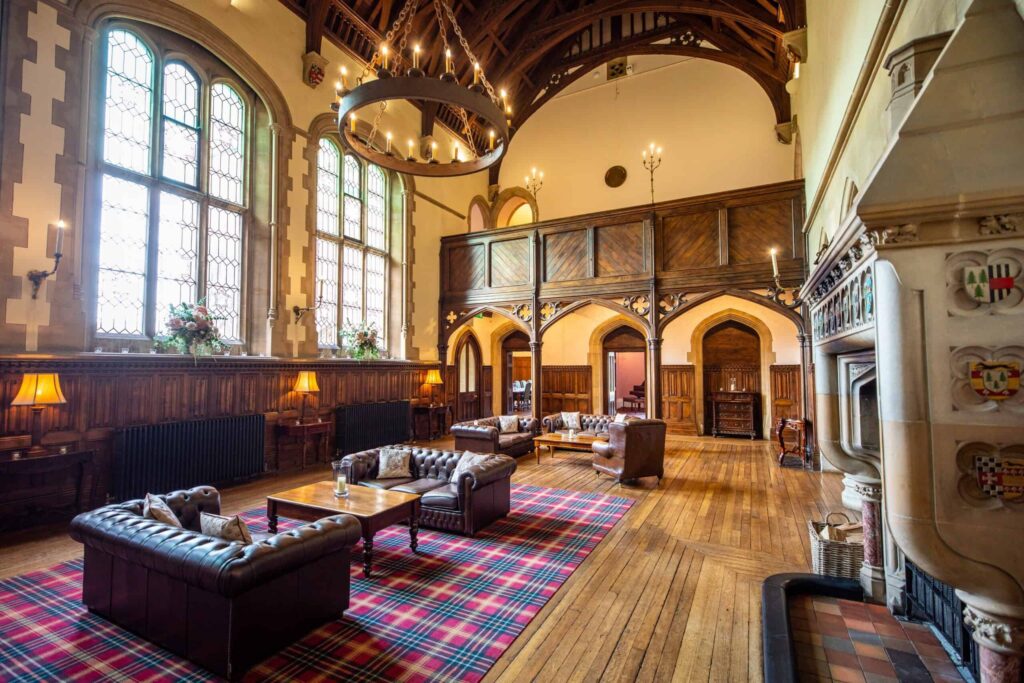
The Duckworth connection runs on into the churchyard. The poet Sir Henry Newbolt, remembered for “Drake’s Drum” and “Vitaï Lampada”, married Margaret Edwina Duckworth, and the two are buried at St Mary’s. The estate’s other wedding venue, Orchardleigh House, is the Victorian mansion at the centre of its 500 acres, with 41 bedrooms of its own. Elmhay Park is its sister, built around gardens rather than a great house.
The garden or the island
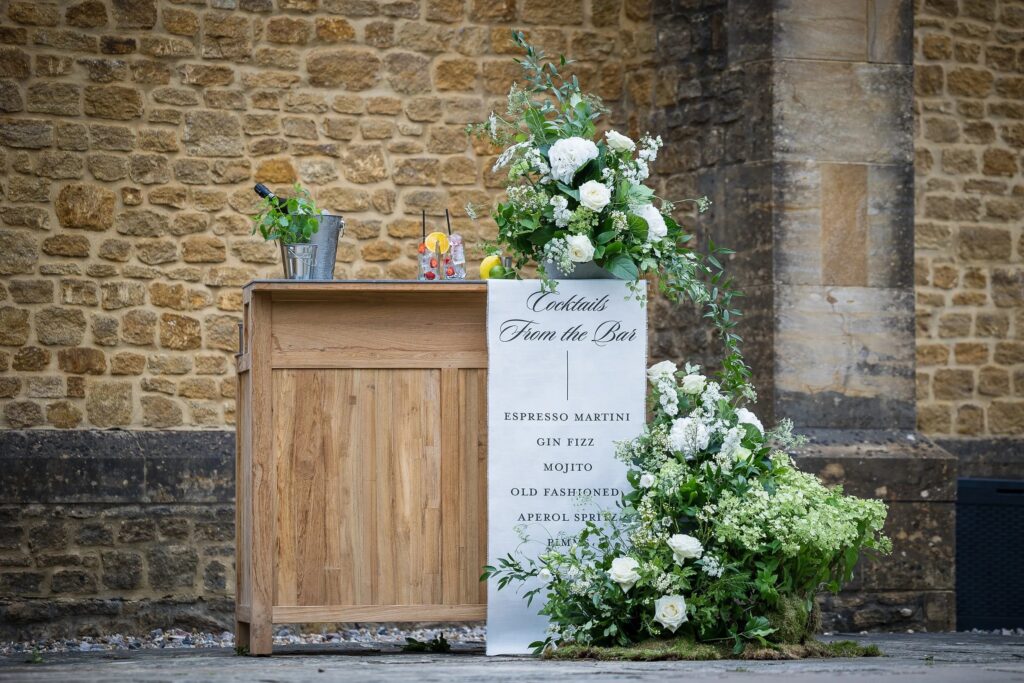
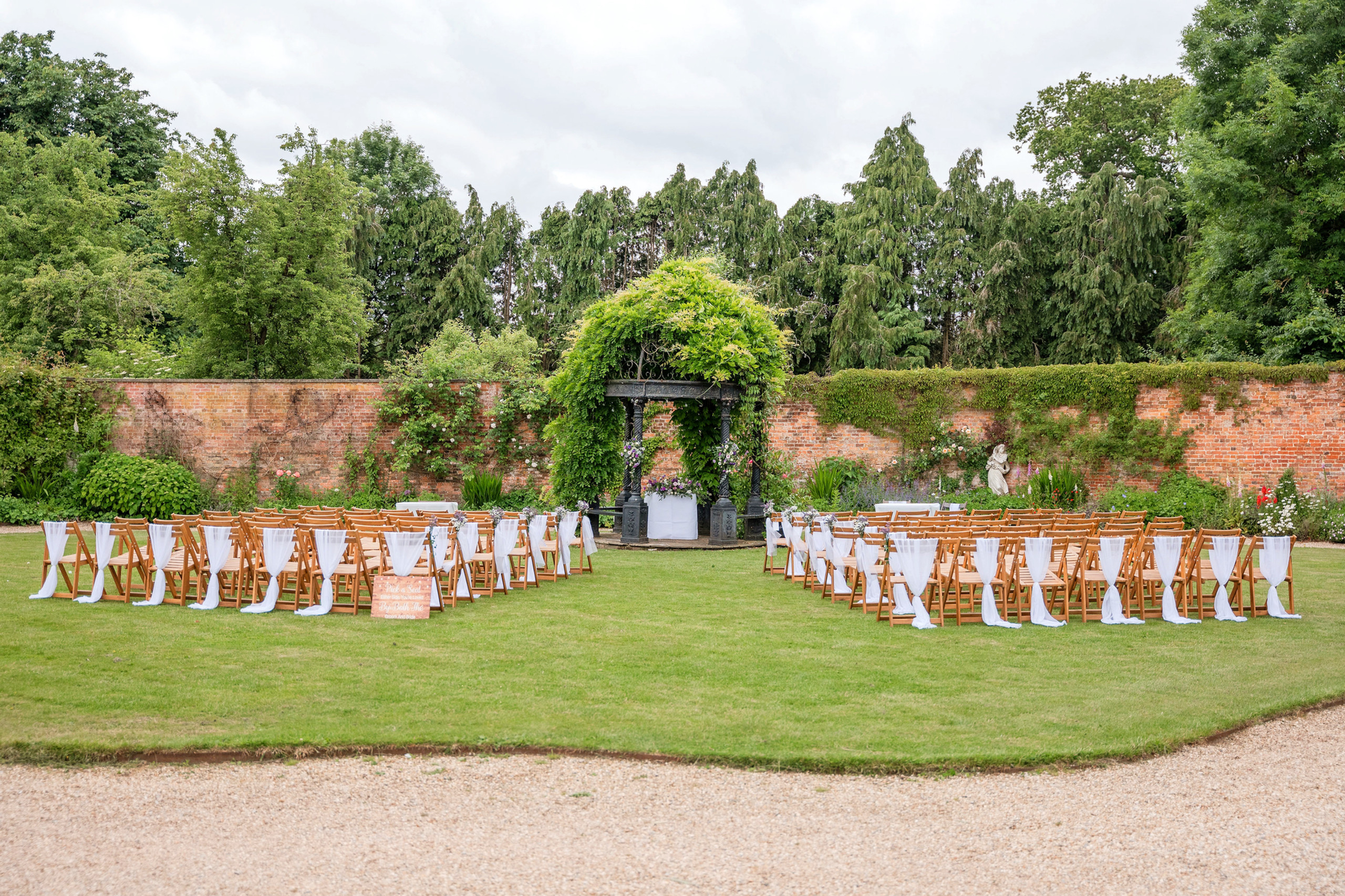
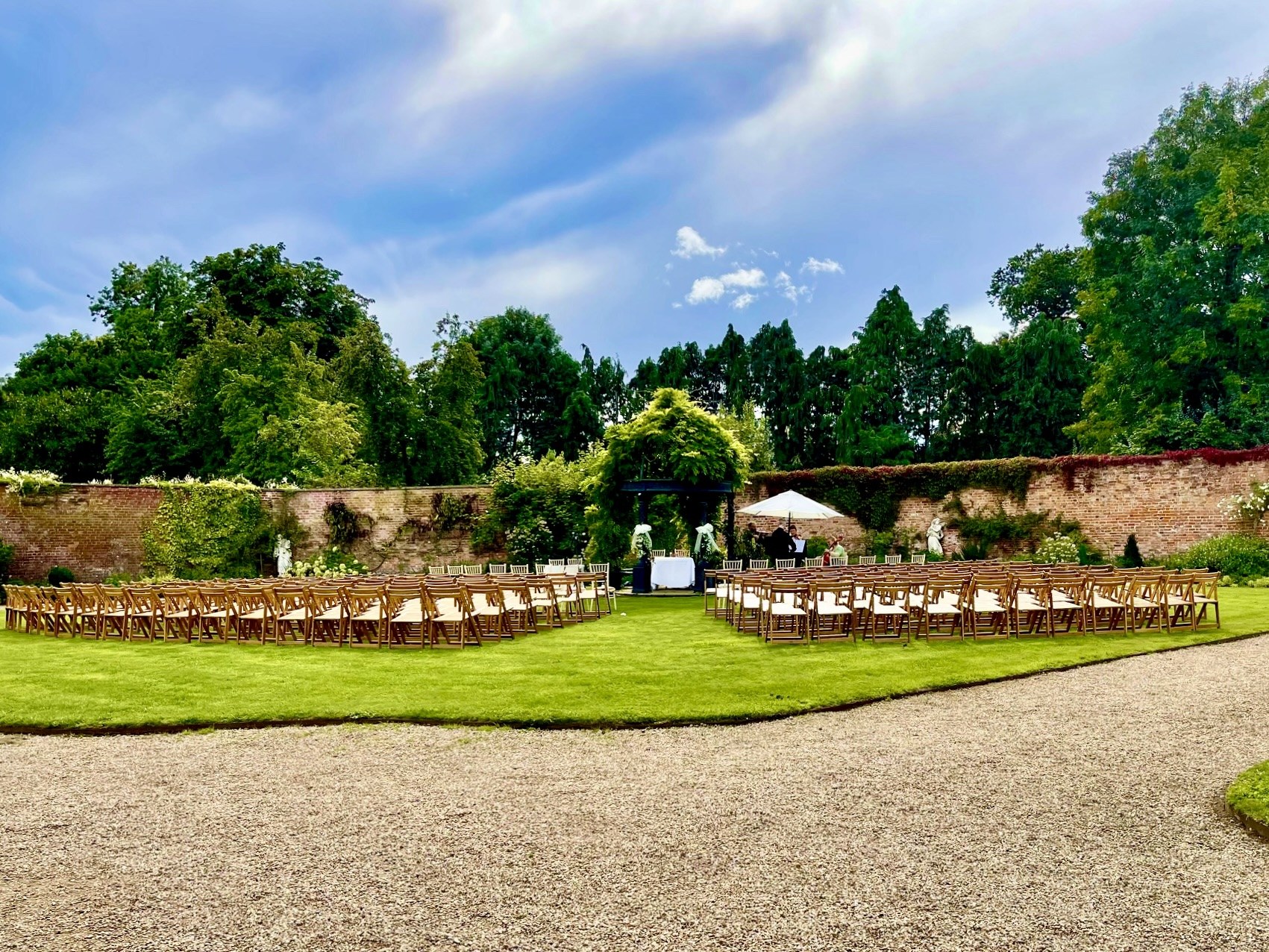
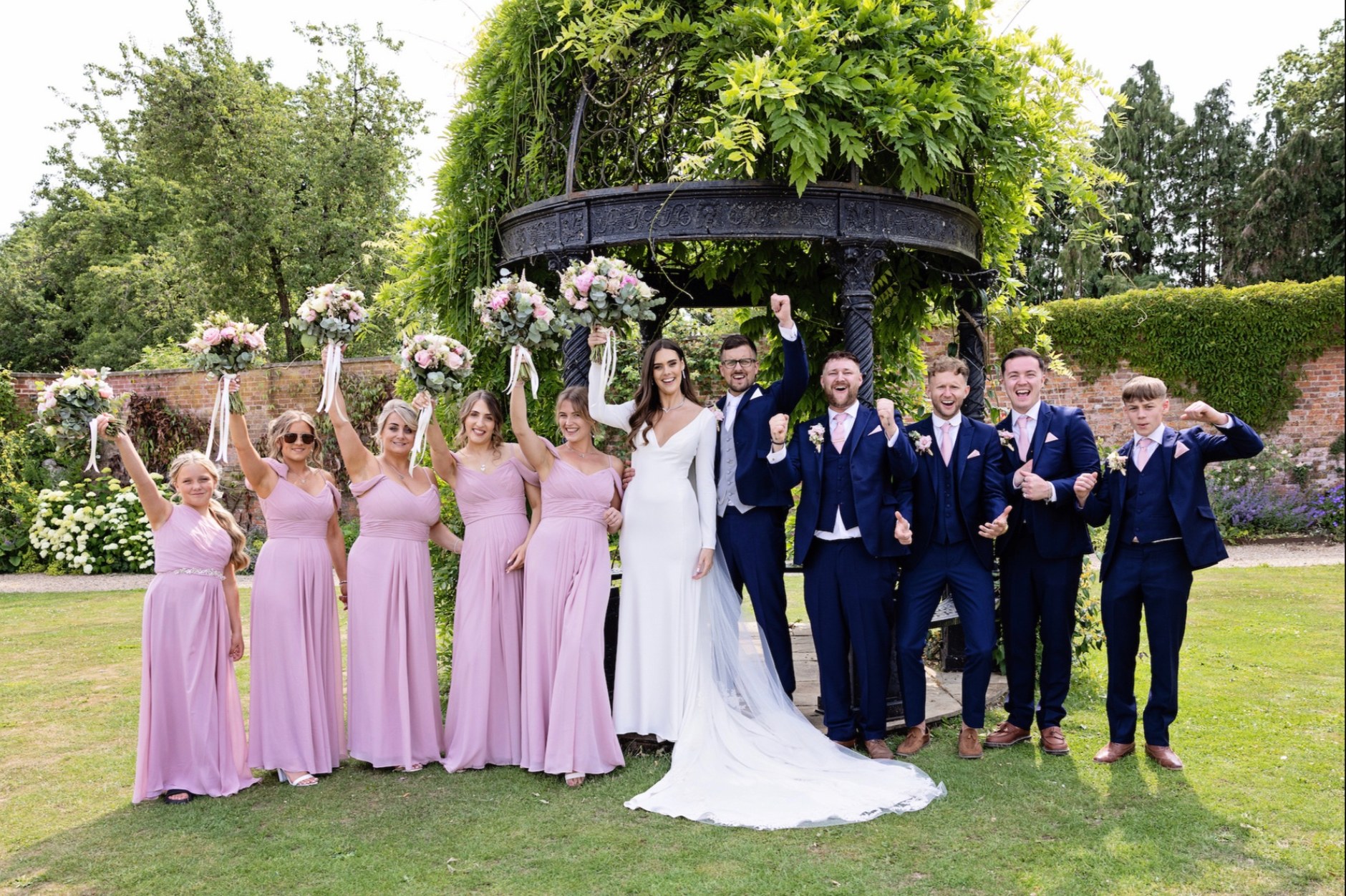
The two routes are planned in quite different ways. A civil ceremony in the gardens is arranged with the venue as part of the wedding itself, on the same ground as dinner, and four settings hold a licence: the covered veranda with its olive trees at the foot of the Italian Garden, which takes up to 250, and three places in the Walled Garden, by the fountain, at the bandstand and along an aisle that runs towards the Orangery. If the weather turns, the ceremony can usually be moved to another setting a couple of hours beforehand.
A church wedding is a separate booking with its own timetable. St Mary’s and All Saints in Lullington, about 400 metres from the estate’s north entrance, are Church of England parish churches in the Beckington benefice, and both are booked through the benefice’s church wedding administrator. A couple can marry in either if one of them, or a parent, lives or has lived in the benefice. Without that tie, a qualifying connection can be made by attending the church’s usual services at least once a month for six consecutive months. The banns are then read on three Sundays within the three months before the wedding, in the chosen church and in the parish where the couple live, and the benefice advises allowing about two months on top for this. On the banns route, a couple with no tie to the villages needs to start more than six months ahead. The other route is by residency: living in the area for seven consecutive days, then giving notice to the Somerset registration service, whose notices are displayed for 28 days.
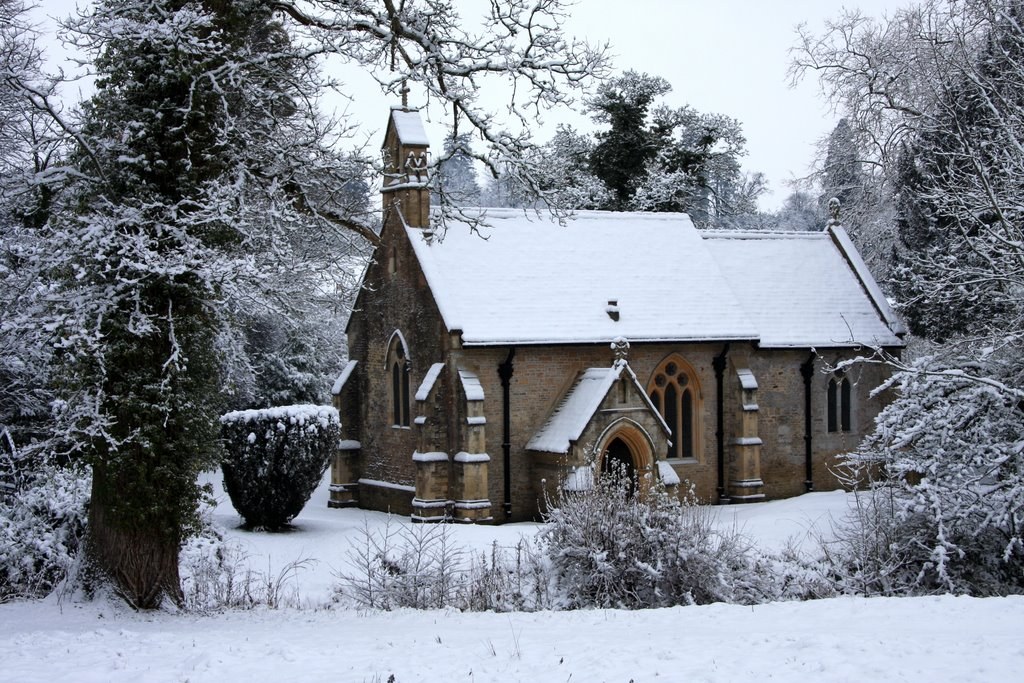
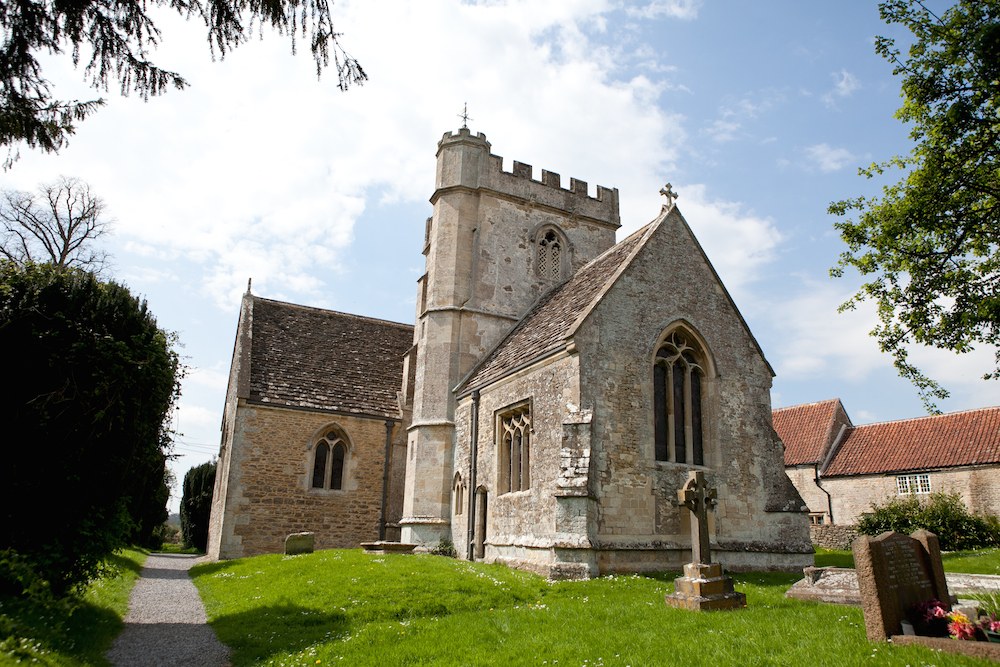
St Mary’s is small inside: about 72 guests sit in comfort, or 90 with a few standing behind the font and in front of the vestry. The verger lights the candles and adds battery candle lights to supplement them, and the church has a bio toilet. All Saints has electric light and seats about 150, which suits a larger congregation. The benefice asks couples to have their reception venue arrange coaches for guests to and from the church; at All Saints the coaches stop on Lullington Lane, about 200 metres away, and anyone who cannot manage the walk can be set down outside. Confetti in either churchyard must be flower petals or biodegradable, and none is thrown inside. St John’s in Frome, two miles away, is a Grade I parish church seating up to 300, booked through its own parish office.
Dinner in the Orangery
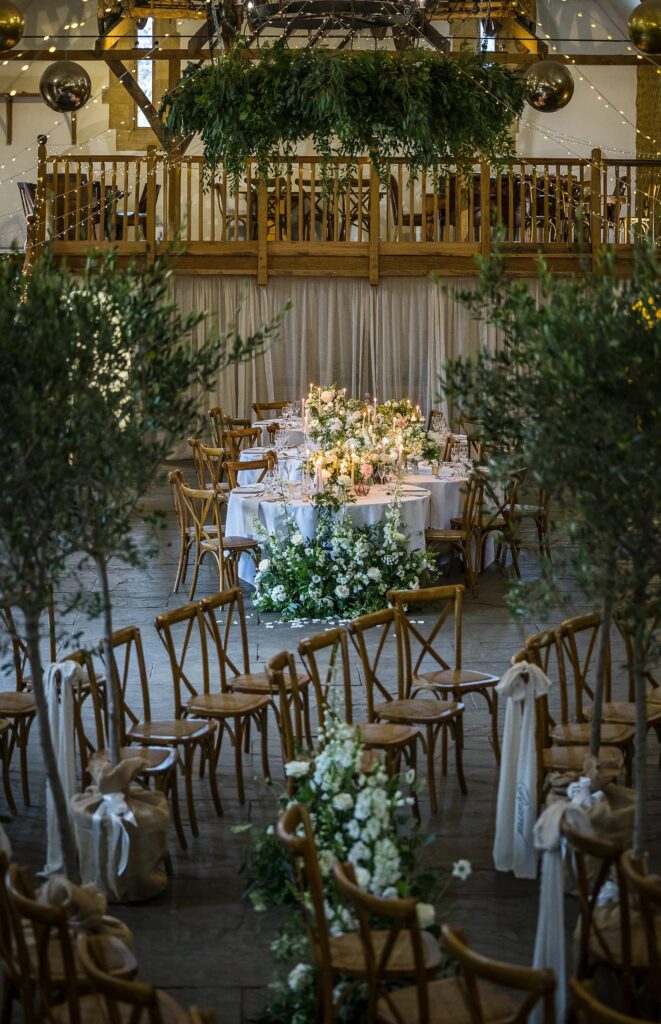
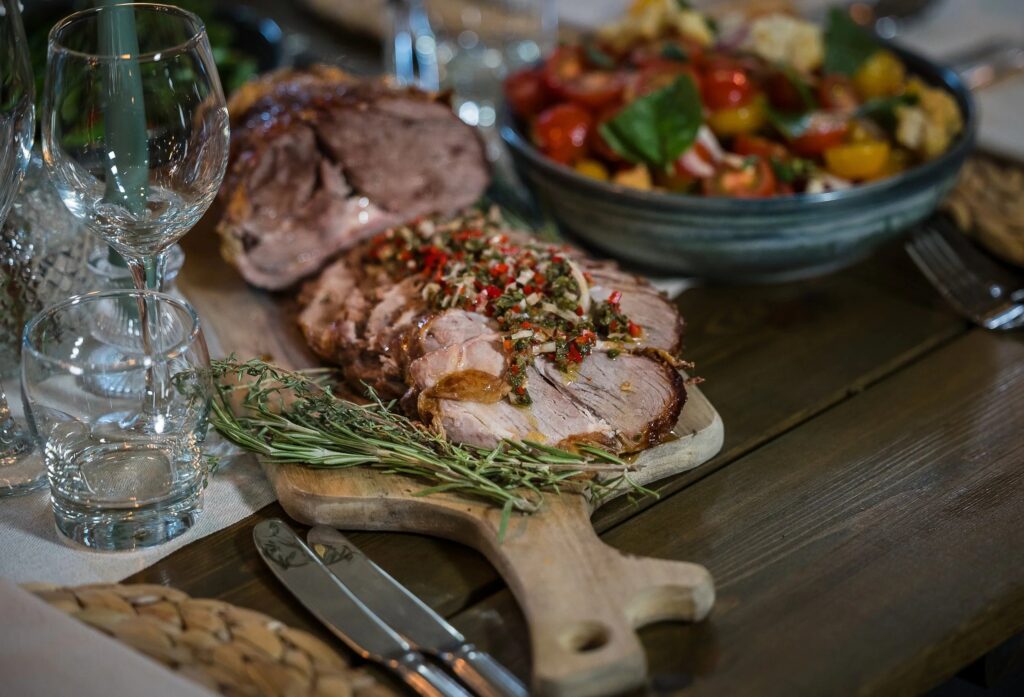
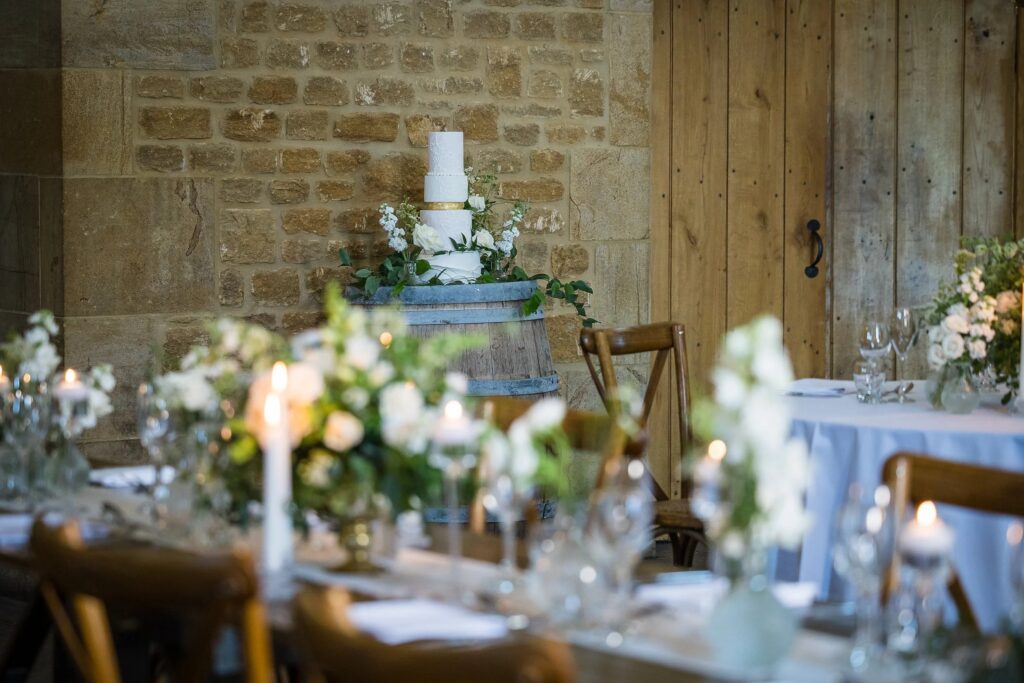
Whichever way the vows go, the wedding comes back to the Walled Garden. Canapés are served with the reception drinks, then dinner is in the Orangery at the head of the garden, an air conditioned room that seats up to 250. Where possible the kitchen uses produce grown or reared on the estate, buying the rest from local farmers, gamekeepers and nurseries. On the three day package the wedding breakfast runs to four courses from the executive head chef, Karl, and an evening buffet follows later on either package.
The morning after has two settings: breakfast back in the Orangery, or a later brunch at the Peacock Restaurant on the estate, which seats up to 70 and can also be booked for a private dinner the night before the wedding.
Winter, summer and the cost of a third day
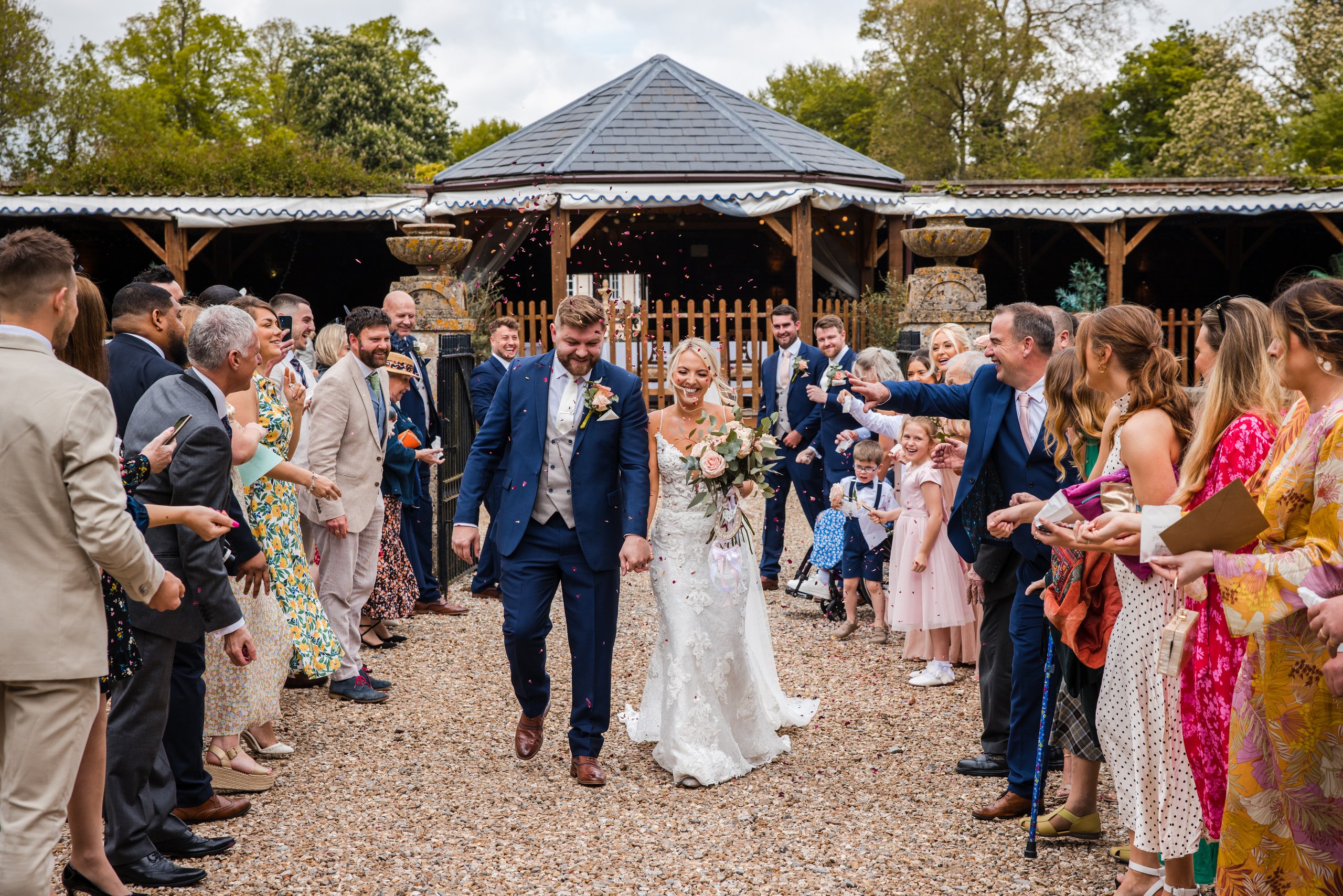
Packages are priced for 60 guests, VAT included, with separate winter and summer rates, and both take up to 250. The one day Bumbelina package starts at £6,268 in winter and £7,166 in summer. The three day Eldon package starts at £6,975 in winter and £9,537 in summer, and the difference buys two nights on the estate for the couple and their party, unlimited drinks and a fourth course. The gap between the two is smallest in winter, at £707, and widens to £2,371 in summer.
Dry hire is the third route, a limited offer on its own terms. A family chooses its own caterers, who work in the full commercial kitchen, and brings its own drinks with no corkage, while a bar runs alongside at pub prices with a minimum spend. Tables, chairs and tableware for 250 are supplied, and on these terms the gardens and the Orangery take up to 300 for dinner or 500 standing. It is offered for a classic British wedding and for Hindu, Sikh, Muslim, Punjabi and Afro Caribbean celebrations alike.
A village behind the Orangery
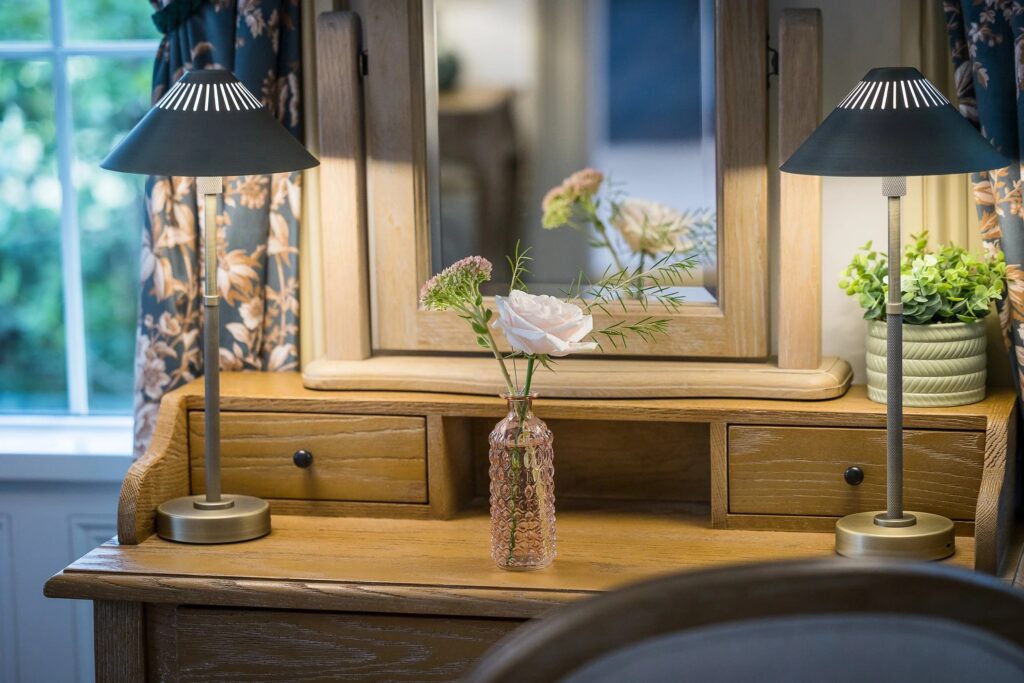
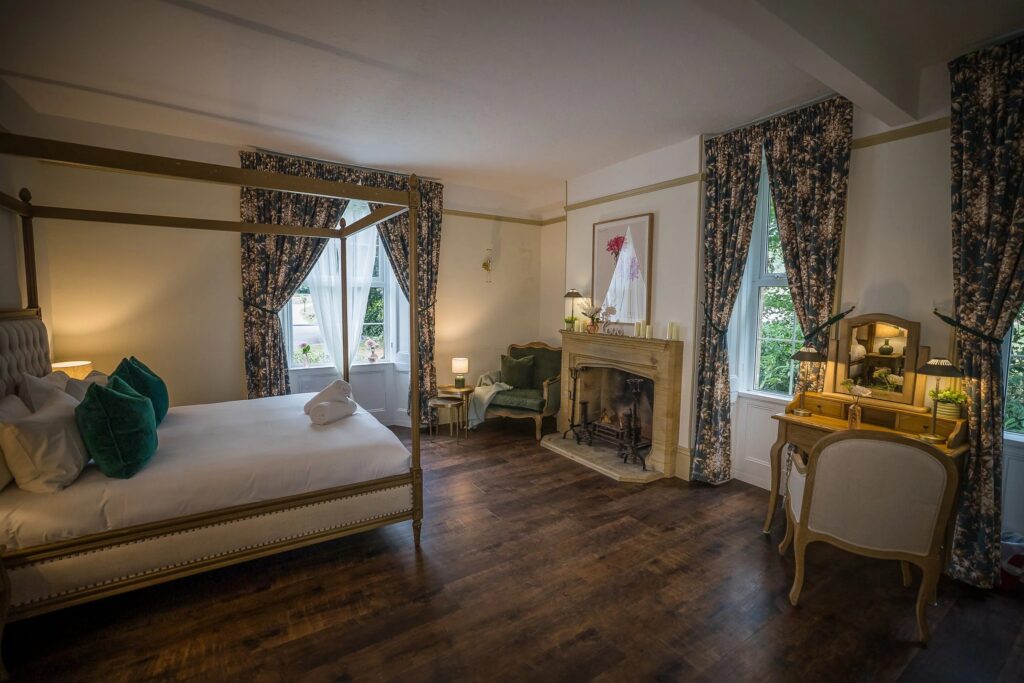
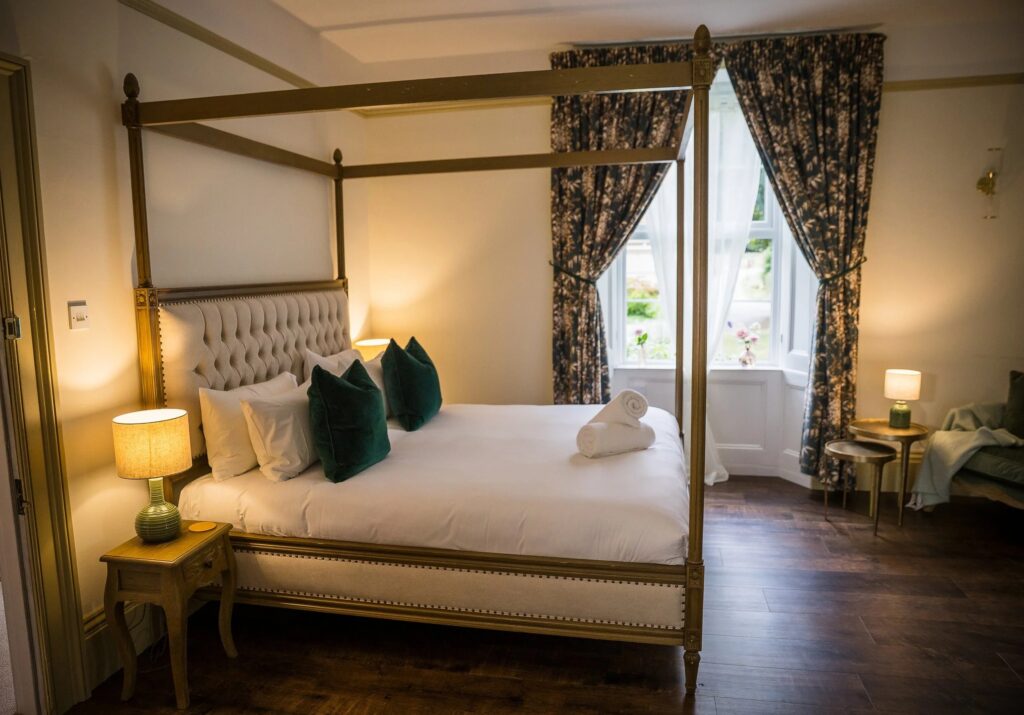
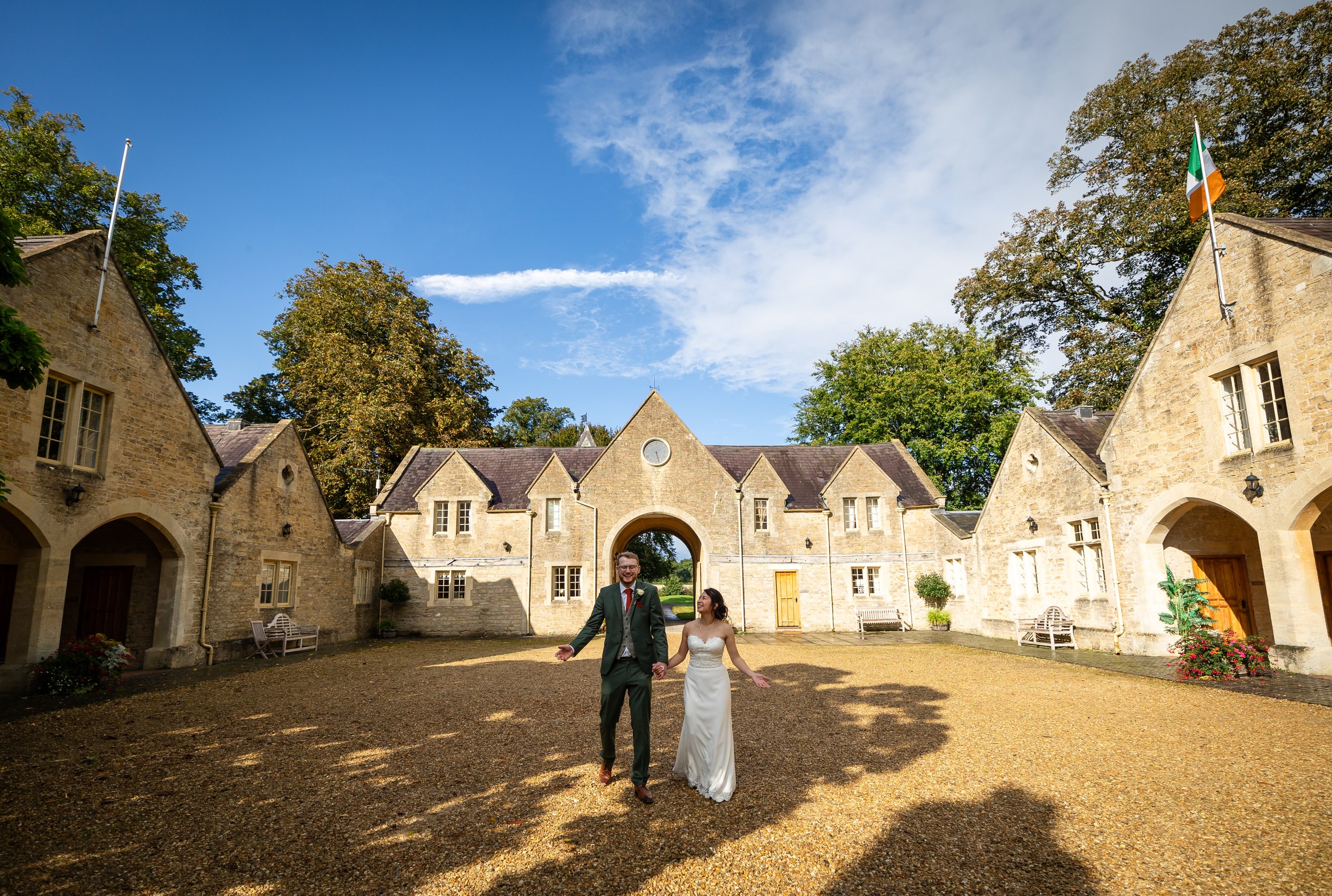
Elmhay Village, a courtyard of twelve self catering cottages a few paces behind the Orangery, has 29 rooms and sleeps up to 70 on the wedding night. The Bell Tower is the bridal suite, with a four poster bed and a Jacuzzi bath in the en suite, and on the one day package it is free when the wedding takes every cottage. Garden House, the largest, sleeps 14, has its own garden and dates in part from the sixteenth century. The Bull Pen has a wheelchair ramp, and there are dog friendly rooms.
The three day package spreads the party across the estate. The night before, one partner can stay with up to eleven others at Orchardleigh Castle in the north of the estate, where the private garden has an eight person hot tub, and the other at Lewis Lodge, which sleeps seven. The night after, the couple have Church Lodge, south of Elmhay Park and a short walk from the island church, with a log fire and a hot tub in its garden. More rooms on the estate are usually available on the nights either side.
The days either side
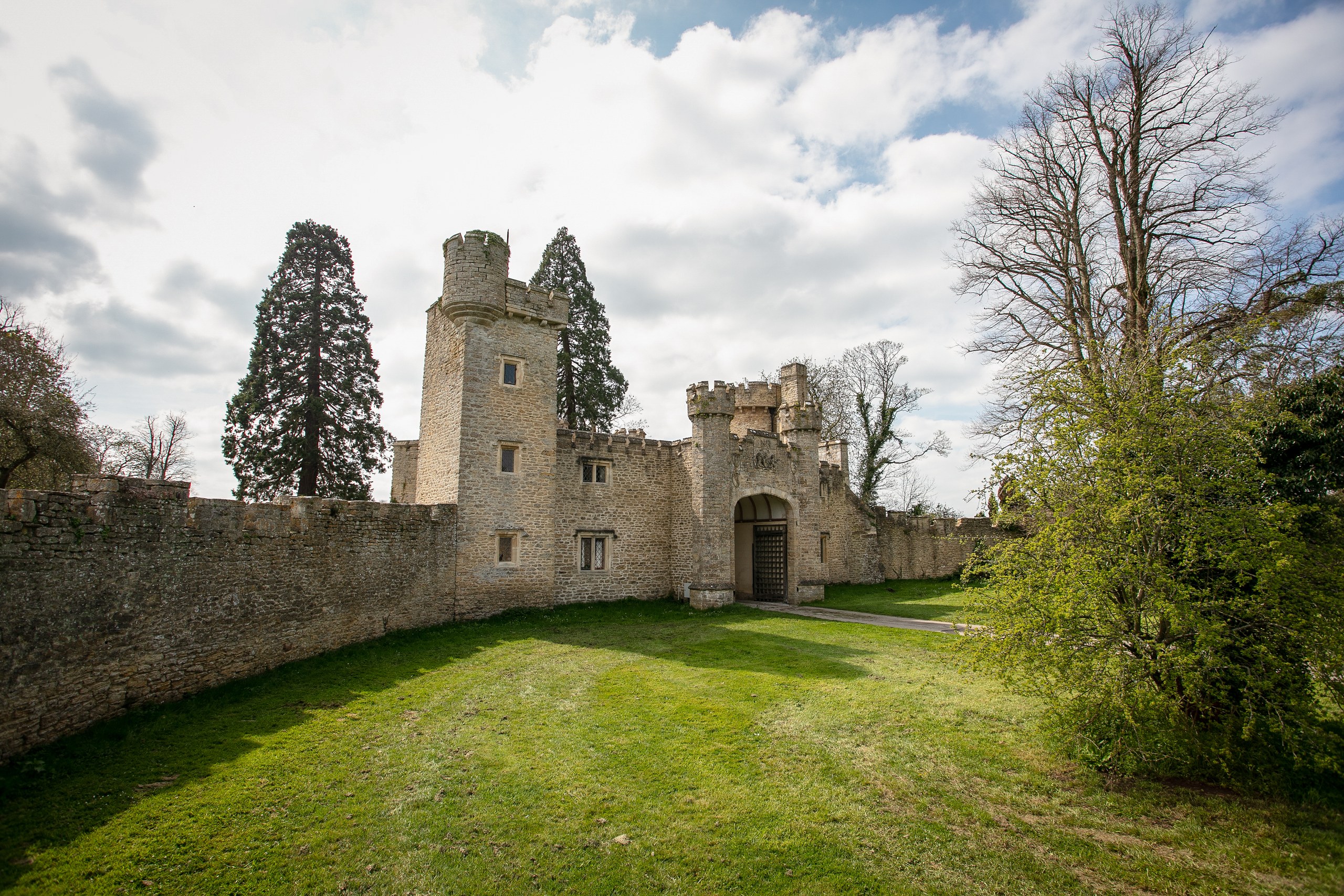
The estate’s 500 acres hold most of what guests need on the days around the wedding. The 18 hole course, designed by Brian Huggett, is free for the wedding party on both packages, with a covered driving range for a wet afternoon. Clay pigeon shooting is kept for wedding parties alone, the 23 acre lake has two fishing swims, and massages, facials, aromatherapy and reflexology can be booked for the day before. Younger guests have a play area behind the golf club, with a treehouse, a climbing frame and a mini tractor track.
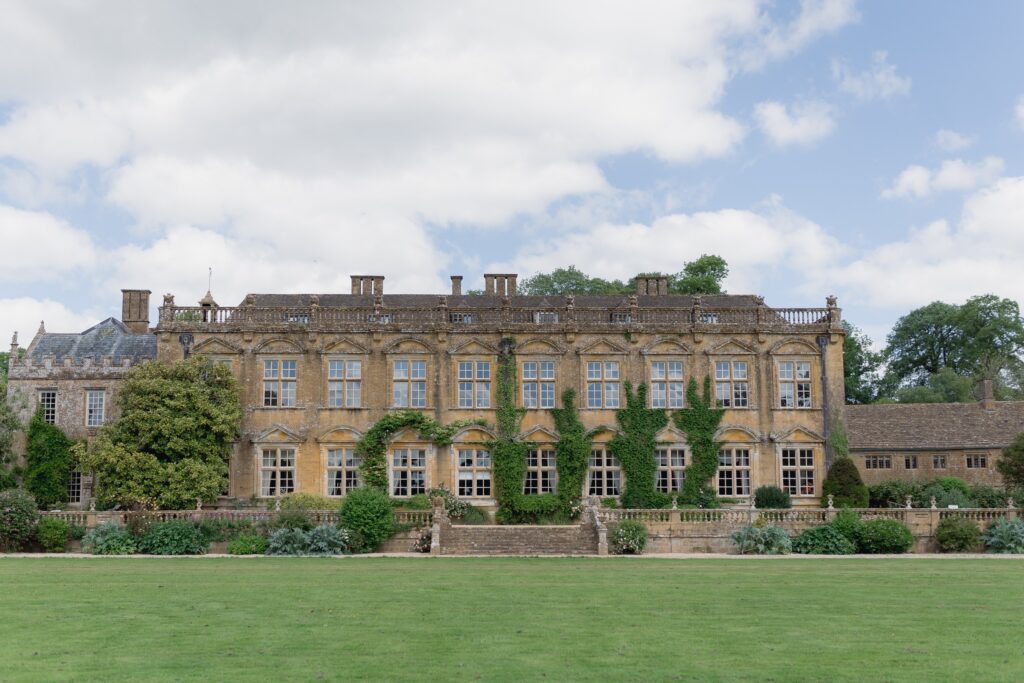
The entrance is on the A362, two miles north of Frome on the road to Radstock. Use the postcode BA11 2PB for satellite navigation, since BA11 2PH can lead to a locked gate, and Frome station, on the Great Western Railway, is the nearest by train. For more of the county, see Somerset wedding venues and the United Kingdom Wedding Atlas, or read our Edit on Brympton House.
Where you marry comes first
Everything else at Elmhay Park follows from one decision: where you marry. A garden ceremony is settled with the venue along with the rest of the day. A candlelit service at St Mary’s depends on the benefice, its qualifying connection and its banns, so speak to the church wedding administrator before you commit to anything else. Then check your date on the Elmhay Park profile.