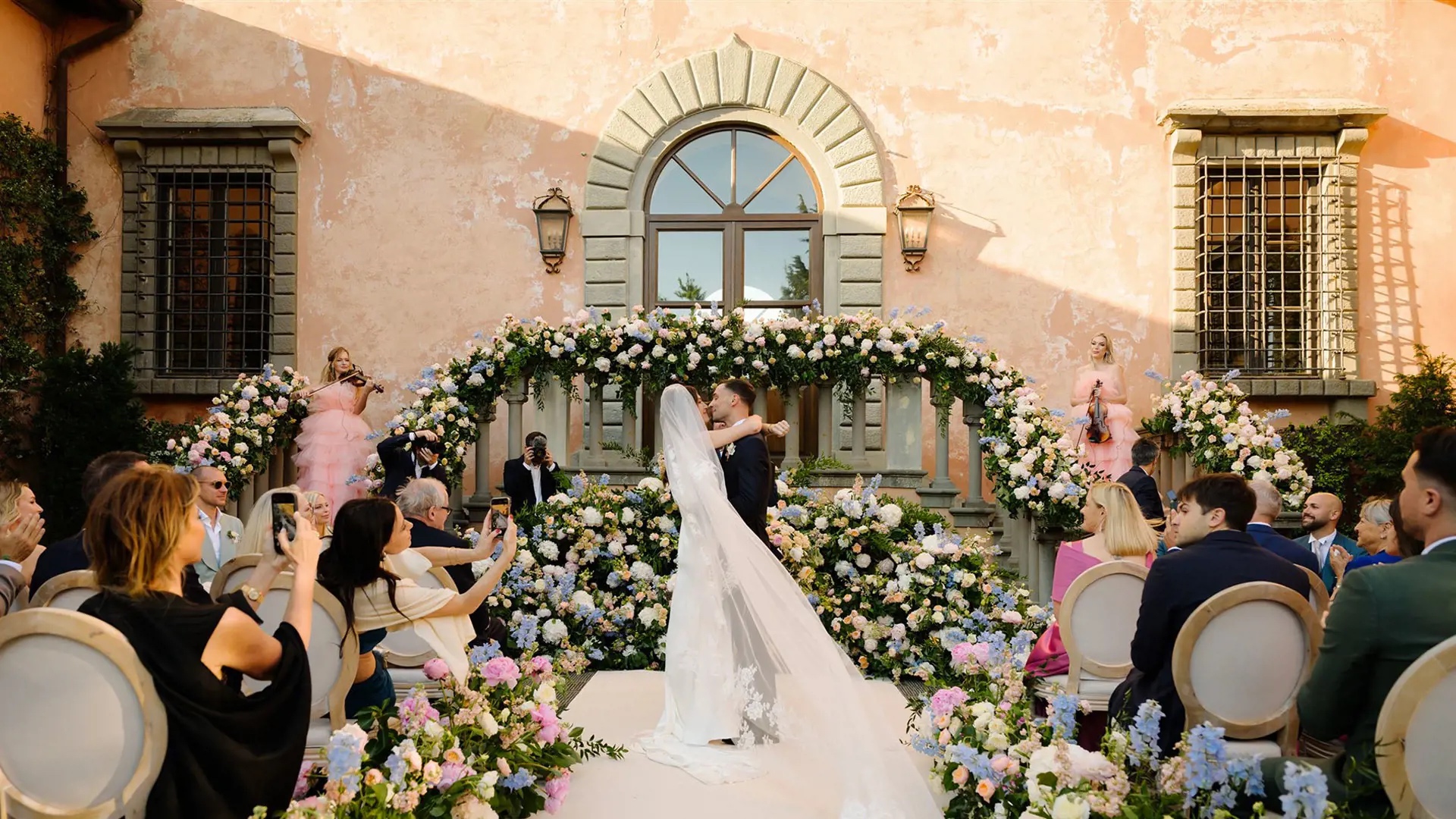
There are three ways to marry in Tuscany: a civil ceremony, which is legally binding in Italy; a religious ceremony, which for Catholic weddings can also be legally binding; and a symbolic ceremony, which has no legal effect. The choice decides the paperwork, where the ceremony can happen and how far from your venue you may have to travel on the day. This guide sets out what each route involves and what the Tuscan venues on 5 Star Weddings have said about the ceremonies they can host.
Decide the ceremony before the venue
Couples often fall for a terrace or a garden and only later learn that a legal wedding there is not possible. A civil ceremony can only take place in a town hall or in a place the comune (the town council) has approved for weddings. A church wedding takes place in a church, and some estates have their own.
A symbolic ceremony can take place almost anywhere, which is why many couples who want a particular setting marry legally at home first. Settle which of the three you want, then shortlist venues that can host it.
Civil ceremonies: where they can take place
A civil wedding in Italy is performed by the mayor or an official the comune appoints. It needs two adult witnesses, and if either of you does not understand Italian an interpreter is present and the formula is translated. What varies most from venue to venue is where the official can marry you.
- Villa Il Cerretino, in the Montalbano hills near Prato, is a registered civil ceremony venue for the comune of Poggio a Caiano. Ceremonies are held at the Nymphaeum in the Belvedere Garden.
- Valle di Badia, in the Pisan hills above Buti, says official civil weddings can be held beside the small lake in its park.
- Castello di Velona, near Montalcino, lists civil and symbolic ceremonies on its panoramic terraces, for up to 250 guests.
- Relais La Costa, near Monteriggioni, says in its 2026 to 2027 wedding brochure that a civil ceremony can take place at the house with a municipal official, or in the town halls of Monteriggioni, Colle di Val d’Elsa or Siena.
- Castello di Casole lists the town hall in Casole d’Elsa, 9 km away, for up to 150 guests, and Siena’s town hall, 40 km away, for up to 15. On the estate it hosts non-legal ceremonies.
- Castel Monastero recommends the 18th-century chamber in Castelnuovo Berardenga town hall, 7 km away, or Villa Chigi Saracini nearby, and its event manager helps with the documents.
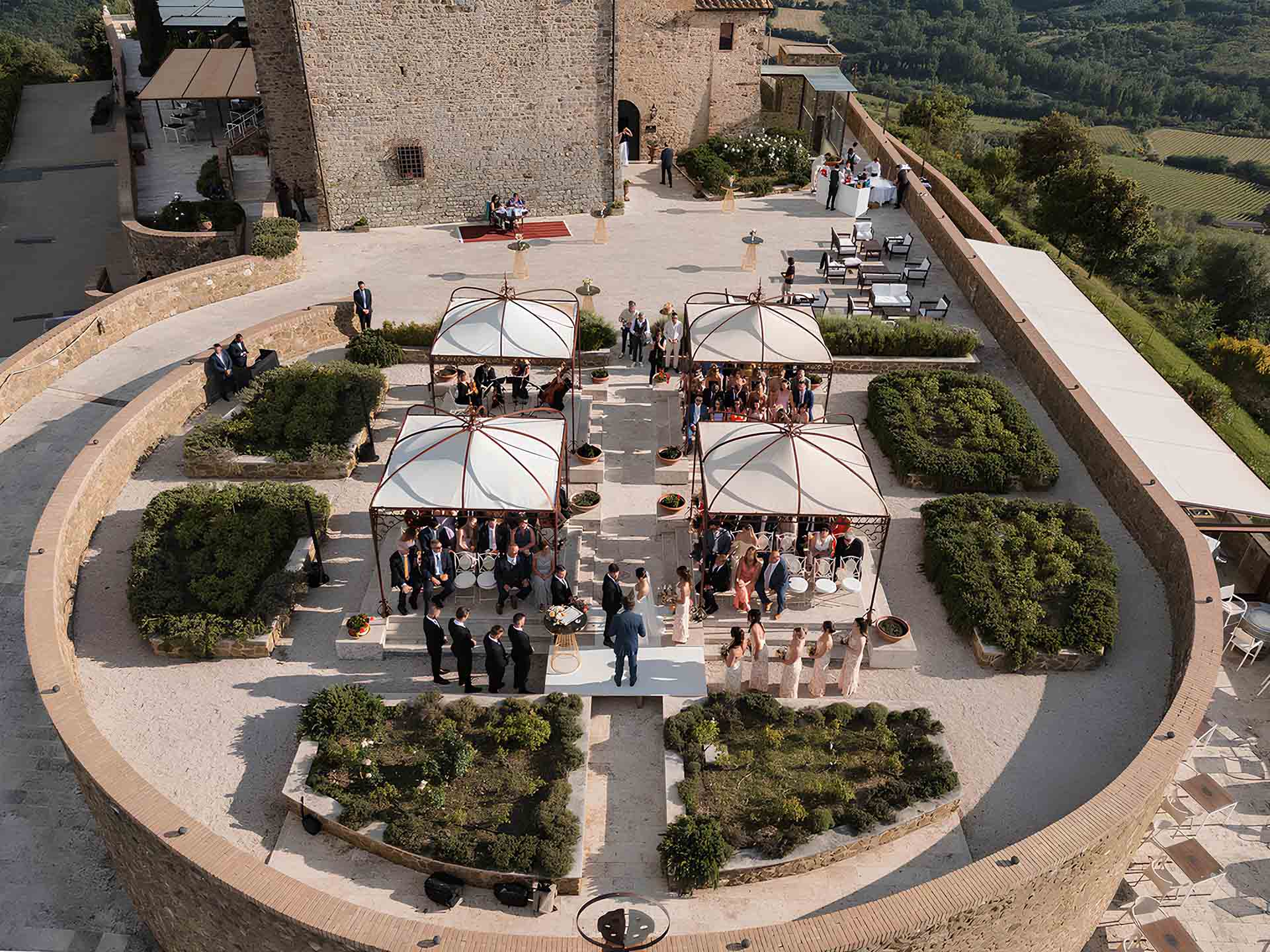
A town hall ceremony means coaches, a fixed slot and a drive back for drinks.
Paperwork for couples from the UK
Each of you has to show the comune that you are free to marry. For British nationals that proof is a certificate of no impediment, which Italian offices call the nulla osta. GOV.UK confirms the two are the same document.
British nationals apply for it by post to the British Embassy in Rome. The application includes a notice of marriage and an affirmation, and you take them to a notary, who witnesses your signature. The forms and worked examples are in the GOV.UK nulla osta application pack for marriages in Italy, last updated in August 2024.
Alongside the nulla osta the comune will ask for your passports and, depending on your circumstances, other documents. Ask the comune, or your planner, for its written list, and which documents need an apostille or a sworn Italian translation. Shortly before the wedding you both attend the comune to declare your intention to marry, with an interpreter if needed.
Couples of other nationalities follow the same principle through their own embassy or consulate in Italy. If you hold different passports, each of you follows your own country’s process.
Religious ceremonies
A Catholic wedding in Italy can be registered with the civil authorities, so it is legally valid without a separate civil ceremony. It is arranged between your parish at home and the church in Italy, and the church sets its own requirements, including baptism and confirmation records and marriage preparation. Other faiths usually pair a religious ceremony with a civil one.
Several of our venues have a church on the estate or close by:
- Castel Monastero: the Church of Saints James and Christopher, inside the walls, for up to 40, or the Romanesque church of Badia Monastero, 2 km away, for larger weddings.
- Castello di Velona: the Abbey of Sant’Antimo, five minutes from the castle, listed for up to 200.
- Castello di Casole: the Collegiata di Santa Maria Assunta in Casole d’Elsa, for up to 200, or the Pieve di San Giovanni Battista at Pievescola, for up to 150.
- Villa Il Cerretino: its own chapel of San Francesco di Paola, with the Church of Bonistallo a few minutes away.
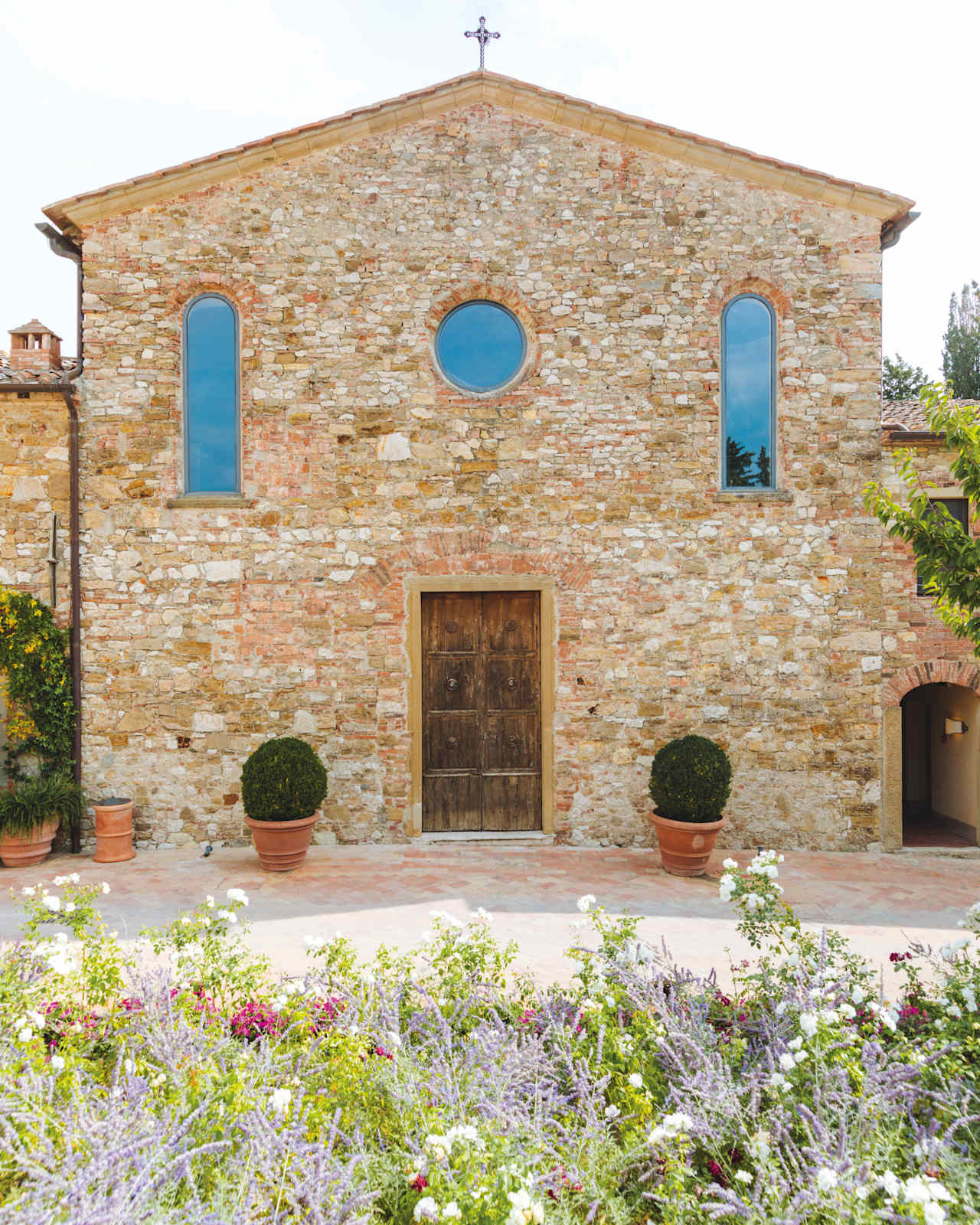
A chapel on an estate is not always consecrated: Castello di Casole’s San Tommaso Chapel hosts non-religious ceremonies for up to 40.
Symbolic ceremonies
A symbolic ceremony has no legal effect in Italy, so there is no Italian paperwork at all. You marry legally at home, before or after the trip, and the ceremony in Tuscany can be at any hour, in any language, led by anyone you choose.
The trade-off is that the date on your marriage certificate will not be the date of the wedding. For many couples that matters less than having the ceremony on the terrace they chose, and it frees the day from the town hall’s timetable.
Who handles it
Most couples marrying from abroad give the paperwork to a planner who knows the comune. Some venues insist on one: Relais La Costa requires a wedding planner for every wedding and suggests partners it trusts. For the wider picture of the region, seasons and costs, see the Tuscany Wedding Atlas.
Questions couples ask
Can we have a legal ceremony at the venue itself?
Only where the comune has approved it. Among the venues above, Villa Il Cerretino, Valle di Badia and Castello di Velona say civil ceremonies take place on site, and Relais La Costa says it is possible with a municipal official. Confirm it for your date.
Who can be our witnesses?
Two adults, who can be guests at the wedding. The comune will ask for their identity documents in advance, so collect passport details early.
Do we need to speak Italian?
No. The civil ceremony is conducted in Italian, but an interpreter translates for anyone who does not understand it.
Updated 1 October 2026